Three things on this date, a century apart, that between them account for the television remote, the phone it is pointed at, and the politician on the screen.
1898: the boat that obeyed
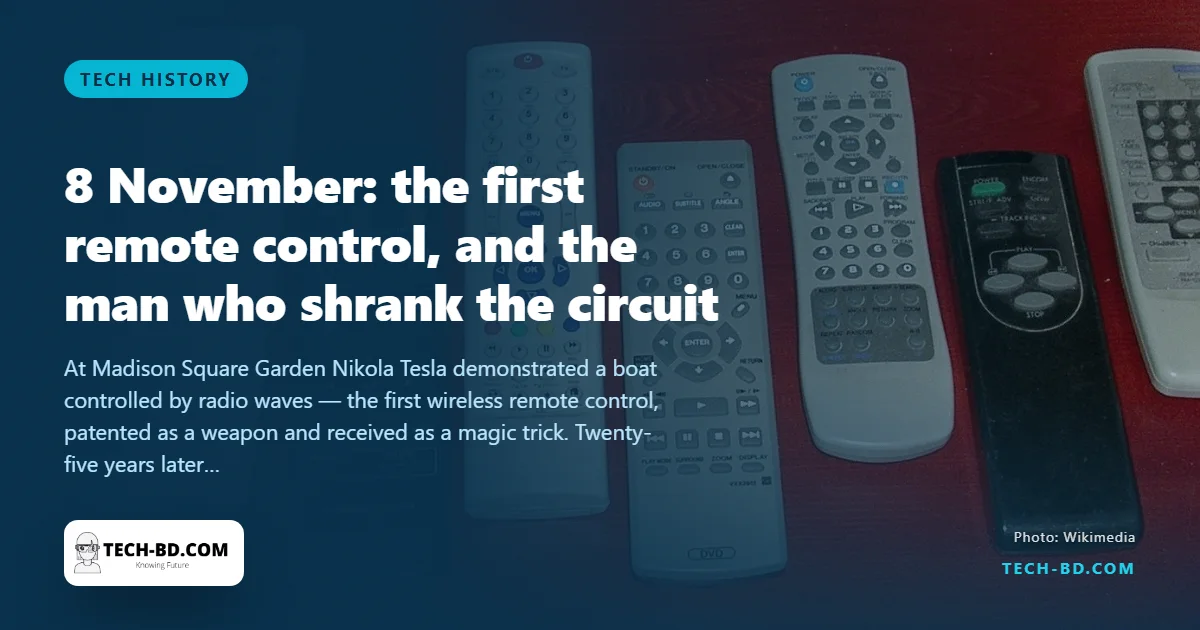
At the Electrical Exhibition in Madison Square Garden, New York, Nikola Tesla put a small iron boat in a tank of water and, from across the hall, made it turn, stop, start and flash its lights, using a box with levers and no wires. Spectators looked for the hidden cable; some suggested telepathy. Tesla was sending radio signals to a receiver in the hull — a “teleautomaton”, he called it, and he patented it as a weapon, a means of steering torpedoes without a crew. Wired remote control was older (Werner von Siemens had used it in 1870), and Ernest Wilson and C.J. Evans in Britain had guided a torpedo by radio in 1897, but Tesla’s boat was the first public demonstration of a machine steered through the air, and every remote since — the television clicker, the drone controller, the car key — follows from it. Tesla, born in what is now Croatia on 10 July 1856, died in New York on 7 January 1943; he also took some of the first X-ray photographs and holds the patents on which radio was built.
1923: Jack Kilby
Jack Kilby was born in Jefferson City, Missouri, on 8 November 1923. After degrees from the University of Illinois and Wisconsin he joined Texas Instruments in 1958, and that summer — a new employee with no holiday entitlement, alone in the lab while everyone else was away — he built a circuit in which the resistor, the capacitor and the transistor were all made in one piece of germanium, connected by fine gold wires. He demonstrated it on 12 September 1958. It was the first integrated circuit, the idea that the microprocessor and every chip since rests on; Robert Noyce at Fairchild arrived at a more practical silicon version months later, and the two are credited jointly. Kilby went on to co-invent the handheld calculator and the thermal printer, and in 2000 shared the Nobel Prize in Physics — a rare award for an engineer — for “laying the foundation of information technology”. He died on 20 June 2005.
1999: the president on the web
On 8 November 1999 Bill Clinton became the first sitting American president to take part in a live webcast, answering questions at George Washington University in an event hosted by the internet company Excite@Home and the Democratic Leadership Council. The stream was jerky and the audience small, and it was the beginning of the direct line between politician and voter that social media would make total.
The Bangladesh footnote
Kilby’s germanium chip had five components. The Bangladeshi engineers now writing chip-design code for Silicon Valley firms from offices in Dhaka work on parts with tens of billions. Sixty-five years is a short time.