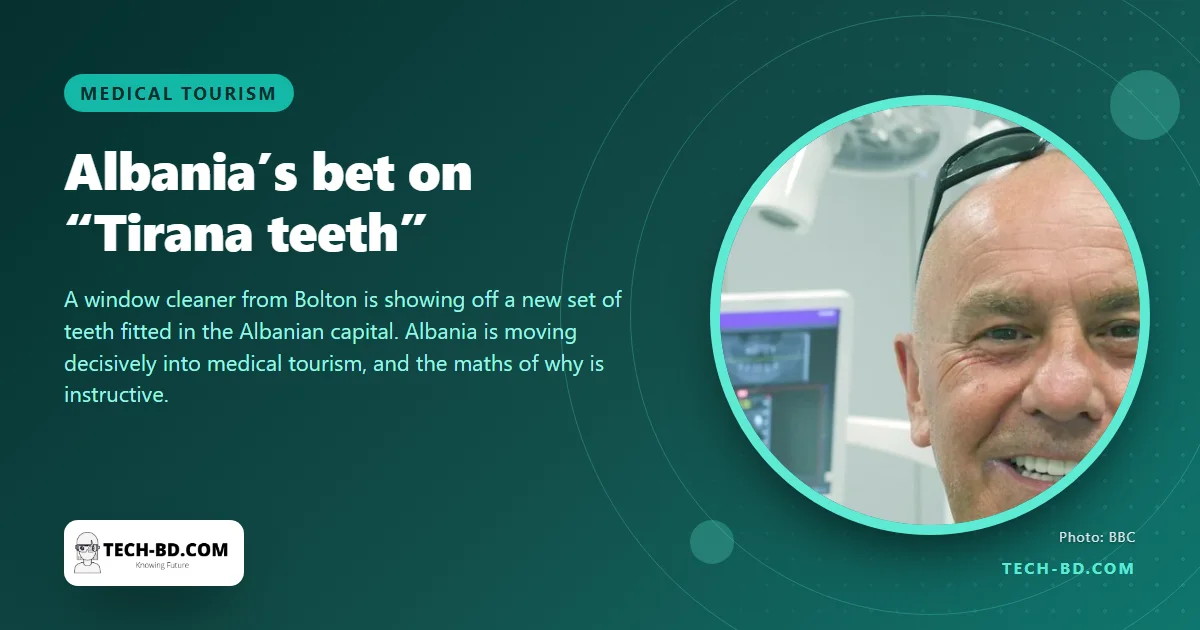
Anthony Hook is sitting in a dentist's chair, grinning into a handheld mirror. The 58-year-old window cleaner from Bolton is the proud owner of a sparkling new set of "Tirana teeth".
A city of molars
That is not a brand name — at least, not yet. But it fits, as Albania moves decisively into the medical tourism business, with its capital at the centre of operations.
Once you spot the first tooth, you see them everywhere: the larger-than-life illuminated molars that advertise a dental clinic nearby. In Tirana's metropolitan area there are almost four hundred dental clinics, most of them in the city centre — for a population of around 600,000.
The economics are not mysterious. Dental work is labour-intensive, largely uninsured in the countries patients come from, and priced on local wages. A country with trained dentists and low costs, inside Europe and a short flight from Britain, can undercut UK private dentistry by enough to cover the flight several times over.
What it means in Bangladesh
Bangladesh sits on the wrong side of this trade, and the number is large. Bangladeshis spend an estimated $4–5bn a year on treatment abroad, overwhelmingly in India, with Thailand and Singapore taking the higher-value cases. That is foreign currency leaving a country that needs it, and it leaves because of a trust deficit as much as a capability one.
The Albanian story is worth reading for what it implies about fixing that. Albania did not become a destination by building world-leading hospitals. It became one by concentrating on a narrow, high-volume, low-complexity procedure, competing on price, and making the experience legible to a foreign patient — clear quotes, English-speaking staff, a package that includes the hotel.
Bangladesh has the same underlying advantage in the same procedures. Dental implants, crowns, cataract surgery and orthopaedic work are all done here competently and at a fraction of Indian private prices. What is missing is not skill. It is accreditation a foreign patient can verify, published prices, and a complaints route that exists.
For Bangladeshi patients going the other way, three checks are worth more than any brochure. Ask who does the follow-up — complications from implant or cosmetic work appear weeks later, when the patient is home and the clinic is in another country. Get the materials specified in writing, because the gap between a good implant and a cheap one is invisible in the mouth and decisive in ten years. And be wary of a price that is dramatically below the local market, in Tirana or Chennai or Dhaka, because in dentistry that discount is almost always in the parts you cannot see.