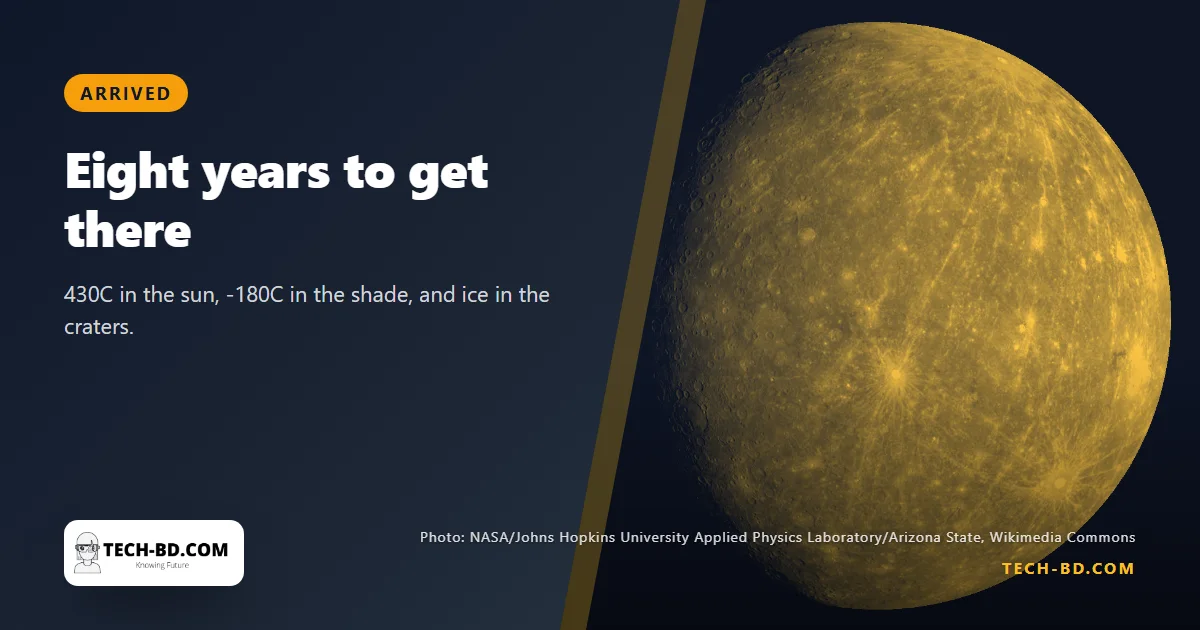
After a journey of about ten billion kilometres lasting eight years, the BepiColombo spacecraft has entered orbit around Mercury. The mission is a joint effort by the European Space Agency and Japan's space agency, JAXA.
Why it took so long
Mercury is not far away. The difficulty is the Sun: anything falling towards the inner solar system picks up enormous speed, and a spacecraft has to shed that speed to be captured rather than fly past.
BepiColombo did it the slow way, using gravity to brake. It launched from French Guiana in 2018 and flew past Earth once, Venus twice and Mercury itself six times before it could settle into orbit. The plan allowed seven years; a problem with the propulsion system added one more.
Only two spacecraft have been there before. Mariner 10 flew past three times in the 1970s, and MESSENGER entered orbit in 2011.
What it is going to look at
The headline question is the strangest one: why is there ice in Mercury's craters when the planet sits closest to the Sun? The spacecraft will also map the mysterious "hollows" scattered across the surface — shallow depressions with steep sides, usually found in clusters, and young in planetary terms at roughly a hundred thousand years old.
Professor Emma Bunce of the University of Leicester said there are many reasons to want to understand Mercury scientifically: how it formed, how it evolved, why it looks the way it does now, how it interacts with the Sun, and how it survives the extreme space weather it faces.
What kind of place it is
Mercury is only slightly larger than our Moon. Surface temperatures run from 430C at the hottest to -180C at the coldest, and the planet is under constant bombardment from solar radiation — which is exactly why so little exploration has been possible.
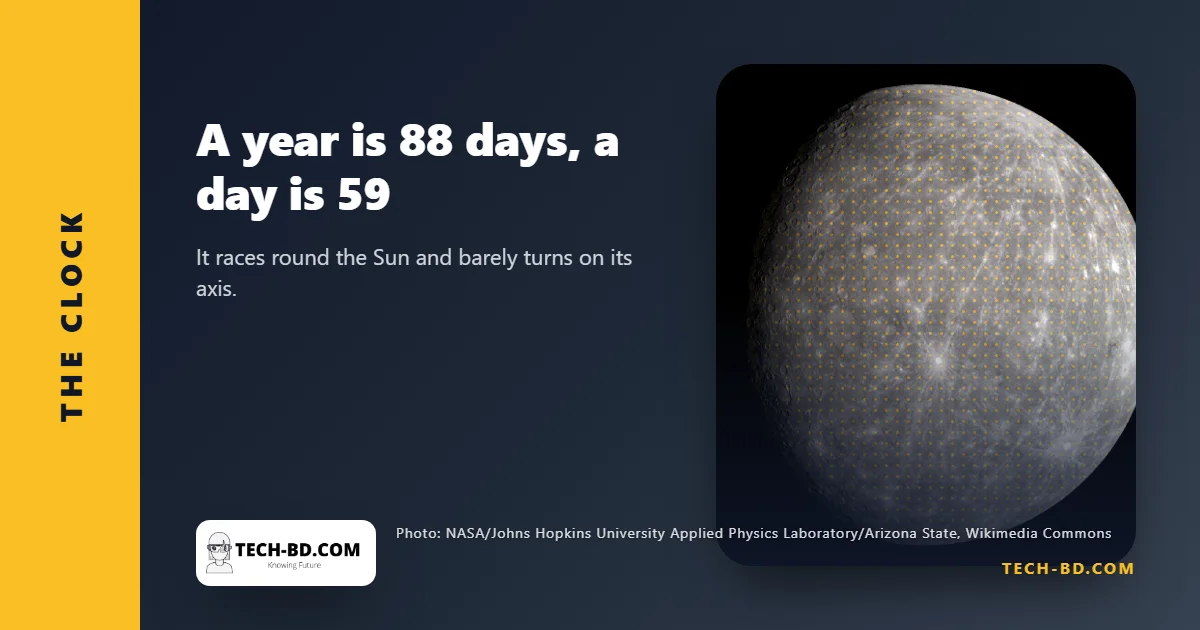
Time there is disorienting. Mercury goes round the Sun so fast that a year lasts just 88 Earth days, but it turns on its own axis so slowly that a single day lasts 59 Earth days. It is covered in ancient volcanoes, towering cliffs and enormous craters.
Why this one matters
Mercury is the least explored of the rocky planets, and it is the one that should not look the way it does. It has a disproportionately large iron core, a magnetic field it has no business having at that size, and ice in permanent shadow next to rock hot enough to melt lead.
Every one of those is a clue about how planets form close to a star — which is most of the planets we are now finding around other stars. The answers will take years. The arrival took eight.
Two spacecraft, not one
BepiColombo is really two orbiters that travelled stacked together: Europe's Mercury Planetary Orbiter, which looks down at the surface, and Japan's Mercury Magnetospheric Orbiter, which studies the magnetic field and the particles around the planet. They separate and take up different orbits.
That split is the mission design answering the puzzle directly. Mercury's magnetic field is the oddity — a small, slowly rotating planet should not have one — and you cannot explain it by photographing the ground. One spacecraft maps the rock, the other maps the field, and the answer, if it comes, is in the relationship between them.