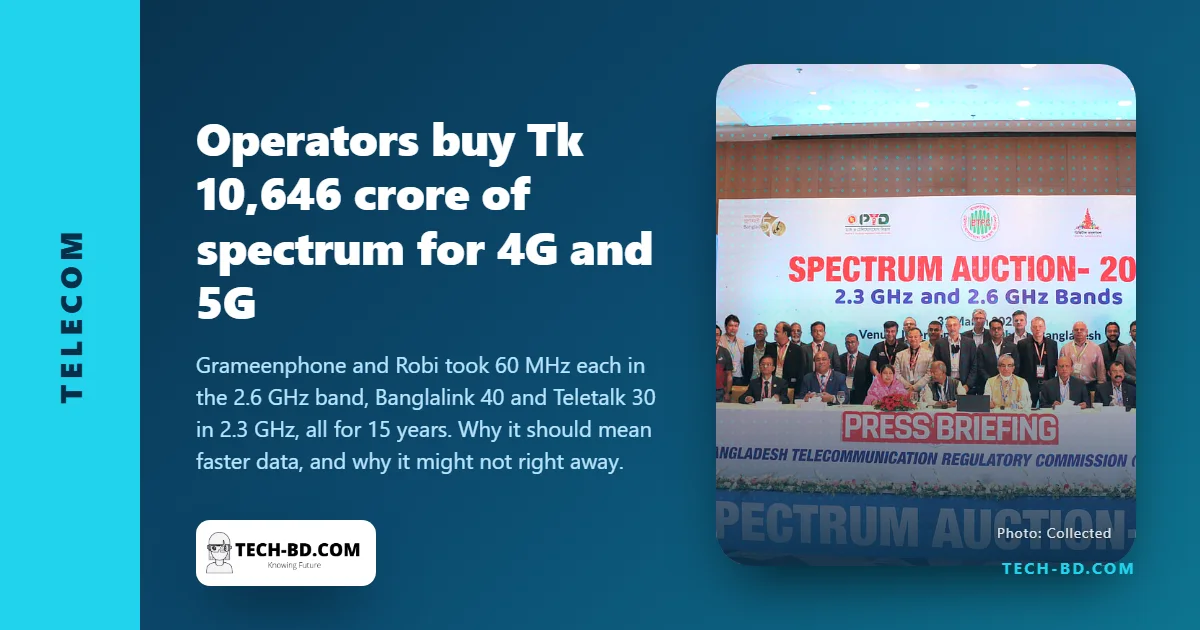
Bangladesh's four mobile operators bought 190 MHz of new radio spectrum for about Tk 10,646 crore at an auction at Dhaka's Hotel InterContinental on Thursday, 31 March 2022. The Bangladesh Telecommunication Regulatory Commission put 100 MHz in the 2.3 GHz band and 120 MHz in the 2.6 GHz band on the block; both are "capacity" bands suited to 4G today and 5G later, and the licences run for 15 years.
Who bought what
- Grameenphone: 60 MHz at 2.6 GHz. Total holding now 107.40 MHz.
- Robi: 60 MHz at 2.6 GHz. Total 104 MHz.
- Banglalink: 40 MHz at 2.3 GHz. Total 80 MHz.
- Teletalk: 30 MHz at 2.3 GHz. Total 55.20 MHz.
The total is roughly what the operators paid in the March 2021 auction, when 27.4 MHz went for about Tk 7,700 crore, but this time they got seven times as much spectrum for it, because the new bands are higher-frequency and cheaper per megahertz. Most blocks went at or close to the floor price; the real competition, and the real money, was in last year's 1800 and 2100 MHz sale.
Why spectrum is your speed
A mobile network's capacity is limited by how much radio spectrum it holds, much as a road's capacity depends on its lanes. Bangladesh's operators have long had among the least spectrum per subscriber in the region, which is why 4G here often delivers 10-15 Mbps while the same phone in a neighbouring country does 30 or more. Telecommunications minister Mustafa Jabbar said as much at the auction: customers complain about quality, the operators lacked spectrum, and "when these 190 MHz are added, it will transform the sector". BTRC chairman Shyam Sunder Sikder asked operators to turn the purchase into service quality, not just balance-sheet assets.
What to expect, honestly
The 2.3 and 2.6 GHz bands carry a lot of data but do not travel far or penetrate buildings well, so they help most in dense city areas where operators add them to existing towers. Rural coverage depends on the lower bands they already hold. Expect a noticeable improvement in Dhaka and Chattogram over the next year as the new carriers are switched on, and expect nothing to change in a village until a tower is upgraded. The same spectrum is what the first 5G services will run on, but no operator has said when that will be.