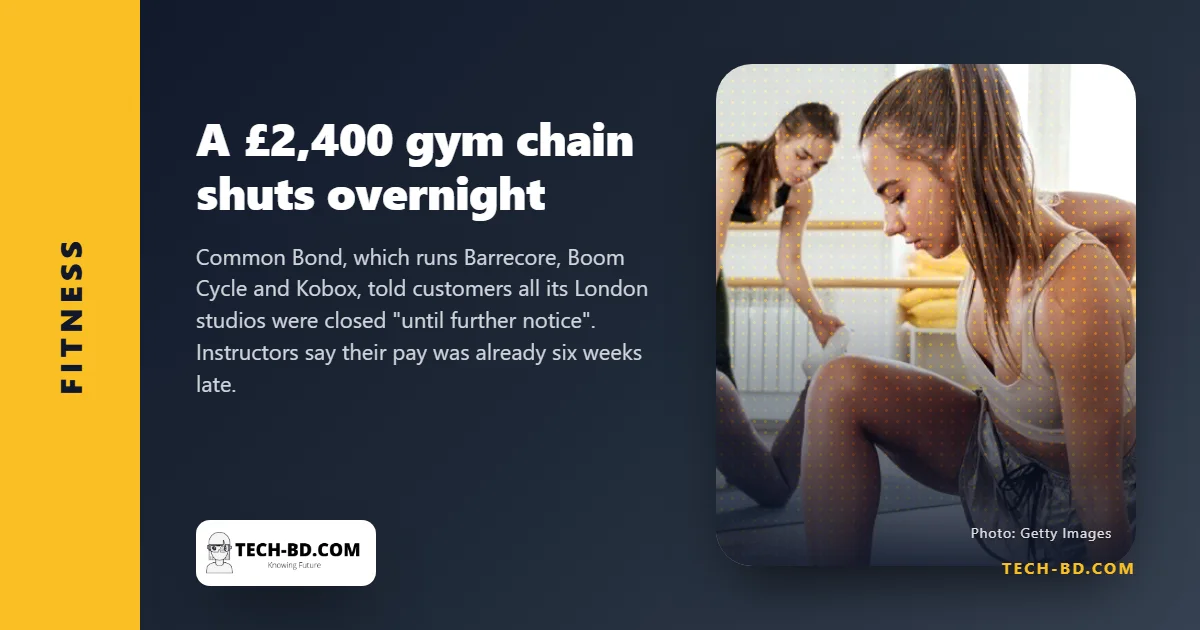
The fitness company behind the high-end exercise classes Barrecore, Boom Cycle and Kobox has suddenly shut all of its studios.
What happened
Common Bond emailed customers to announce that its locations — all currently in London — were closed "until further notice". The firm describes itself as a wellness collective and charges £2,400 for 12 months of unlimited classes. It also runs the Reformcore and Triyoga brands, and said in August last year that it had ten sites.
Its website is no longer publicly accessible. The BBC has contacted Common Bond for comment.
The email, sent on Wednesday and seen by the BBC, said: "We're sorry to let you know that all Common Bond studios are closed until further notice. We sincerely apologise for the inconvenience and disruption this may cause."
Instructors told the BBC they had been informed the week before that they would not be paid on time, and that they only learned about the closures from the same Wednesday email. One said she and her colleagues were told their pay would be delayed on 14 August, the day it was due. "In good faith, I continued to teach my classes without any news on when or if payment would be made. I have heard absolutely nothing since," she said.
What it means in Bangladesh
This is not really a fitness story. It is a story about paying for a service in advance, and it describes a risk Bangladeshi consumers carry far more of than British ones.
Prepayment is the default model here across a long list of businesses: gym memberships sold as yearly packages at a discount, coaching centre course fees, salon and spa packages, lifetime-membership clubs, wedding venue advances, tuition paid by the term, and instalment schemes on furniture and electronics. In each case the customer's money is handed over long before the service is delivered, and the customer's protection if the business closes is close to nil.
When a Dhaka gym or coaching centre shuts, the members who paid for a year are unsecured creditors with no realistic route to recovery. There is no regulator that pursues it, no deposit protection, and the cost of a civil case exceeds what most people lost. The practical defences are therefore all at the point of purchase.
Three of them are worth keeping. Pay monthly or quarterly even when the annual package is cheaper — the discount is the price of the risk, and it is often a bad trade. Prefer paying by a method that leaves a record and, where possible, a route to dispute, rather than cash with no receipt. And treat late staff wages as the warning sign it is: the instructors in this story knew six weeks before the customers did, and in a small business, staff being paid late is almost always the first visible symptom of the end.
There is a second, quieter cost in this story that also applies here. The instructors kept teaching in good faith, unpaid. Freelance trainers, coaching-centre teachers and salon staff in Bangladesh carry exactly that exposure, usually with no contract at all — and when a business fails, they lose both the arrears and the job.
We looked at the other end of this industry, the marketing-led side, in cycle-syncing.