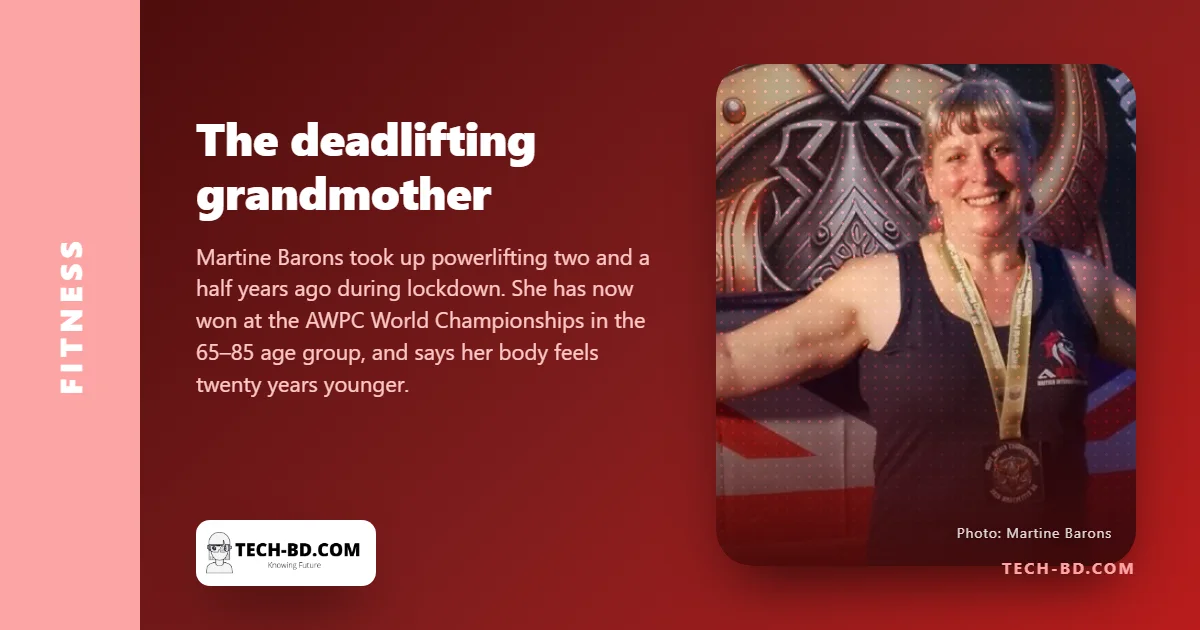
A 65-year-old grandmother has become a three-time world champion powerlifter after taking up the sport only two and a half years ago.
How she started
Martine Barons, from Stratford-upon-Avon, began lifting weights during lockdown after hearing a seminar which said that women going through the menopause should run less and lift more.
A colleague at the University of Warwick, who is also a personal trainer, showed her how to deadlift and spotted her potential. She is now known as The Deadlifting Grandma.
She won at the AWPC World Powerlifting Championships in the 65 to 85 age group, becoming a three-time world champion — having started entering competitions just for fun.
"I have seen such a huge change in my own physique and my capabilities — I am sure that my body is at least 20 years younger," she told BBC CWR.
Why the advice she heard was sound
The seminar's advice has a real physiological basis, and it is worth stating because it runs against what most women are told.
The fall in oestrogen around menopause accelerates bone density loss and muscle loss. Endurance exercise, which is what women are most often steered towards, does relatively little for either. Loading the skeleton — resistance training, and particularly compound lifts like the deadlift — is one of the few interventions that stimulates bone to maintain itself, alongside maintaining the muscle mass that protects against falls.
The deadlift in particular trains the exact movement that determines independence in later life: picking something up from the floor and standing up with it.
What it means in Bangladesh
Osteoporosis is substantially underdiagnosed in Bangladesh, and the risk factors here are stacked: low dietary calcium, widespread vitamin D deficiency despite abundant sun — because of clothing, indoor work and skin pigmentation — earlier average menopause than in Western populations, and very low rates of resistance training among women of any age.
The consequence shows up as hip fracture in a woman in her seventies, which in Bangladesh carries a far worse outlook than in the UK: surgery is often delayed or unaffordable, rehabilitation is scarce, and the loss of mobility is frequently permanent.
The useful thing is that the prevention does not require a gym. Loading the skeleton means resistance, not equipment. Carrying shopping deliberately rather than minimising it, standing up from a chair without using the arms, climbing stairs, squatting to floor level and standing again — the movements traditional Bangladeshi domestic life is full of, and which modern urban life has quietly removed.
For anyone who does want to lift, the two conditions are that it is learned properly and progressive. Barons was shown how by someone qualified, which is the part of this story most likely to be skipped. The equivalent of chair-based classes for those not ready for weights is set out in seated exercise — the principle is the same, and the starting point is wherever you actually are.