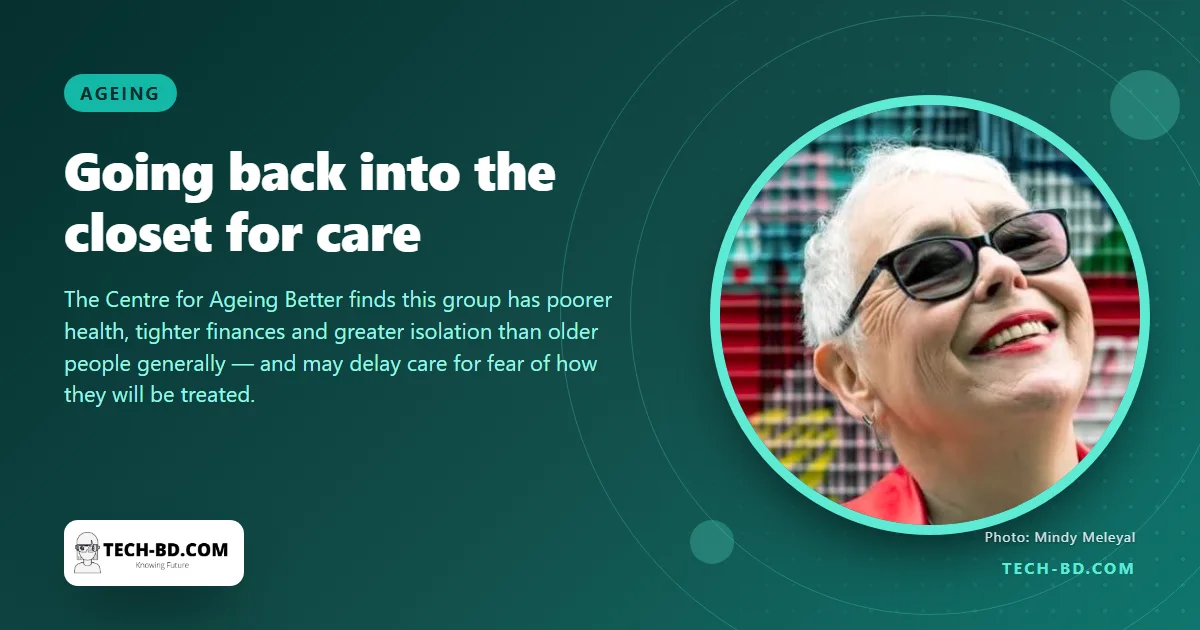
Mindy Meleyal is 75, and has lived through every major milestone of the modern LGBT rights movement — from the beginning of decriminalisation in 1967 to the first same-sex marriages in 2014. She says this part of her identity is now frequently overlooked because of her age.
What the report found
A new report from the Centre for Ageing Better suggests England's older LGBTQ+ community often experiences poorer health, more limited finances and greater social isolation than the wider older population.
Its central warning is specific: without specialist support, this growing group could be forced "back into the closet" when accessing care — and may delay getting the care they need because of concerns about homophobia.
Adam Preston, a housing development manager at the LGBT Foundation charity, says he regularly meets older members of the community in exactly that situation.
Why this group is structurally more exposed
There is a demographic reason this is not simply about attitudes, and it explains the isolation finding.
People now in their seventies and eighties came of age when being open carried real legal and social risk. Many are less likely to have children, more likely to have become estranged from birth families, and more likely to have built their support around friends — a network that thins with age exactly when care needs rise. Where a heterosexual person of the same age often has adult children advocating for them in a hospital or care home, this group frequently does not.
That is what makes returning to concealment so costly. Care at home or in a residential setting is intimate, and a person who does not feel safe being known will manage that by withdrawing, understating symptoms, or not asking.
What it means in Bangladesh
The specific legal and social context in Bangladesh is very different, and this report does not transfer directly. What does transfer is the underlying finding, which is not really about sexuality at all: people who expect to be judged by a health service delay using it, and that delay is where the harm accumulates.
That mechanism is well documented here across several groups — unmarried women seeking reproductive health care, people with mental illness, hijra and transgender communities, people seeking treatment for addiction, and older people who do not want to be a burden. In each case the clinical problem is the same: the patient arrives late, with a condition that was cheaper and easier to treat earlier.
The design lesson is the practical part. A service that wants to reach people who expect judgement has to signal safety before it is asked to — through what is written on the wall, what is asked at registration, whether confidentiality is stated out loud, and whether staff have been told plainly that a patient's circumstances are not their business. Those are decisions a single upazila health complex or private chamber can make this week, without policy.
The isolation finding is the other half. As Bangladesh's older population grows and joint families thin in cities, the number of older people with no one to advocate for them in a hospital is rising. Whoever they are, that is the group whose symptoms go unreported and whose deterioration goes unnoticed.