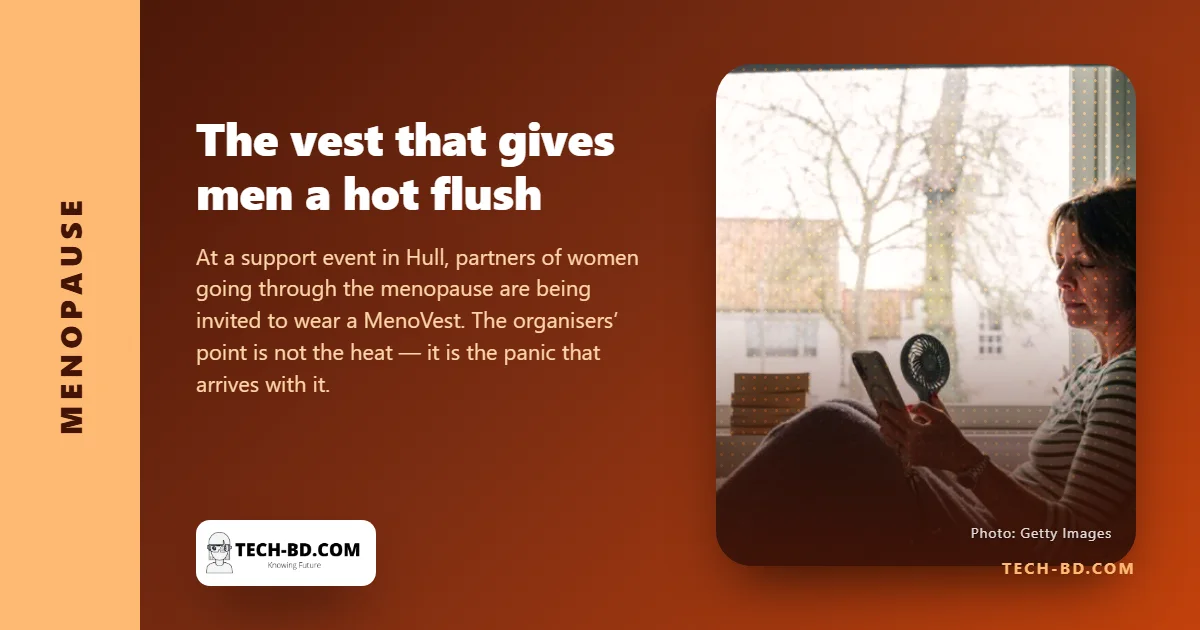
Partners of women going through the menopause are being invited to experience one of the symptoms directly — by putting on a vest that produces it.
The event
At the Menopaus'ull Support Network event in Hull next month, health group Over The Bloody Moon will bring one of its MenoVests, allowing people to experience a hot flush.
Sarah Weichardt, who co-manages the project, said: "We're particularly interested in getting men along to come and experience the MenoVest, just so that they can understand what women go through."
The event runs at Princes Quay shopping centre on 17 October, from 10:30 to 14:30 BST.
Why a wearable, and not a leaflet
The reasoning behind the vest is in Weichardt's second remark, and it is the part that survives translation to any country.
"It's not just a hot flush, it's what the hot flush brings with it," she said. "So it could be panic, it could be anxiety. It's experiencing it all at the same time."
That is the gap a leaflet cannot close. Described in words, a hot flush sounds like feeling hot — an inconvenience. Experienced, it arrives as a sudden autonomic surge with a racing heart and a wave of dread, in the middle of a meeting or a conversation, several times a day, unannounced. The people who dismiss it are not usually unkind; they have simply been given a description that makes it sound minor.
The menopause marks the end of a woman's reproductive years and often happens around the age of 50. The period leading up to it, the perimenopause, is when many women first notice their periods becoming unpredictable — and it is where most of the confusion sits, because the symptoms begin while periods are still happening.
What it means in Bangladesh
There is no equivalent of this event anywhere in Bangladesh, and the underlying gap is wider than in the UK. Menopause here is largely undiscussed, rarely treated, and frequently reinterpreted as something else entirely — a woman in her late forties with palpitations, night sweats, insomnia, joint pain and low mood is often investigated for heart disease or thyroid problems, given something for gastric trouble, or told it is a nervous condition.
Average age at menopause in South Asian populations is somewhat earlier than in Western ones, which means the misattribution starts earlier too. And because hormone therapy is barely discussed outside a handful of private clinics in Dhaka, most Bangladeshi women pass through this stage with no treatment offered and no explanation given.
Three things are worth stating plainly. These symptoms are physiological, not psychological — the woman is not imagining them and is not being difficult. They are treatable, and a gynaecologist is the right person to ask, including about non-hormonal options where hormone therapy is unsuitable. And the symptoms most likely to be dismissed at home are the ones that do the most damage over years: broken sleep, and the mood effects that follow it.
The cheapest version of the MenoVest, for any Bangladeshi household, costs nothing at all. It is a husband or a son believing her the first time she says it. The same principle we set out about resistance training after menopause applies here — see the deadlifting grandmother, who started at 62.