Can you imagine seeing the words "shame lips" on your medical notes? The term, which can also be translated as "pubic lips", is the Dutch word for a part of a woman's body — and for campaigners it is one of countless examples that are outdated and loaded with stigma.
What changed
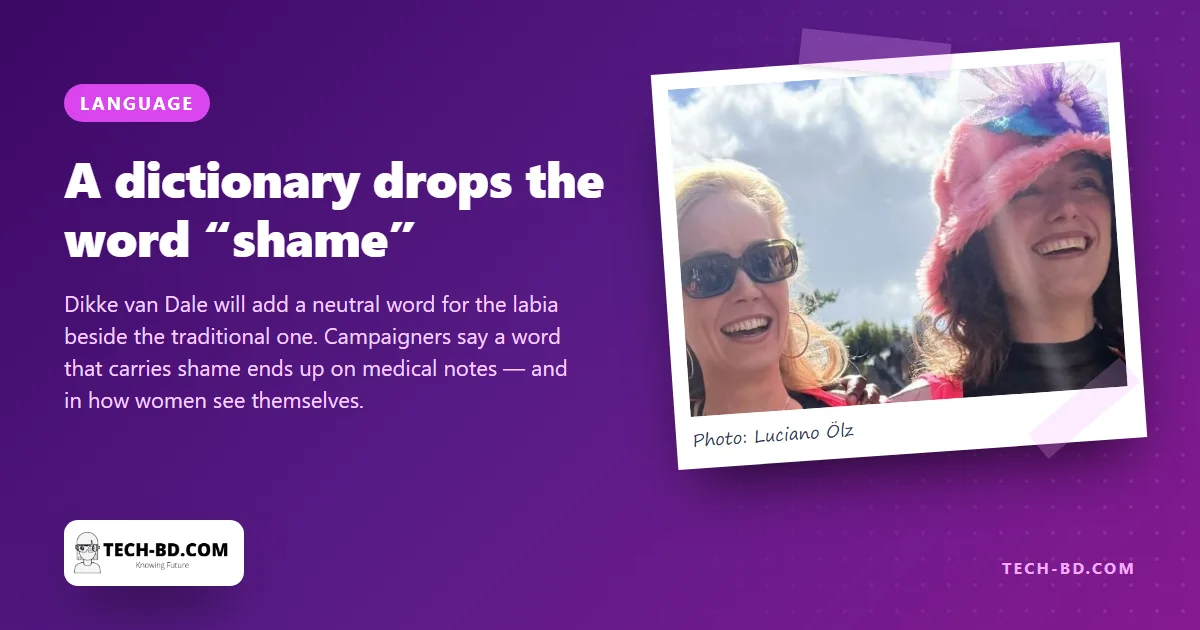
Last month the leading Dutch dictionary Dikke van Dale said it would include a new term for the labia, "vulvalippen", in its upcoming online edition — alongside the traditional "schaamlippen".
European campaigners have long called for a rewrite of the terms used to discuss women's bodies, sexuality and health, united by a wish to move away from words seen as misogynistic or judgmental.
"Language shapes how we see ourselves," says Shari Klein, a founder of the Schaamteloos campaign, which targets words built on "schaam" — shame. "It's crucial people have a more neutral, anatomically correct word — not a word that links to shame, whether consciously or sub-consciously."
Calls to use vulvalippen are not new, but campaigners say inclusion in the dictionary may show society is "finally ready for change". Esther Van der Valk of the feminist group Dolle Mina says it is also about sex positivity and reducing body shaming. The campaign's next step is to persuade doctors and officials to use the word in leaflets and consultations.
Ton den Boon, the dictionary's editor, says the addition is justified because the word is becoming established — appearing in the media, in biology textbooks, in medical leaflets, and even in veterinary medicine.
What it means in Bangladesh
Bangla has the same problem and has had it longer, without a campaign or a dictionary editor to answer to.
The everyday vocabulary for women's anatomy and reproductive health in Bangla runs to either clinical English loanwords or euphemism, and the euphemisms are built on exactly the root the Dutch campaigners object to — লজ্জা, shame — or on avoidance so complete that no word is used at all. The consequence is not literary. It is that a woman with a symptom in the affected area often has no non-embarrassing way to describe it, and so describes it vaguely, or not at all, to a doctor who has ten minutes.
That has measurable costs. Cervical cancer is among the leading cancers killing women in Bangladesh, and it is one of the most preventable — screening and the HPV vaccine both work. Late presentation is the whole problem, and shame is a substantial part of late presentation. The same applies to fistula, prolapse, incontinence and infertility, all of which are treatable and all of which are routinely endured in silence for years.
The Dutch story is useful here because it identifies the smallest possible intervention. Nobody has to change a culture. What changes outcomes is a doctor, a teacher, a mother or a textbook using a plain anatomical word without lowering their voice — because the first person to do that gives a girl permission to say it out loud herself.
The related mechanism, where something harmful goes unnamed and therefore unrecognised for years, is set out in a survivor's account of FGM.