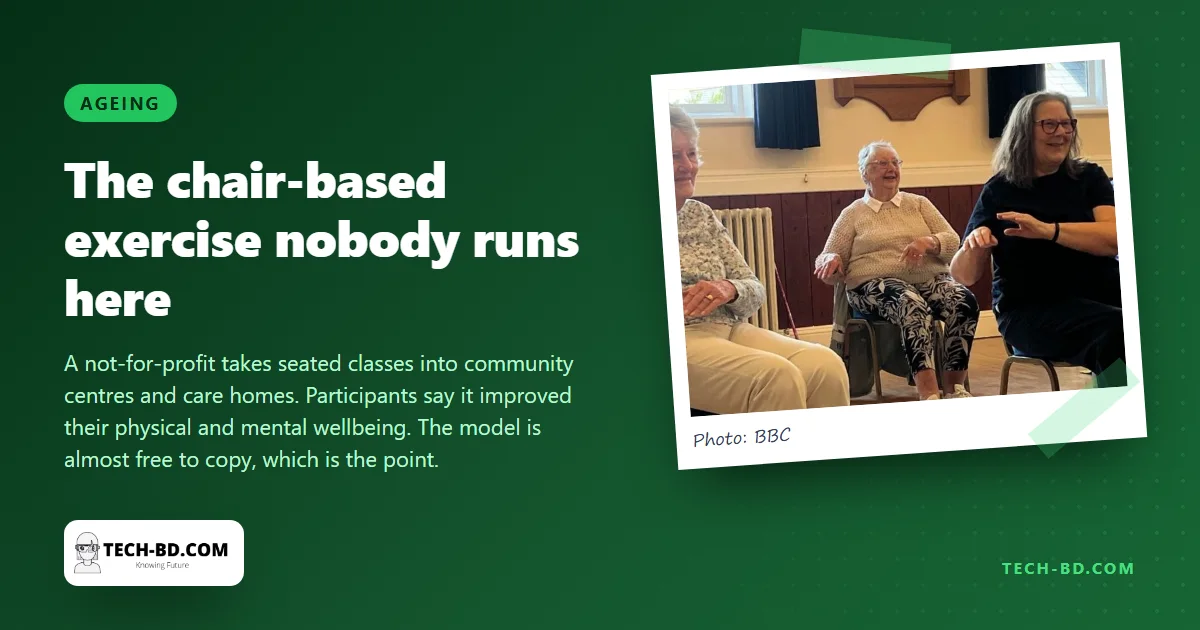
People attending free seated exercise classes and laughter yoga say the sessions have improved both their physical and mental wellbeing.
The group behind them, Laugh, Move & Groove, takes its sessions around community centres and care homes in Jersey to keep people moving. The not-for-profit also works with charities to support people of different physical abilities to stay active, and has been shortlisted for a BBC Radio Jersey Make a Difference Award.
Why seated exercise is not a lesser version of exercise
It is easy to file chair-based classes under "gentle" and move on. That underrates what they do.
For an older adult, the things that determine whether they keep living independently are lower-limb strength, balance and the ability to get out of a chair. Seated and supported exercise trains exactly those, at an intensity the person can actually sustain, without the fall risk that makes standing classes unsuitable for some.
The second half is social, and it is not a bonus. Isolation in older people is associated with worse health outcomes on a scale comparable to well-known physical risk factors. A weekly class that someone leaves the house for, and where they are missed if they do not arrive, is doing two things at once — and the laughter element, whatever one makes of it as a technique, is a low-barrier way of getting a room of strangers to relax together.
What it means in Bangladesh
Bangladesh is ageing faster than its services are adapting. The over-60 population is growing quickly, the joint family that historically absorbed that care is thinning in cities, and there is essentially no organised provision for keeping older people physically active outside a handful of private facilities in Dhaka.
What makes this story worth reading here is that the intervention is close to free. It needs a room, chairs, someone trained for a few hours, and a fixed weekly time. Mosque and temple compounds, community clubs, union parishad halls, school rooms in the evening and the waiting areas of upazila health complexes all exist and are mostly idle at the relevant hours.
The likely obstacle is not money but expectation. Exercise in Bangladesh is culturally coded as something for the young and the male, and an older woman in particular is unlikely to see a class as intended for her. The version most likely to work is one attached to something already happening and already respectable — a class after a regular gathering people attend anyway, rather than a new thing they must decide to join.
For families, the single most useful takeaway is narrower still. If an older relative has stopped going out, the intervention that matters is not a supplement or a check-up. It is getting them to move, in company, once a week, for reasons other than health.