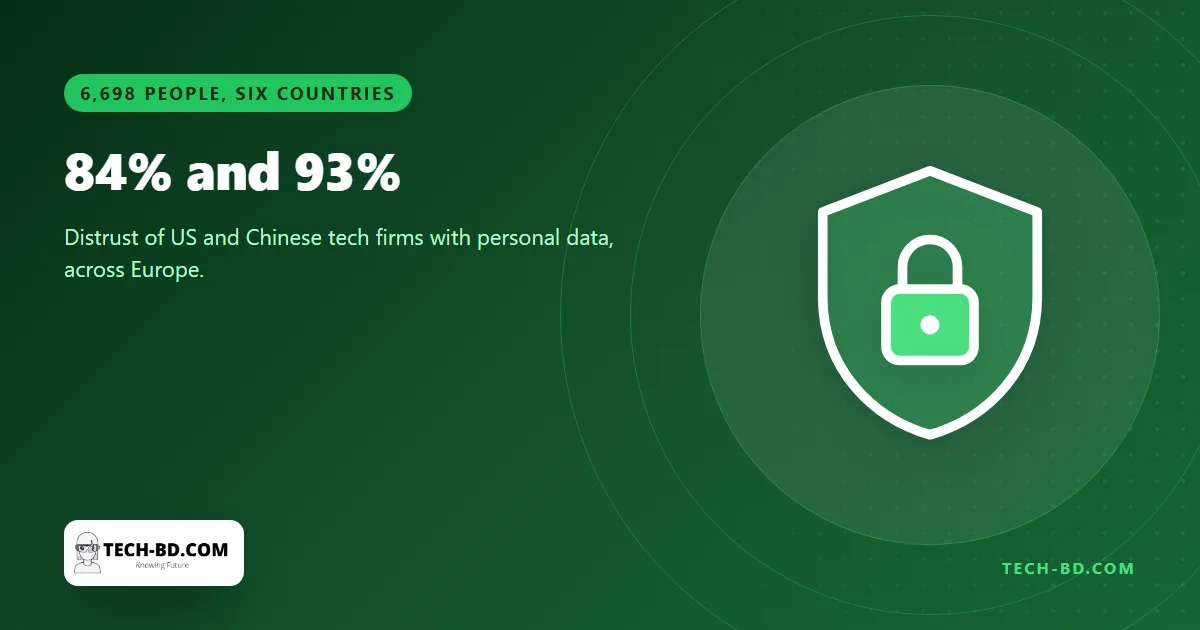
A survey by Politico of 6,698 citizens across Spain, Germany, France, Italy, Poland and Belgium found that more than eight in ten Europeans do not consider it safe for their personal data to be held by US or Chinese technology firms.
The figures
- 84% do not trust US tech firms to handle personal data responsibly.
- 93% do not consider Chinese firms responsible for data protection.
- 51% trust European tech firms.
The country-level numbers are sharper. In Germany, 91% distrust US firms and 98% distrust Chinese ones. In Poland, 38% trust US firms and 20% trust Chinese firms. In Belgium, 59% trust European firms to keep data secure — the highest confidence in European providers of any country surveyed.
One figure deserves attention more than the headline. European firms are trusted by only 51% — barely half. The finding is not that Europeans have switched their confidence to a local alternative. It is that trust has fallen everywhere, and the local option is merely the least distrusted.
Why the mood changed
Mark Scott, senior resident fellow at the Atlantic Council, said Brussels and Washington no longer agree on basic issues such as free trade, NATO and free speech.
That is the part that makes this different from ordinary privacy complaint. Data protection disputes between the EU and the US have run for years under GDPR without changing procurement much. What has changed is the political relationship underneath — and once the disagreement is about alliances rather than compliance, "where is the data" becomes a strategic question instead of a legal one.
Governments are already moving
European Commission President Ursula von der Leyen has emphasised digital sovereignty since taking office again in 2024, and the Commission announced a "Tech Sovereignty" package in June to build advanced semiconductor and AI infrastructure in Europe.
Two concrete decisions show what this looks like in practice. Austria's military dropped Microsoft for open-source European services. Denmark's data protection authority told schools to stop using Google laptops.
Neither is symbolic. A military and a school system are exactly the institutions whose software choices are hardest to reverse.
What this means from here
Bangladesh's public and private sectors have adopted US cloud services on the same assumption Europe once held: that they are the capable, neutral default. This week's Microsoft outage was a reminder of the operational risk in that; the European survey is about a different risk, which is jurisdictional.
The practical question for an organisation here is narrower than "should we leave the cloud". It is whether you know which of your data sits under foreign jurisdiction, and whether any of it is the kind that would matter if access were restricted for reasons that have nothing to do with you. Most organisations have never written that list down, and writing it down costs nothing.
One caution about the survey
Survey questions about trust measure sentiment, not behaviour, and the two routinely disagree. The same Europeans who tell a pollster they do not trust US tech firms with personal data are, in large numbers, still using those firms' email, phones and cloud storage every day — because switching is difficult and the alternatives are thinner.
That gap does not make the finding meaningless. Sentiment is what makes a procurement rule politically possible, and the Austrian and Danish decisions show it converting into policy. But it is worth reading the 84% as a measure of what governments can now do without resistance, rather than as a description of what citizens have already done.