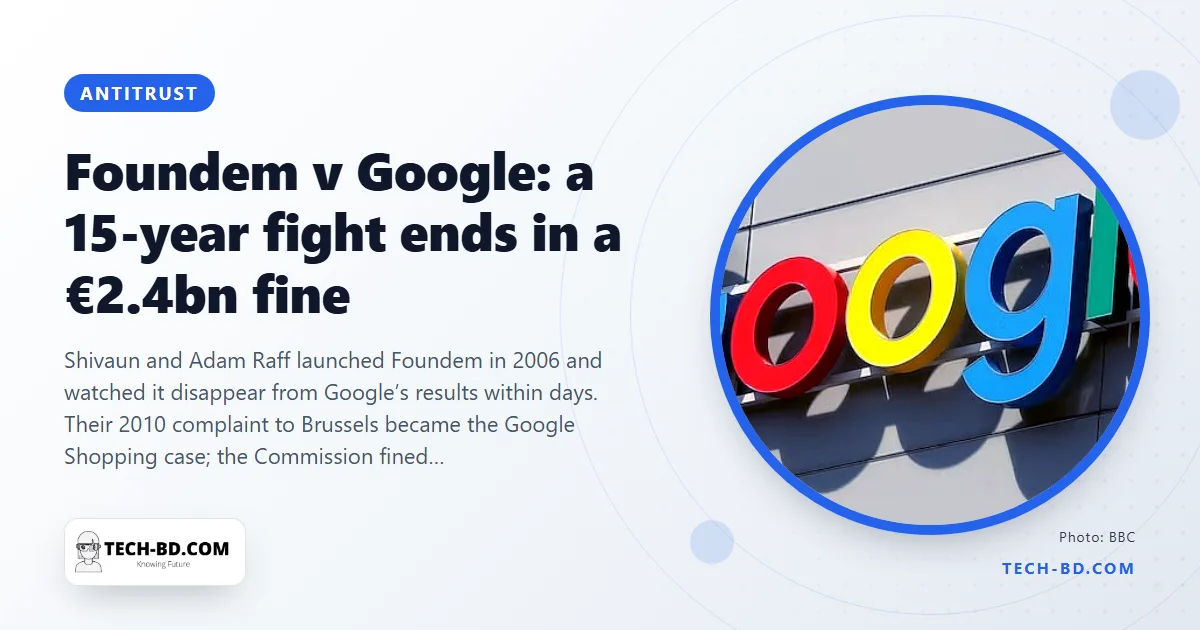
In June 2006 a British couple, Shivaun and Adam Raff, launched a price-comparison website called Foundem. Within days it had vanished from Google’s search results — caught, Google said later, by an automatic spam filter, and never fully released. For searches like “price comparison” or a product name, Foundem sat pages deep while Google’s own shopping results sat on top. In 2010 the Raffs complained to the European Commission. That complaint became the Google Shopping case; in 2017 the Commission fined Google €2.42 billion, then the largest antitrust penalty it had ever imposed; and in September this year the European Court of Justice dismissed Google’s final appeal. The fine stands.
What Google was found to have done
Not to have filtered Foundem specifically, but to have used its dominance in search — over 90 per cent of the European market — to favour its own comparison service, Google Shopping, placing it in a prominent box at the top of results while demoting rivals by algorithm. The Commission found that traffic to Google’s service rose forty-fold after the change and traffic to competitors collapsed. That is the textbook abuse of a dominant position, and the court agreed at every level.
Who gets the money
Reports that the Raffs “win £2 billion” are wrong. The fine is paid to the EU budget. Foundem itself closed in 2016, its traffic gone; the Raffs filed their own damages claim against Google in the High Court in London in 2012, and that case, now able to rely on the EU finding, continues. Whatever they eventually receive will be a fraction of the headline figure and will have taken close to two decades.
Why the case matters more than the money
Google Shopping was the first of three EU decisions against Google — Android (€4.3 billion) and AdSense (€1.5 billion, later annulled) followed — and the template for the Digital Markets Act, which since March has banned self-preferencing by law rather than case by case. It is also the ancestor of the US Justice Department’s search case, which found Google an illegal monopolist in August. Two people with a website started it.
The lesson for a small site
Any publisher or shop in Bangladesh whose traffic comes through Google is in the Raffs’ position in 2006: entirely dependent on a ranking it cannot see and cannot appeal. Their fifteen years teach two things. Keep records — Foundem’s evidence of its own rankings before and after was decisive. And do not build a business on a single channel; the Raffs had no email list, no direct traffic, no other way to be found. Google’s AI Overviews, which now answer questions above the results, are doing to news and reference sites in 2024 what Google Shopping did to Foundem.
Sources: BBC, NDTV, Hindustan Times, via Prothom Alo.