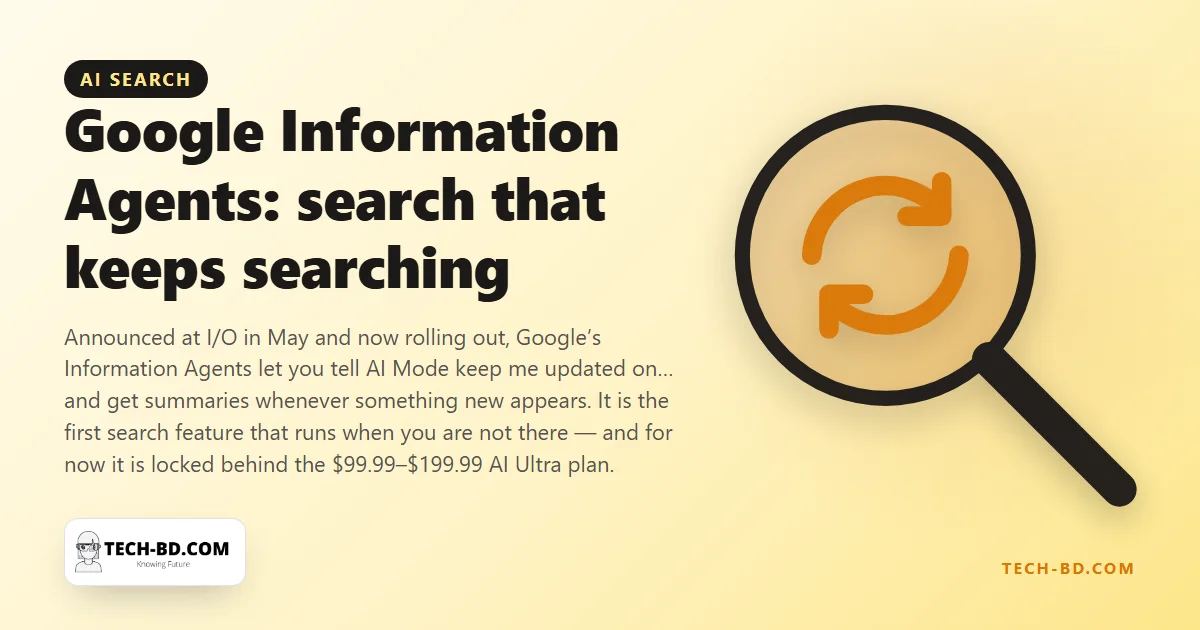
Search has always been a thing you do. Google is now shipping a version of it that keeps going after you close the tab. Information Agents, first shown at Google I/O 2026 in May and now rolling out inside AI Mode, take a standing instruction — "keep me updated on the Dhaka metro rail extension", "alert me when the Pixel 11 price is announced" — and monitor the web on your behalf, sending a short summary each time something new turns up.
How it works
You phrase the request in AI Mode using wording like keep me updated on or alert me when. The agent then takes responsibility for the topic: Google says it can gather and analyse information from news sites, blogs, social media, shopping platforms and sports sources, detect new material that matches your instruction, and present it in condensed form. The point is to remove the habit of re-running the same search every morning to see whether anything changed.
What it costs
For now, a great deal. Information Agents are limited to Google AI Ultra subscribers, whose plans cost $99.99 to $199.99 a month depending on tier. The feature is being enabled in every language and region where AI Mode is available, so Bangladeshi Ultra subscribers should see it; whether anyone here pays Tk 12,000-plus a month for it is another matter. Google's pattern with AI features is to debut them at the top tier and push them down over time, and there is no reason to expect otherwise here.
Why this is a bigger deal than it sounds
Standing search is not new — Google Alerts has emailed keyword matches since 2003. The difference is judgement. Alerts fires on any page containing the words; an agent is meant to understand what you are actually tracking, ignore the repetition and the noise, and tell you what changed in a paragraph. If it works, it replaces a category of tools that professionals pay for: media-monitoring services, price trackers, competitor watch dashboards. If it half-works, it is a firehose of confident summaries you have to double-check, which is the failure mode of every AI feature so far.
The problem that has defeated every tool before it
Standing monitoring has one structural difficulty, and it is not a matter of better models. Every monitor sits on a dial between two kinds of error.
Turn it one way and nothing gets missed: every page mentioning the metro rail arrives, including the forty syndicated copies of the same wire story, the forum post asking what the metro rail is, and the unrelated company called Metro. The alerts become unreadable, so you stop reading them, so the tool has failed while technically working perfectly. This is why most Google Alerts subscriptions end in a mail filter.
Turn it the other way and the inbox stays clean, at the price of silent omission. You do not know what was filtered out. A monitor that misses the one announcement you set it up for has failed invisibly, which is worse than failing loudly, because you carry on believing you are covered.
There is no setting that escapes this. Alerts chose the first error. An agent is a bet that a model can make the editorial call a keyword cannot — deciding that the fortieth copy of a story is not news, and that a single line in a tender document is. That is a genuine advance if it holds, and the way to test it is not whether the summaries read well. It is whether the agent ever tells you that nothing happened, and whether it was right.
What you are actually subscribing to
One practical point that the announcement does not make. An agent can only report on pages Google has crawled, so a standing instruction inherits the crawl schedule. For a major news site that means minutes. For a government notice board, a university page or a small Bangla-language outlet — exactly the sources a Bangladeshi user would set a monitor on — it can mean days, or never.
So the thing being sold is not surveillance of the web. It is a readable layer on top of Google's index, with that index's blind spots passed through intact, and the summary gives no indication of which it is.
The questions worth asking
- Who gets watched? A tool that monitors "everything about X" is also a tool for monitoring people; Google will need visible limits.
- What happens to publishers? An agent that summarises new articles as they appear is one more layer between readers and the sites doing the reporting — and unlike a search result, a summary carries no reason to click.
- Does it know Bangla? AI Mode's language support is broad, but the quality of monitoring Bangla-language news, blogs and Facebook — where much of Bangladesh's information lives — is untested.
- Can you see what it discarded? Without that, a quiet week and a broken agent look identical.