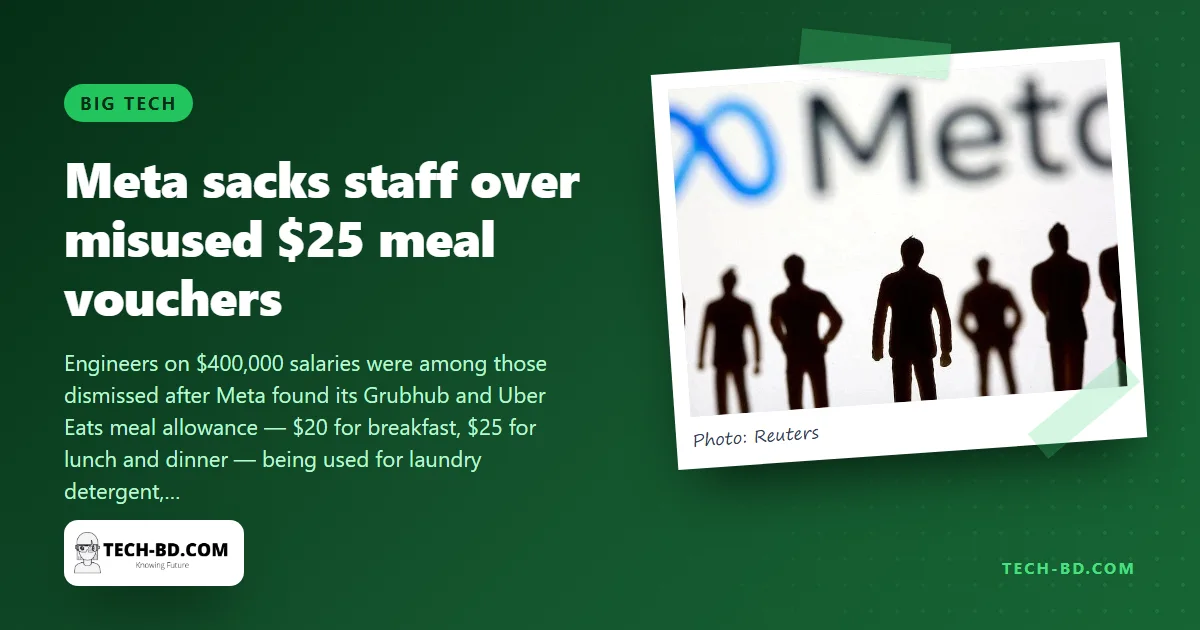
Companies fire people for losing money, for incompetence or for misconduct. Meta has found a smaller reason. According to reports first published by the Financial Times, the company dismissed about two dozen employees at its Los Angeles office this month for misusing their meal credits — the daily allowance, delivered as vouchers on Uber Eats and Grubhub, that Meta gives staff in offices without a canteen: $20 for breakfast, $25 each for lunch and dinner.
What they bought
The credits are meant for food eaten at work. An internal investigation found staff using them for toothpaste, laundry detergent, wine glasses, tea and other household goods; ordering meals delivered to their homes on days they were not in the office; and pooling credits with colleagues to cover larger orders. One of those dismissed, an engineer earning around $400,000 a year, wrote on the anonymous forum Blind that they had been let go for the practice. Some employees who had done it occasionally were reprimanded rather than sacked; those who did it habitually were dismissed.
What Meta said
Very little. Spokesperson Tracy Clayton declined to comment on the meal-credit dismissals and instead confirmed that Meta had made changes to several teams that week “to align with long-term strategic goals”, with some staff moved to other teams and others given new roles — a separate round of cuts at Reality Labs, WhatsApp and Instagram that happened to land in the same news cycle.
Why $25 matters to a $1.5 trillion company
Not because of the money. Meta spent $4.5 billion in the last quarter alone on its metaverse division. It is about the rules. Free food was one of the defining perks of the Silicon Valley boom — the Facebook campus had a sweet shop, a barbecue, a bakery — and when Meta shrank its office footprint after 2022 the vouchers replaced the kitchens. Vouchers, unlike a canteen, can be spent on anything, and a company that has laid off 21,000 people in two years and told the survivors this is a “year of efficiency” cannot be seen to let $25 walk out of the building. Buying detergent with the meal card is also, whatever the amount, expense fraud, and expense fraud is a firing offence at every company that has ever had an expense policy.
The view from here
A Bangladeshi reader may note that $25 is a day’s lunch for a whole team in Dhaka, and that the employee who lost a $400,000 job over it made, in a month, roughly what a Bangladeshi software engineer makes in a decade. The lesson is nonetheless universal and old: the perk is not salary, and the people who treat it as salary are the ones who get made an example of.
Source: ABC News, via Prothom Alo.