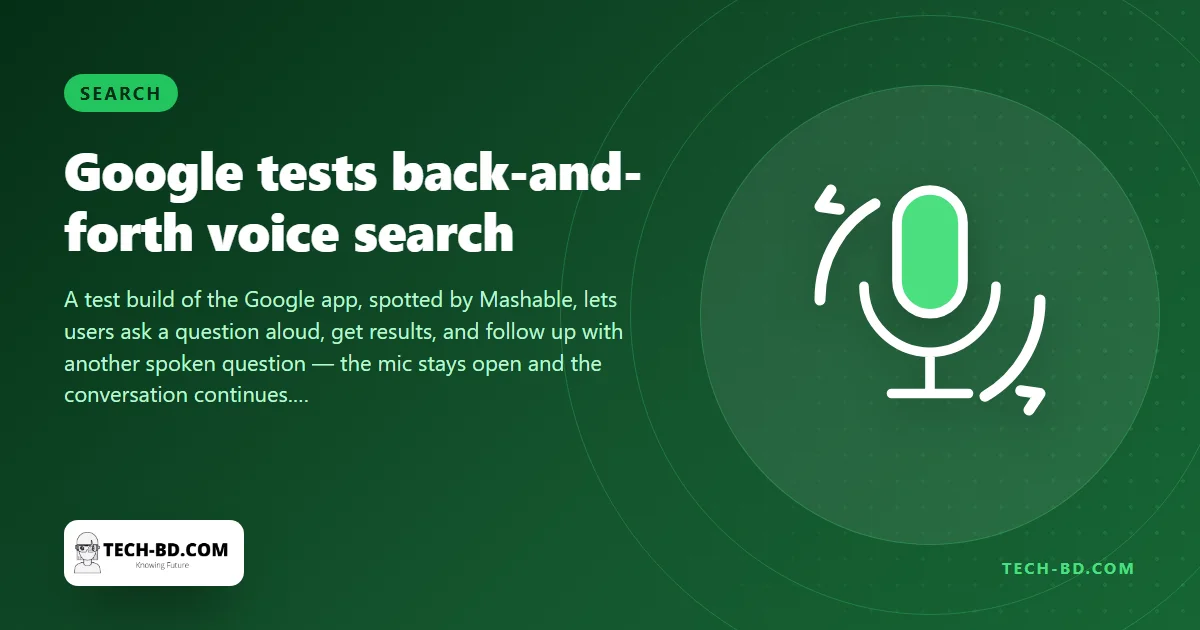
On 31 October OpenAI turned ChatGPT into a search engine: paying subscribers, and soon everyone, can ask it a question and get an answer built from live web results with links. It is the first credible challenge to Google’s core product in two decades, and Google’s reply arrived within ten days — not as a launch but as a test, seen in a beta build of the Google app and reported by Mashable.
What the test does
Voice search in the Google app today is one question per tap: press the microphone, speak, get results, and press the microphone again for the next question. In the test build the microphone stays open. Ask a question, see the results, then ask a follow-up in the same breath — “and which of those is open now?” — and Google answers using the context of what it just showed you. Results appear as you talk, as ordinary search results and AI Overviews rather than as a chatbot paragraph. It is search that behaves like a conversation without becoming a chatbot.
How it differs from Gemini Live
Google already has a spoken conversational AI: Gemini Live, launched in August, which talks back in a synthetic voice. The difference is what comes back. Gemini Live gives you an answer; the voice-search test gives you results — links, listings, maps, prices — which is what Google’s advertising business is built on and what Gemini’s answers threaten. The test is Google trying to make search itself feel conversational, so that the habit of talking to a machine does not move to an app that shows no ads.
Timing
Google has not said when, or whether, the feature will ship; the company tests many things that never appear. But the sequence — ChatGPT search on 31 October, a conversational search test within days — is the pattern of the past two years, in which nearly every Google search feature has followed an OpenAI announcement. The competition is good for users. Search is better than it was in 2022 because of it.
Where Bangla stands
Google’s voice recognition supports Bangla and has for years; a Bangla spoken query works in the app today. Whether the conversational test does is not known — such features usually launch in English and add languages later — and Google’s AI Overviews, which the follow-ups depend on, do not yet appear for Bangla searches. The conversation, when it arrives, will be in English first.
Source: Mashable, via Prothom Alo.