Reading a phone in a moving car makes a large share of people feel sick, and the reason is a disagreement inside the head. The eyes, fixed on a screen that is not moving, report stillness; the inner ear, which senses acceleration, reports motion. The brain, receiving two stories, does what it does when it suspects poisoning: it makes you nauseous. Apple attacked the problem in iOS 18 with Vehicle Motion Cues, and Google is now building the same thing into Android 16 under the name Motion Cues.
How it works
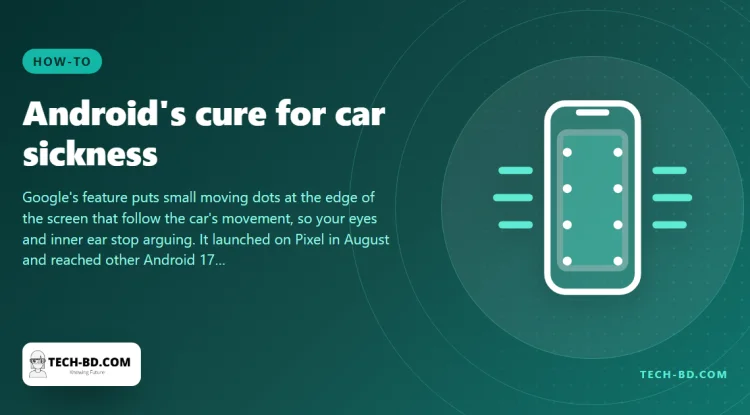
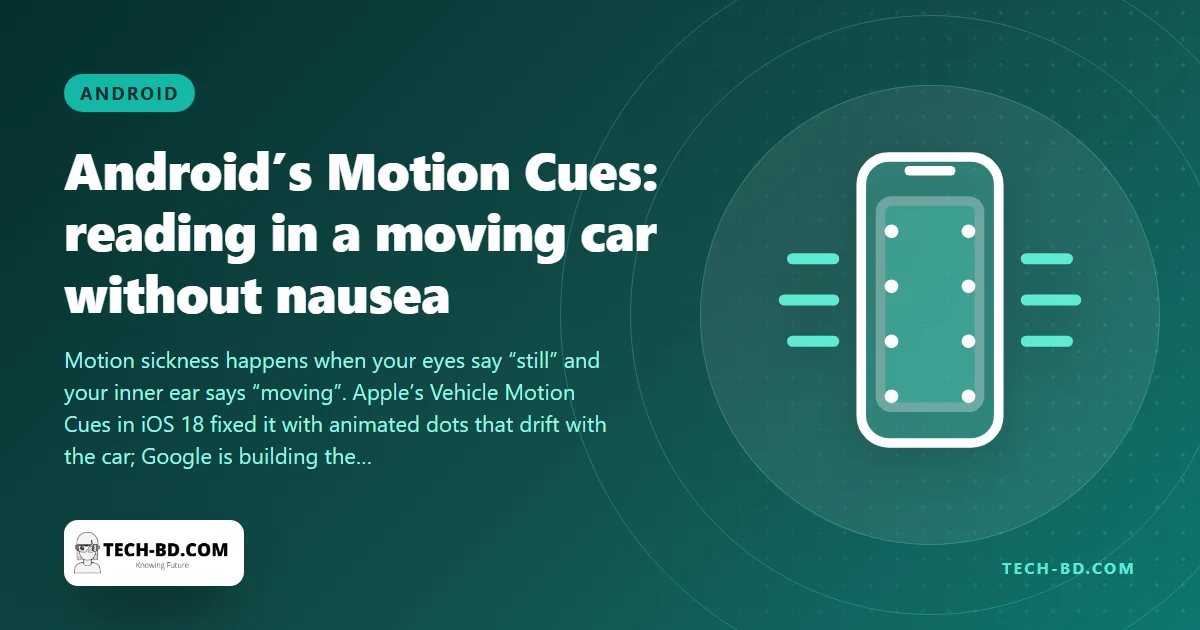
With the feature on, small dots appear along the edges of the screen. When the car accelerates, brakes or turns, the dots move in the direction of the motion, using the phone’s accelerometer and gyroscope. The eyes now see movement that matches what the inner ear feels, the two stories agree, and for most people the nausea does not start — or starts much later. The dots sit outside the content and are faint enough to ignore; they are a peripheral signal, not something to look at.
Where it is
Android Authority found the feature in a test build. It is switched on from a Quick Settings tile, and if the phone has the “display over other apps” permission it can turn itself on automatically when it detects that you are travelling, and off when you stop. Google has not announced it formally; Android 16 is due earlier than usual, in the second quarter of 2025, and the feature is expected to ship with it or in a Pixel Feature Drop before.
Does it work?
The technique has a research history: visual cues that match vehicle motion have been shown in driving simulators and car studies to reduce symptoms, and users of Apple’s version report it helps, particularly on smooth motorway driving. It does not work for everyone, and it works less well when the motion is violent — the sudden swerve rather than the gentle curve.
The Dhaka caveat
Which brings us to the bus. Motion Cues is designed for the kind of movement a sensor can track and an eye can follow: a car on a road with curves. A Dhaka local bus lurching between stops, a CNG auto-rickshaw at speed, or a launch on the Padma produces jolts that the dots will faithfully reproduce, which may be no comfort at all. For the Dhaka–Chattogram highway in an air-conditioned coach it should do what it does in California. For the number 6 bus through Mirpur, the old advice stands: look out of the window.
Source: Indian Express, via Prothom Alo.