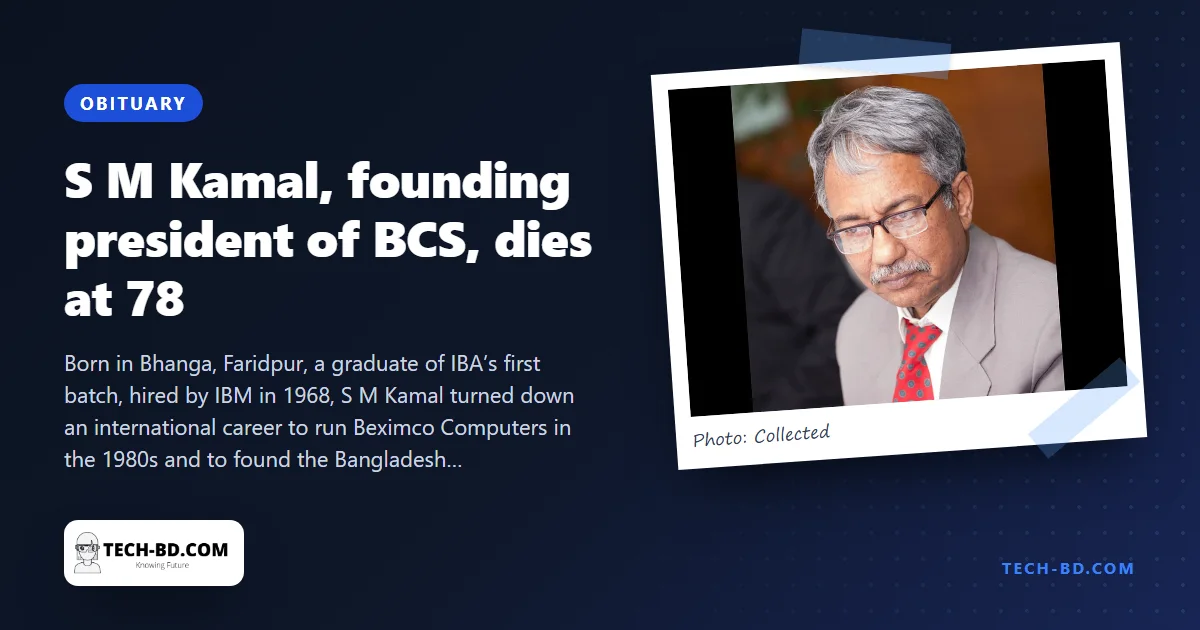
S M Kamal, the founding president of the Bangladesh Computer Samity and one of the handful of people who can be said to have started the country’s information-technology industry, died on Wednesday evening at LabAid Cancer Hospital in Dhaka after a long illness. He was 78. His friend of many decades, the former BCS president Abdullah H Kafi, confirmed the death to Prothom Alo.
From IBA to IBM
Kamal was born on 1 February 1946 in Bhanga, Faridpur. In the 1960s he took his MBA in the first batch of Dhaka University’s Institute of Business Administration, and in 1968 he joined IBM — at the time the computer company, and in East Pakistan a door to a career anywhere in the world. He did not take it. He came back, and from the mid-1980s he ran Beximco Computers, then the largest computer business in the country, for several years. The details come from Rahitul Islam’s biography, Tathyaprojuktir Nayak S M Kamal.
Building an industry, then an association
In the 1980s a computer in Bangladesh was an import, a customs argument and a support contract, and the businesses that sold them had no common voice. Kamal gave them one. He was the founding president of the Bangladesh Computer Samity (BCS), established in 1987 as the first trade association of the sector — the body that today runs the BCS Computer City and represents thousands of hardware businesses. When the software industry grew its own association, BASIS, he served as its president as well, one of very few people to have led both.
What colleagues say
“In bringing the country’s IT sector into organisation and structure, S M Kamal’s role was the greatest,” Kafi said, his voice breaking. “He gave up an international career at IBM to come home and build a computer industry. In coordinating the government and the private sector for the spread of computing he was unique. Honest, unattached, publicity-shy — he built the industry and left it to us.”
Family and funeral
S M Kamal is survived by his wife, three sons, two daughters and grandchildren. His janaza will be held after Fajr prayers on Thursday at Sobhanbag Mosque in Dhanmondi, and he will be buried at Banani graveyard.
A note
The men who built Bangladesh’s technology industry in the 1980s are now in their late seventies and eighties, and most of their story is unwritten outside a few memoirs. Kamal’s name is not well known to the generation that runs the industry now — which is, by Kafi’s account, how he preferred it. It should be known anyway.