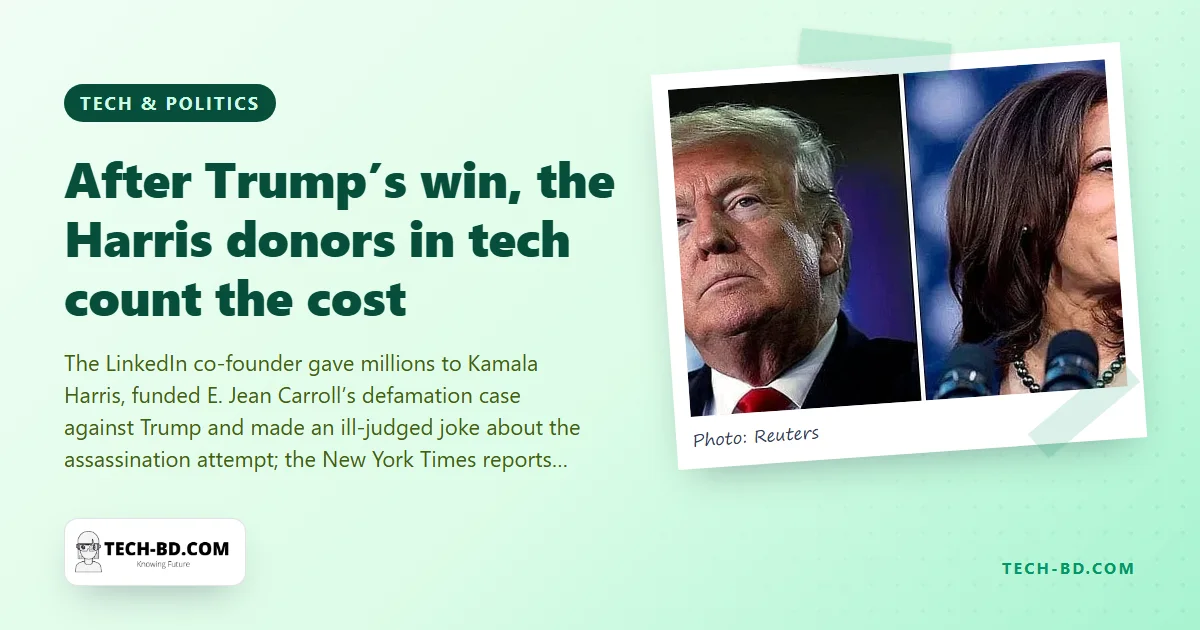
Silicon Valley chose sides in the American election more openly than it ever had, and one side lost. A month after Donald Trump’s victory, the New York Times reports that Reid Hoffman — co-founder of LinkedIn, partner at the venture firm Greylock, and one of the Democratic Party’s largest donors in technology — has told friends he fears the incoming administration will pursue its political enemies and is considering living outside the United States.
Why Hoffman in particular
Hoffman did more than write cheques to Kamala Harris. He helped fund the writer E. Jean Carroll’s defamation lawsuit against Trump, which ended in an $83 million verdict against the former president. After the assassination attempt on Trump in July he told a private gathering that he wished he had made the shooter “a martyr”, a remark he immediately apologised for and which Trump’s allies have repeated since. Trump has promised, in public and often, to go after those he regards as persecutors. Hoffman, on the record, is among the people with most reason to take that literally. He has since said publicly that he is not leaving; the report describes what he told friends in the weeks after the election.
Altman’s different problem
Sam Altman of OpenAI also supported Harris, though far less visibly. His difficulty is not the president but the man beside him. Elon Musk, who co-founded OpenAI with Altman in 2015, left in 2018, and has spent 2024 suing it and building a rival, spent $250 million electing Trump and now has an office in the transition and a mandate to cut the government. An administration in which Musk shapes AI policy is one in which OpenAI’s regulatory life gets harder, and Altman knows it: he congratulated Trump within hours of the result.
Who backed whom
For Harris: Hoffman, Altman, Bill Gates (reportedly $50 million to a supporting group), Vinod Khosla, Mark Cuban and most of the old guard. For Trump: Musk, the venture capitalists Marc Andreessen and Ben Horowitz, Peter Thiel and his network, including the vice-president-elect, and a wave of younger founders. Staying out: Mark Zuckerberg, Jeff Bezos and Sundar Pichai, who all called Trump to congratulate him and whose companies have all since made donations to the inauguration.
Why it matters beyond the Valley
The companies these people run decide what Bangladeshis see on Facebook, which AI models they can use and on what terms, and whether the cloud services the country’s exporters depend on stay open to it. An American administration that rewards friendly companies and punishes hostile ones changes those decisions, and the companies know it — hence the phone calls and the donations. The tech industry spent 2024 learning what every industry in Bangladesh already knows: that the relationship with the government is the business.
Source: Times of India, via Prothom Alo.