Behind today’s numbers is a distribution system that has changed almost completely in a decade, and the change is worth describing on its own — because it is one of the few pieces of digital government in Bangladesh that reaches the entire population of a cohort on a single morning.
What happens at 11am
The minister inaugurates publication at the Secretariat. At that moment the result is released simultaneously online and to institutions — not sent to the boards to be posted, not printed and distributed, but switched on everywhere at once.
Institutions then pull their own full result sheet. The inter-board committee’s instruction is specific: go to the result corner of the board website and download using the board name and the institution’s EIIN, its identification number. That is how a college produces the printed sheet that goes on the noticeboard an hour later.
Students reach the same data three ways: the boards’ common results portal, their own board’s site, or SMS to 16140.
The part that is genuinely well designed
The SMS channel. It needs no internet connection, no smartphone, no electricity beyond what charges a handset, and it works identically on every operator and in every upazila. On a morning when a million people try to load the same website, a text message is the channel that degrades gracefully — it queues rather than failing.
For a country where mobile coverage is near-universal and reliable broadband is not, keeping a plain-SMS route alive in 2026 is a deliberate accessibility decision, not a legacy that nobody removed.
And the part that is fragile
Everything is concentrated into one hour. A results portal is sized for ordinary traffic and then asked to serve an entire cohort simultaneously, which is why these sites are slow or unreachable every single year. That is not a surprise failure; it is a predictable load that could be handled with static pre-rendered pages and a content delivery network, both of which are ordinary technology.
The second fragility is informational. Because the official channels are slow at exactly the moment everyone needs them, search results and social media fill with unofficial result sites — some harvesting roll numbers, some simply wrong. The inter-board committee issues a standing reminder every year that results exist in no physical office anywhere, and it does so precisely because that vacuum gets filled.
What changing the SMS number this year demonstrates
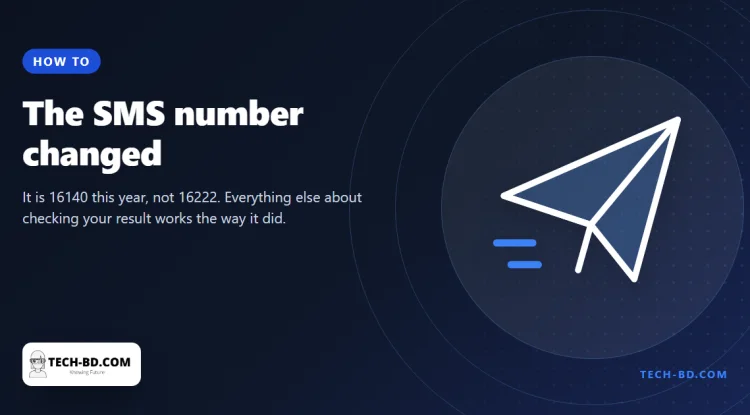
The short code moved from 16222 to 16140, and that single change is a neat illustration of the whole system’s strength and weakness together.
It is centrally administered, so it can be changed cleanly in one place. And it is undocumented at the edges, so a student following last year’s instructions — or a college noticeboard that was not updated, or any of the thousands of web pages still carrying the old number — sends a message that costs money and returns nothing.
One last observation. The whole system now assumes a mobile phone — to receive the SMS, or to load the portal. For the small number of candidates in households without one, the college noticeboard is not a convenience but the only route, which is a good reason for the printed sheet to keep going up even as everything around it moves online.