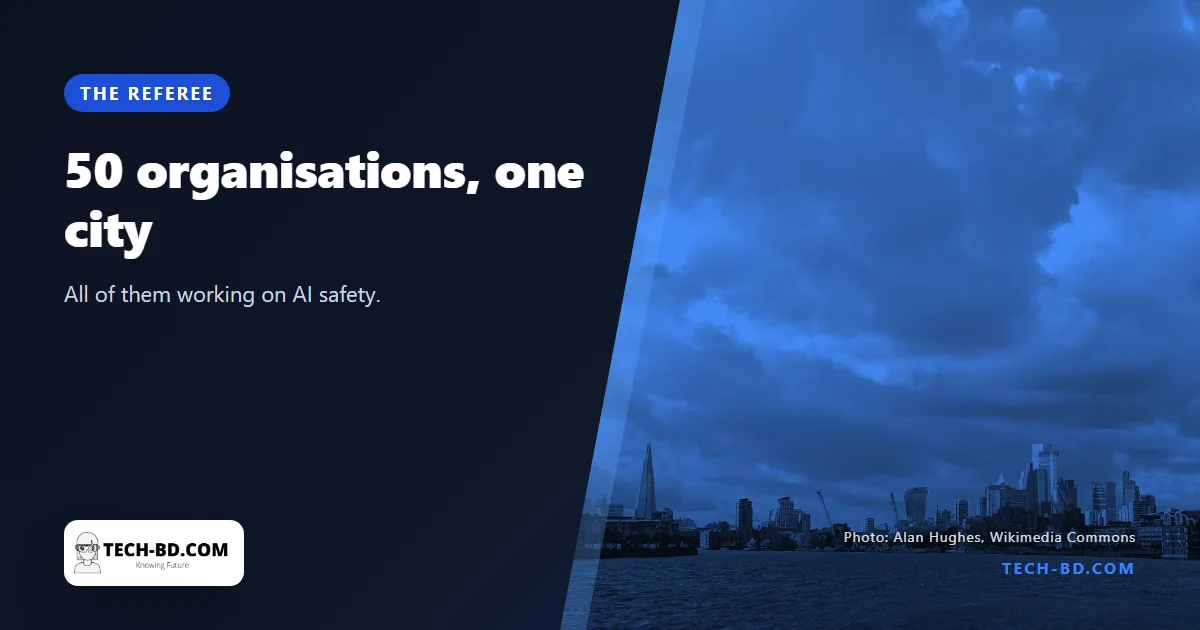
Up to 50 organisations in London now focus on AI safety, according to the London AI Hub, a co-working space and community for AI entrepreneurs.
They include the UK's AI Security Institute (AISI) — described as the first state-backed organisation for assessing leading models before and after release for risks such as cyber misuse — and Apollo Research, which studies whether AI models might act against human interest by lying or cheating.
The London Initiative for Safe AI (LISA), a non-profit that connects people working in the field, is moving to a large headquarters in King's Cross, part of the capital's growing "AI corridor".
What the government is funding
The government has announced fresh investment worth hundreds of millions of pounds in AI safety and security. The stated scope runs from cyber-attacks to the possibility of advanced systems acting beyond human control.
The worry that is growing fastest
One concern increasingly occupying researchers is biology, and it is a genuinely double-edged one.
AI could accelerate the discovery of new medicines and vaccines. The same capability could make it easier to develop harmful pathogens.
In response the government is launching an AI Biosecurity Lab. One of the organisations involved is Basecamp Research, an AI biology company based in a former watch factory in Farringdon, central London.
Working alongside OpenAI and Anthropic, Basecamp Research will help develop antibiotics and vaccines to protect against future pandemics and get "ahead of emerging threats".
Co-founder Oliver Vince believes it will "put the UK at the forefront of the intersection of AI and biology", particularly in defending against harmful pathogens. London, he says, is a key player in AI security because of its "opportunity, culture, history and expertise".
Player, or referee
Rupert Elston of the London AI Hub gives the formulation worth keeping. With up to 50 safety-focused startups clustered in the capital, the city has become "not just a player in the global AI game, but also something of a referee".
"The boundaries are very clearly defined. That creates an environment where people want to come and build, and helps attract talent as well."
That is a real claim and an interesting one: clear rules as a competitive advantage rather than a cost, the argument being that firms prefer to build where they know what is permitted.
The open question
The BBC puts the harder question directly, and it has not been answered: as warnings about the technology's dangers grow louder, will any of this genuinely make a difference on the global stage?
A safety institute can assess a model, but it cannot compel a company based elsewhere to submit one. Fifty organisations in one city is a substantial concentration of expertise, and expertise is not the same thing as jurisdiction. The next few years will test whether being the referee means anything when the players are somewhere else.
There is a reading of this that is more optimistic and probably more accurate. Safety work does not need jurisdiction to matter if the findings are published: a method for detecting that a model is deceiving its evaluator is useful to everyone who runs one, whoever discovered it. On that view the cluster is less a regulator than a research base, and its output travels even where its authority does not.