About 55% of workers in Bangladesh’s private sector now use artificial intelligence in their work — more than half — and almost all of those who do report that it helps.
The figures come from MetLife Bangladesh’s Employee Benefit Trends Study (EBTS) 2026, released on Sunday at the company’s office in Motijheel, Dhaka.
How it was done
The survey was carried out in August 2026 and collected responses from 709 people: 583 full-time employees and 126 employers or people who make the key decisions about staff benefits. Respondents came from the ready-made garment sector, NGOs, banks, fast-moving consumer goods, telecom and retail.
Present at the release were Nowfel Anwar, head of marketing and product, and Saifur Rahman, head of communications, at MetLife Bangladesh.
What the users say
91% of those using AI say it is having a positive effect on their lives. Below that headline the responses are mostly about pressure rather than output:
- 54% say AI tools directly help reduce work-related stress.
- 48% say AI helps increase their overall productivity.
- 46% say the growing use of AI at work keeps them free from overload and frustration.
- 40% say it reduces routine workload and lets them focus on more meaningful and creative work.
- 34% say it reduces mental fatigue and has a positive effect on their personal life too.
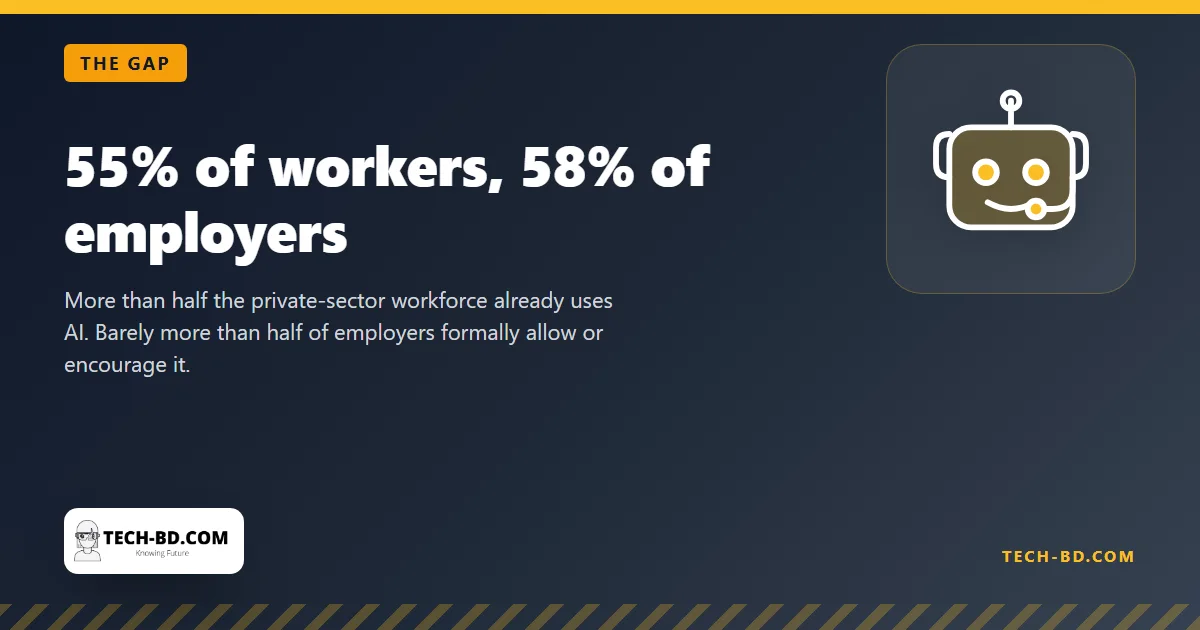
The gap
Workers are comfortable with the tools: 84% of those who use AI daily say they are at ease doing so.
Institutions are slower. Of the employers surveyed, only 58% currently encourage or allow staff to use AI in their day-to-day work.
Put the two numbers side by side and the picture is specific: 55% of staff are using it, and 58% of employers permit it. Those are close enough that the averages hide the problem. In any organisation where the policy has not been written, some share of that 55% is people using AI on work documents without anyone having decided what may be pasted into a third-party system.
Why this is the number to act on
The productivity findings are encouraging but unsurprising — people who chose to adopt a tool tend to report that it helps. The unsanctioned-use finding is the one with consequences, and it is the cheapest thing on this list to fix.
An organisation does not need an AI strategy to tell its staff which categories of information must never leave the building. It needs one page. The survey suggests that in a significant share of Bangladeshi companies, that page does not yet exist — while the usage it would govern is already at 55%.
Three caveats on the numbers
It is self-reported. Everything here is what people say about their own experience, not a measurement of output. "AI reduces my stress" and "AI reduced my stress" are different claims, and a survey cannot separate them.
The sample is not the whole economy. 709 respondents across garments, NGOs, banks, FMCG, telecom and retail is a reasonable spread of the formal private sector — and says nothing about the informal economy, which is where most people in Bangladesh actually work.
Adopters are a selected group. The 91% satisfaction figure describes people who chose to use the tools. Those who tried them and stopped are not in that number.
The one page
If your organisation is in the 42% that has not sanctioned anything, the useful first document is short: what may never be pasted into an external AI service (client data, salary information, anything under an NDA), what may, and who to ask when it is unclear. That is a morning’s work and it converts an invisible risk into a known one.