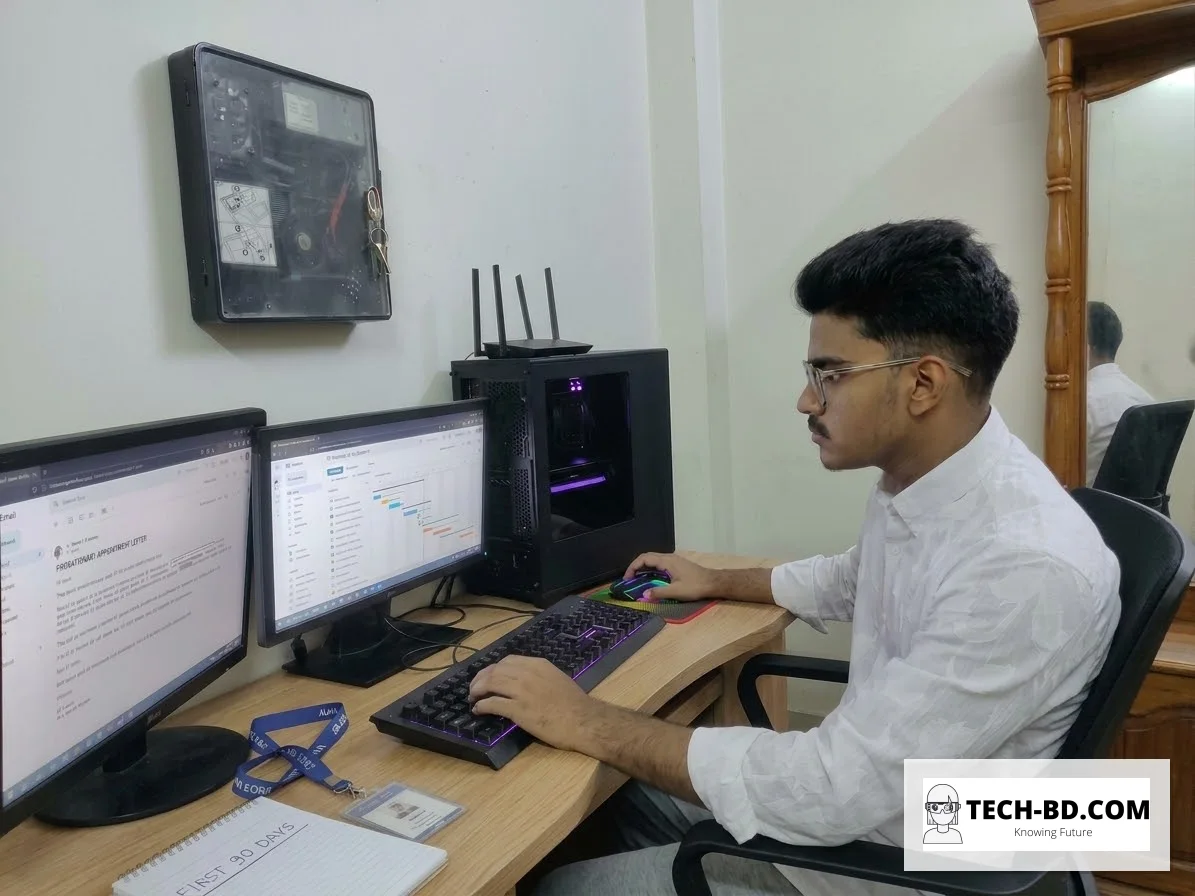
Nurnabi Islam is 19, a first-year chemistry student at Govt. M. M. Ali College in Kagmari, Tangail, and currently living in Gazipur. He is also the developer of DownGo, a download manager for Windows that has been through the Microsoft Store’s certification process five times. Four of those were rejections.
He answered our questions by email and gave permission to publish his name and the photograph above. Photo: Nurnabi Islam — the Tech BD mark on it says where the picture was published, not who owns it.
Where it started
Islam began experimenting with programming in class nine — small bots, chatbots and automation projects in his spare time, learned from online resources, his own trial and error, and AI tools. The interest moved towards Windows software, and on 22 June 2026 he started building DownGo in Python. The idea was unremarkable in the best way: he used download managers himself, and wanted one built the way he would have built it.
“It is possible to do something good in technology without being a computer science student,” he writes, “through regular learning, effort and problem-solving.”
The engine that would not hold
The first real problem was not the interface. Testing with five files, he would often get one to download successfully while the rest failed. Connections to the server would drop partway through, and transfers would die mid-file.
“I understood that building a nice interface would not be enough; making the download engine reliable was essential,” he says. Parallel and multi-threaded downloading and error handling came out of fixing that.
Four rejections, in order
This is the part worth copying down, because every independent Windows developer in Bangladesh will meet some of it.
One. He submitted an EXE and hit packaging problems. Microsoft Support advised MSIX packaging instead.
Two. His first MSIX package carried extra icons and other defects. He fixed those and was rejected again.
Three. The cause of the second rejection turned out to be subtler: he had converted an installer-based EXE into MSIX, and installer behaviour was surviving into the package. He rebuilt as a portable EXE with no installer, then converted that. On the third review, downloads failed after a certain number of files, and the engine crashed during SHA-256 checksum verification. He moved checksum verification into the background, running after a download completes, and improved error handling.
Four. The fourth review found video URLs failing. He added yt-dlp for video downloads and tested for about five days across different situations.
The fifth submission was approved after about five days of waiting. “Failure does not mean the work is impossible,” he says. “You have to find the cause of the problem and improve.”
What AI did, and what it did not
Islam is direct about using AI, and precise about the limits. He used it to find bugs, analyse error messages, understand possible causes and get ideas for implementing features — particularly during the certification failures, where the error reports do not tell you much.
“But I did not finish the work by accepting the solutions AI gave me directly. I changed the code myself, tested it, and improved again according to the result.” And: “AI is not a magic solution for me; it is a tool that increases the speed of learning.”
What it cost: about Tk 1,000
By his own reckoning the whole thing cost roughly Tk 1,000: about Tk 500 for the domain and about Tk 500 for a Chrome Web Store developer account — which exists because DownGo has a browser extension that passes links to the desktop app. The website runs on GitHub, so there is no hosting bill. There was no marketing budget and no company infrastructure.
The obstacle that had nothing to do with code
When he was preparing to publish, Islam did not have a national identity card and had not applied for one. The Microsoft Partner Center account was therefore opened in his father’s name; the Store lists the publisher as Rafix Technologies. He volunteered this without being asked, and draws the distinction himself: the registration identity and the development work are two different things.
It is worth stating the general case plainly. Developer registration on the major stores requires verified identity documents, and a Bangladeshi developer who is under 18, or over 18 but has not yet been issued an NID, cannot register in their own name. The usual workaround is a parent’s account — which works, and which also means the public record of the work does not carry the name of the person who did it.
Marketing is the wall
Asked for the biggest challenge facing an independent developer here, he does not say code. He says reaching users. Facebook and YouTube advertising costs money a student on a limited budget cannot spend, so he is relying on free channels, technology communities and publications that write about software.
By his own count DownGo has passed 200 installs and a second app, Passport Photo Studio Pro, has passed 300. He flags both as his own approximate figures rather than verified numbers, and notes the Store dashboard is where exact statistics live — a caveat worth preserving, since the Store does not publish install counts and we cannot check them. DownGo is free with optional in-app purchases; the website says the free tier supports up to four parallel connections and the Pro tier up to sixteen. The current version is 4.0.26.
What comes next
He wants DownGo more stable and more capable, driven by user feedback, and he intends to keep studying chemistry alongside it. The longer aim is more software, and eventually a sustainable income from products that solve real problems.
There is a version of this story that is purely inspirational, and it would be less useful than the one he actually told. A teenager without a computer science course, without an NID and without a marketing budget got a Windows application through a certification process that rejected him four times — by reading the failure each time and fixing the specific thing it named. That is a method, and it travels further than the encouragement.
Related: freelancing from a Kurigram village on a phone tied to a bamboo pole.