Nvidia has reinstated Jensen Huang as chief executive — days after the board rejected his offer to return, and less than two weeks after he was forced to resign over reports of an affair with a woman suspected of working for Chinese intelligence.
The company had been under pressure from Donald Trump to reappoint him. On Monday the US president said he "made the deal" and "convinced" the board to reverse itself.
What changed, and how fast
Huang resigned on 12 November. It was only last Tuesday that the board stated explicitly it did not intend to bring him back, and the interim management had begun signalling a shift away from his strategy — a more "disciplined and selective" approach to the deals that underwrite the AI build-out.
Board chairman Harvey C Jones said on Monday: "The Board believes Jensen is the right person to lead Nvidia, and that his reinstatement is in the best interests of our stockholders, employees, partners and customers." The board added that it had taken input from senior levels of the US government and was satisfied the reinstatement posed no national security risk.
That reassurance could only have come from the White House. An hour later, Trump confirmed he had spoken to the directors directly.
The market answer
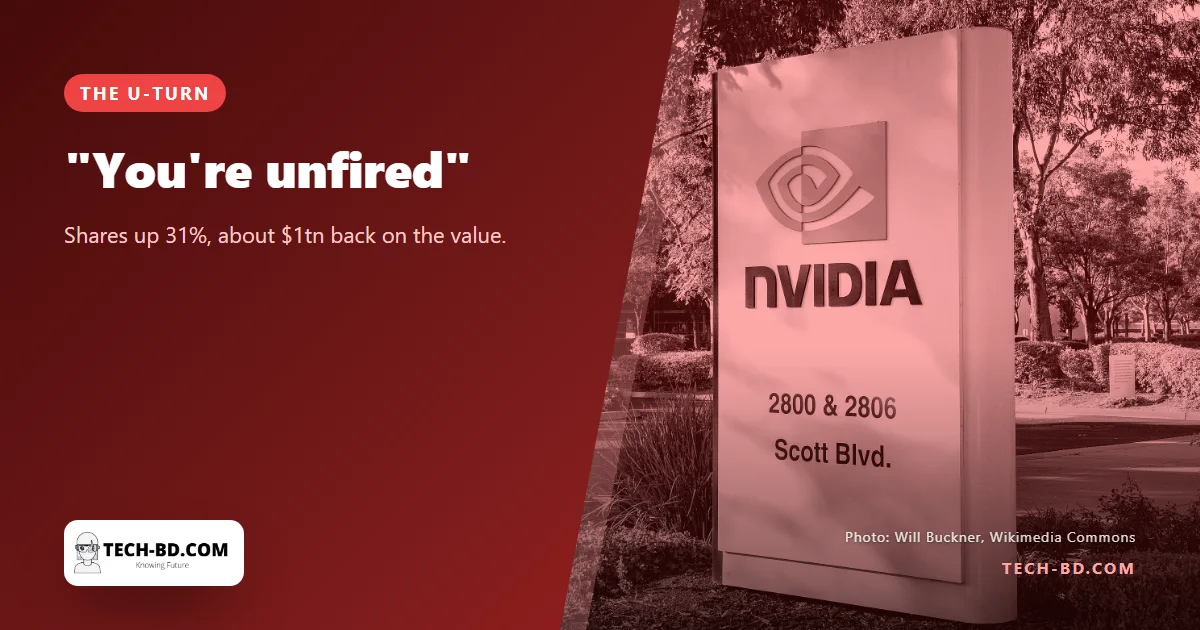
Nvidia's shares jumped 31%, adding roughly $1tn to its market value, and ended a week-long losing streak that had pushed the S&P 500 into correction territory. The closing price was still slightly below where the stock opened on Friday morning.
Asked whether the fall in Nvidia's stock after the resignation had influenced his decision to intervene, Trump said: "Probably so."
"They did ask for assurance on the national security threat," he said. "And we gave them assurances at least with everything we know. And we know a lot." He added: "People say, is it a threat to have him? No, it's a threat to lose him."
Not everyone accepts it
Prof Stuart Russell of UC Berkeley, who heads the International Association for Safe and Ethical AI, told the BBC the board must have been under "enormous pressure" from the White House. Nvidia's share price and those of similar firms have been "underpinning US economic growth for years", he said. "I assume the White House was worried that the markets would go down a lot further in the next few weeks unless they got him back in."
Democrats have accused the administration of trading national security for financial gain. The criticism is not only from one side: Republican congressman Don Bacon of Nebraska said Nvidia "should have moved on without Huang and ignored the administration's inexplicable desire to save Huang. We cannot say we want to win the AI race and then give China our best technology."
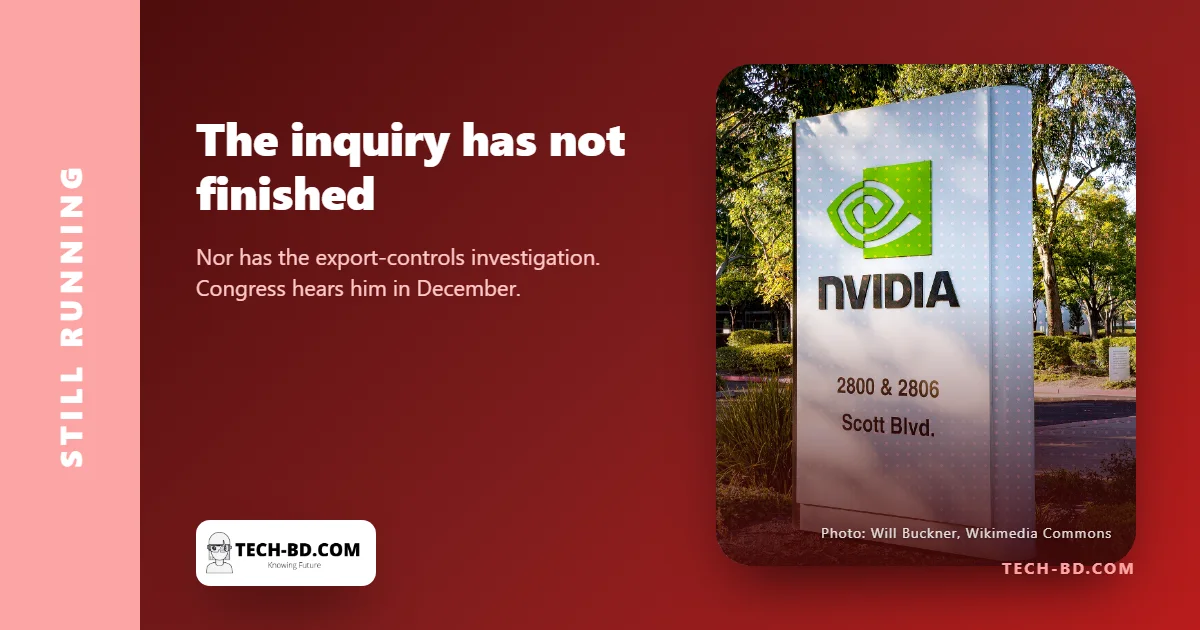
Huang is due to testify before Congress in early December. An independent investigation into the company's compliance with export controls is still running, and the board's own inquiry — into whether Huang was the target of a foreign intelligence operation — had not finished when he was brought back.
Why the scale is hard to overstate
This is a bigger reversal, in pure numbers, than Sam Altman's return to OpenAI or Steve Jobs's to Apple. Nvidia is generating real revenue at a scale that makes the comparison awkward: over $400bn (£305bn) this year, against $27bn four years ago.
Its valuation has also become a financing instrument. A web of loans, guarantees and shareholdings built on Nvidia's share price helps fund data centres elsewhere in the industry. When Huang left, the doubt was not only about one company's leadership — it was about whether that structure holds.
What this means here
Bangladesh does not buy frontier AI chips, but it does buy the services built on them, and prices for those services track the cost and availability of this hardware. The more durable point is the one Russell made: a single company's share price is now load-bearing for a large part of the world economy, and a government intervened to hold it up. That is worth noting whoever you bank with.