
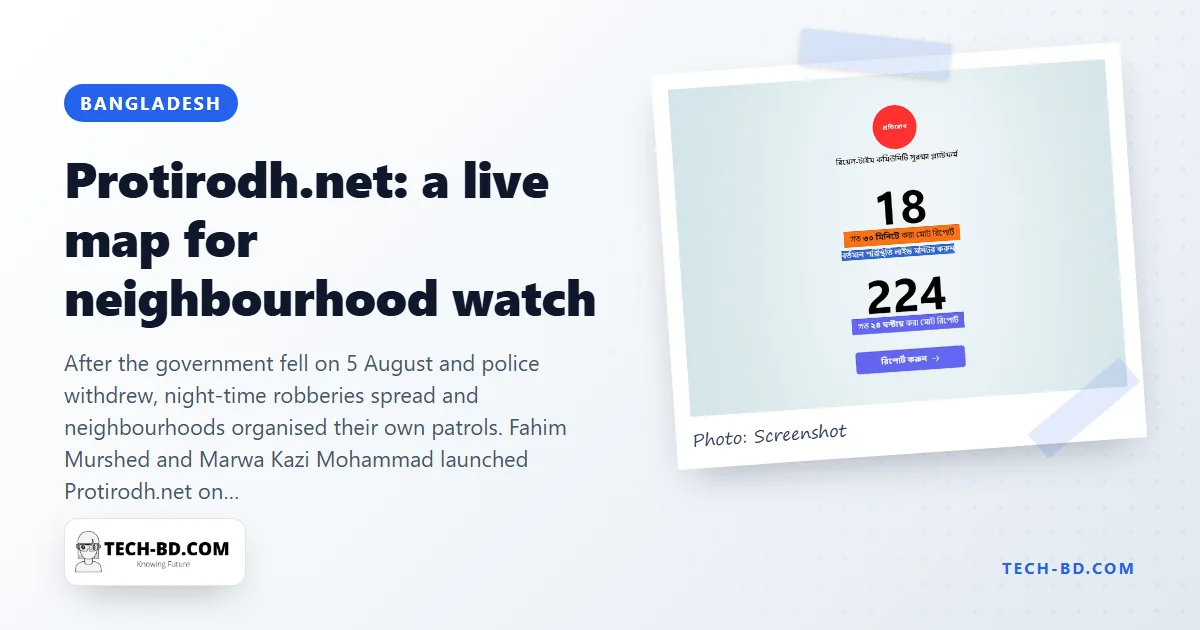
In the days after the Awami League government fell on 5 August, the police left the streets, and for a week the country’s cities had no functioning force. Robberies — most often at night, in groups, targeting homes — spread through Dhaka and beyond. Neighbourhoods responded the way they always have, with young men on the corner with sticks and a whistle. What they lacked was information: which street, how many, where were the nearest volunteers. Protirodh.net — “resistance” — was built to answer that, and it went live on 8 August.
What it does
Open the site and the first thing it shows is a number: how many robbery reports have come in in the last 30 minutes. Tap “monitor the current situation live”, share your location, and a Google Map appears with incidents near you, so people in the area can gather and go. Anyone can file a report in a few clicks — six categories of crime, the reporter’s location pinned automatically, photos and video attached. Reports are graded: alerts, marked orange, for suspicious activity, and incidents, marked red, for attacks in progress. Others can comment on a report, which is how a false alarm gets flagged and a real one gets confirmed. A 24-hour view shows everything filed in the past day.
The numbers
By Monday, four days in, the site had received more than 3,500 reports and had been viewed more than 350,000 times on 8 and 9 August alone — extraordinary for a project with no advertising, spread entirely by Facebook shares.
Who built it
Fahim Murshed and Marwa Kazi Mohammad are both graduates of Dhaka University’s Organisation Strategy and Leadership department; Fahim is now tech lead at Co-Design, a software company, and Marwa is a management trainee at a mobile operator. “At the start we saw a lot of local work but no coordination,” Fahim said. “There was plenty of information on Facebook. We are collecting all of it through one website.” Marwa lives in Banani, where residents were already standing guard in separate groups each night: “Everyone started working separately. We are trying to bring everyone together through this site.”
What it borrows, and what comes next
The design will be familiar to anyone who knows Ushahidi, the Kenyan platform built to map violence after the 2007 election and used since for earthquakes and floods worldwide: crowd reports, a map, colour-coded severity, comments as verification. Protirodh’s contribution is speed — the 30-minute counter — and the fact that it was built and adopted inside a week by the people who needed it. The founders intend to keep it running after the crisis for violence against women, street muggings and theft, coordinating the same volunteers against ordinary crime. Whether a platform born in an emergency survives normal times is the usual civic-tech question; for now it is the most useful website in the country.