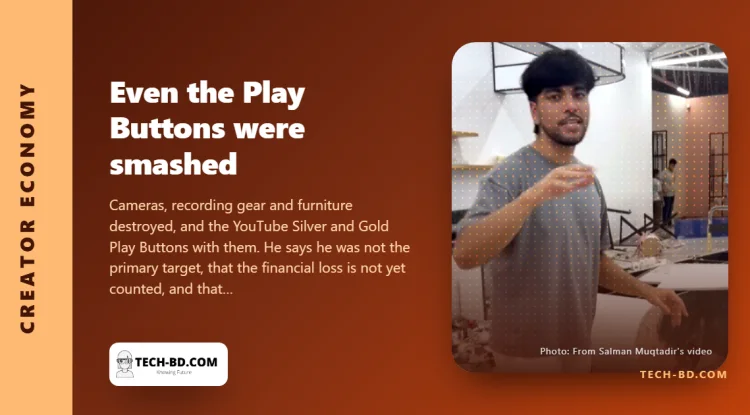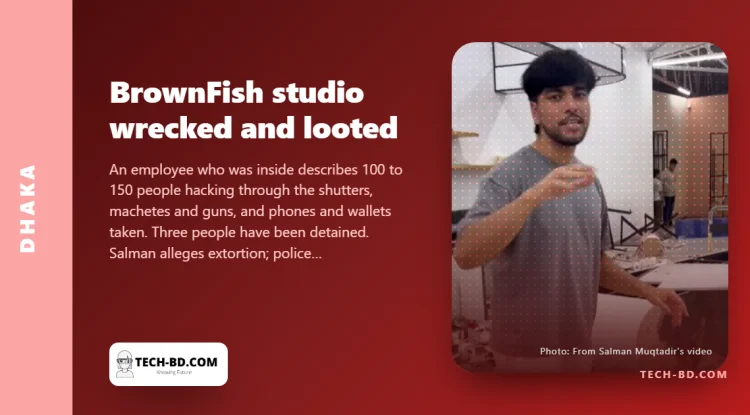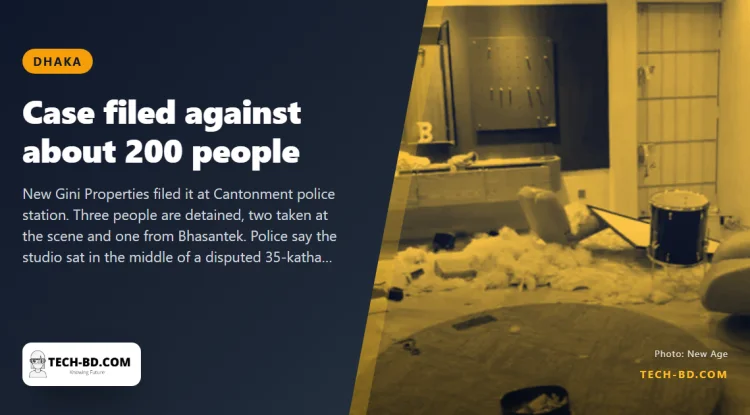
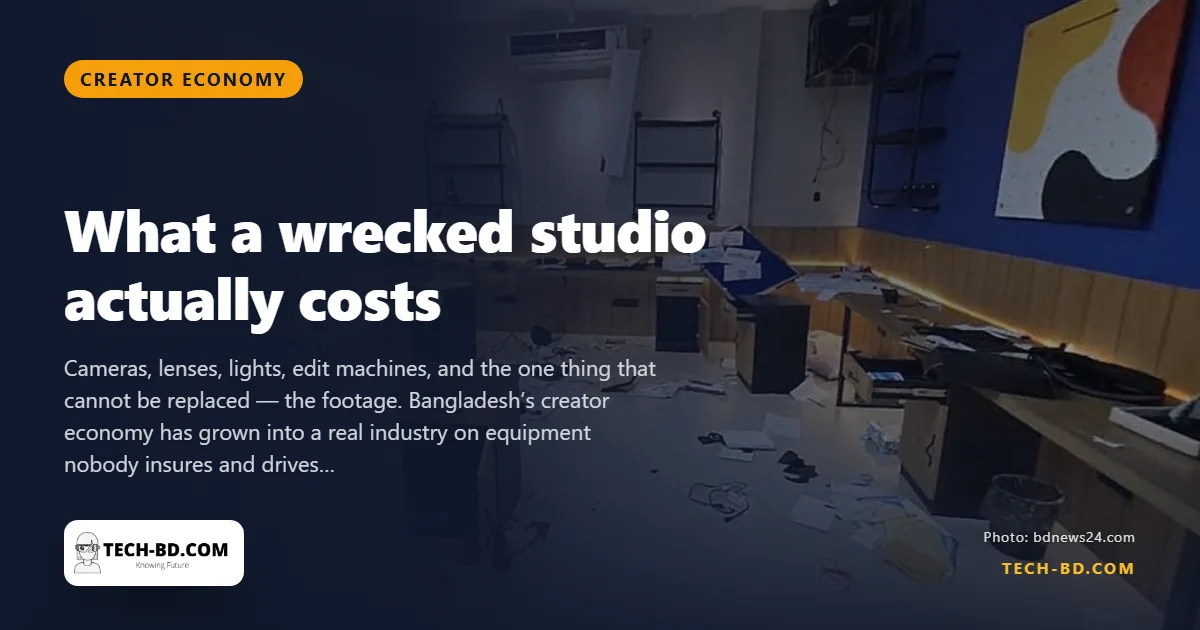
The video from BrownFish shows broken chairs and tables, a smashed television, equipment across the floor and staff in tears. It is worth being precise about what a night like that actually destroys, because the furniture is the cheapest thing in the frame.
The bill nobody itemises
A working production studio in Dhaka holds a surprising amount of value in a small space. A mirrorless body and two or three lenses. Lights, stands and modifiers. Audio — lavaliers, a boom, a recorder. A machine fast enough to edit on, and the monitors in front of it. Stands, gimbals, batteries, cards, cables. None of it is exotic, and together it runs to many lakhs of taka, most of it imported and most of it bought over years rather than at once.
Then there is the part that has no price, because it cannot be bought again: the footage. Raw takes, unfinished edits, project files, archive from shoots that cannot be repeated. If that lived on the machines in the room and the drives beside them, it is gone with them.
And there is the part nobody counts at all: a production schedule with commitments on it. A brand deal with a delivery date does not pause because the studio did.
Why creators here carry all of it themselves
In most industries this is what insurance is for. In Bangladesh's creator economy it effectively does not exist. General insurers here write policies for factories, shops, vehicles and cargo — not for a production studio's kit, and certainly not for business interruption at a channel. A creator who asks for cover usually finds either no product, or a premium priced as if the risk were unknowable, which from the underwriter's side it is, because nobody has the loss data.
The tenancy is the second gap. A lot of studios run out of rented structures on someone else's plot, on an informal arrangement — which is exactly the situation at the centre of this case, where the police account is a dispute over the property the studio happened to sit on. A creator with no registered lease has a weak claim to anything afterwards.
What is actually worth doing this week
- Get the footage off the premises. One drive in the studio is not a backup. Cloud storage for finished work, and a second physical drive that lives somewhere else entirely — a family home, another office. This is the only loss on the list that is permanent.
- Photograph and list the equipment with serial numbers and purchase receipts, and keep that list off-site too. Without it there is no claim, no police complaint with specifics, and no way to prove what was in the room.
- Put the tenancy in writing and register it. An unregistered arrangement is worth very little when the ownership of the land underneath is contested.
- Ask your insurer anyway. Some general insurers will write an all-risk policy against an itemised equipment schedule, even without a creator-specific product. The market will not build one until creators ask often enough to look like a market.
- Separate the business from the person. Registering the studio, keeping its accounts and holding its contracts in the company's name is what makes any of the above enforceable.
The wider point
Bangladesh's creator economy is no longer a novelty. It employs editors, camera operators, writers, production assistants and managers, and it earns in foreign currency. But it has grown up outside the structures that protect every other business of that size — no standard contracts, no sector insurance, no registry, and very little recourse when something goes wrong. We saw a version of this in the supplier paperwork behind the Foodpanda dispute, and again when platforms went after creators over engagement: the people doing the work carry risks that, in a mature industry, somebody else would be holding.