
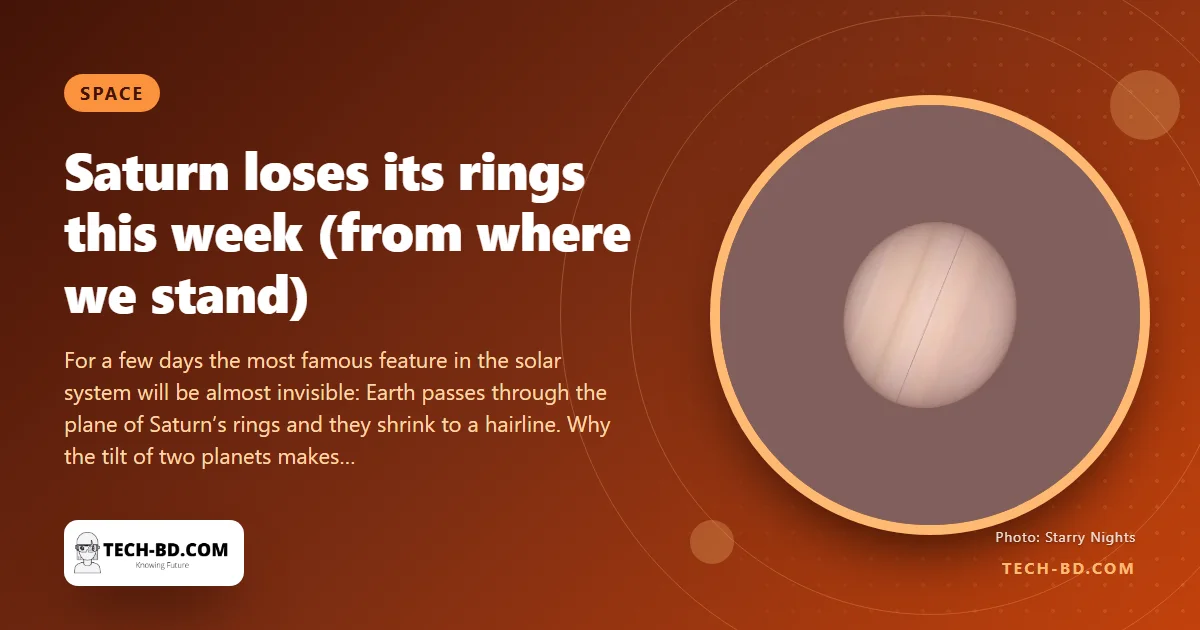
On 23 March 2025, at 16:04 UTC, Earth passed through the plane of Saturn's rings and they effectively disappeared from view. The next crossing visible from Earth is in 2038.
Most accounts stopped at "the rings vanish". The interesting parts are why that happens, and why almost nobody got to see it.
The geometry
Saturn's rings are extraordinarily wide and extraordinarily thin. They span roughly 170,000 miles and are only about 30 feet thick.
Put those numbers side by side and the disappearance stops being mysterious. The ratio is comparable to a sheet of paper several kilometres across. Viewed face-on it is an enormous bright surface; turned edge-on it presents almost no area at all, reflects almost no light, and vanishes against the glare of the planet.
Saturn is tilted about 26.7 degrees relative to its orbit, and that tilt stays fixed in space as the planet takes 29 and a half years to go round the Sun. Twice per orbit, Earth crosses the plane the rings sit in — which is why the event recurs every 13 to 16 years rather than on a neat schedule.
Why hardly anyone saw it
The coverage mostly left this out, and it explains why the event was a non-event for observers.
The crossing is determined by orbital geometry, not by convenience. In March 2025 Saturn happened to be positioned very close to the Sun from Earth's point of view, sitting low on the eastern horizon in morning twilight. A planet that low, in a brightening sky, is a difficult target even without asking anyone to detect the absence of a feature.
So an event that sounds spectacular was, for practical purposes, unobservable — a reminder that astronomical significance and visibility are independent of each other, and that announcements of rare sky events are worth checking against where the object actually is.
What it is good for
Ring plane crossings are genuinely useful to astronomers, for a reason that inverts the disappointment.
With the rings edge-on and reflecting almost nothing, the thing that normally dominates the view is removed. Faint objects close to Saturn — small moons, and the dim outer ring material — become far easier to detect against the reduced glare. Several Saturnian moons were discovered during past crossings for exactly this reason.
The rings being briefly invisible is, in other words, the observing opportunity rather than the loss.
What to do with the next one
The 2038 crossing is far enough off to be useless as a plan, but the rings do not switch between visible and invisible overnight. The tilt changes continuously, which means the years around a crossing offer progressively narrower rings and the years after it open them up again.
For anyone with a small telescope, that makes the period after a crossing the better one: the rings reopen, the shadow they cast on the planet becomes more pronounced, and Saturn returns to being the object that converts more people into amateur astronomers than anything else in the sky.
Sources: EarthSky; Smithsonian Magazine; Sky at Night Magazine; Astronomy Now; and Prothom Alo's original report.