A CNN reporter opened the Siri app on her iPhone last weekend and found a summary of a private conversation with her husband. The summary was expected — she had turned the feature on. What was not expected was that it had got a key health-related detail wrong.
What Siri Recap is
Siri Recap is a new Apple Watch feature that, with permission, passively monitors conversations and produces high-level summaries. The idea is an assistant that notes the things you forget from a meeting, a lecture or a chat — an action item, a recommendation from a friend.
It is part of Apple's push to make its products more personal with AI, an ambition that started badly after repeated Siri delays, and it puts the company in a race with rivals building assistants that understand users' daily lives on and offline.

The privacy design, which is the interesting part
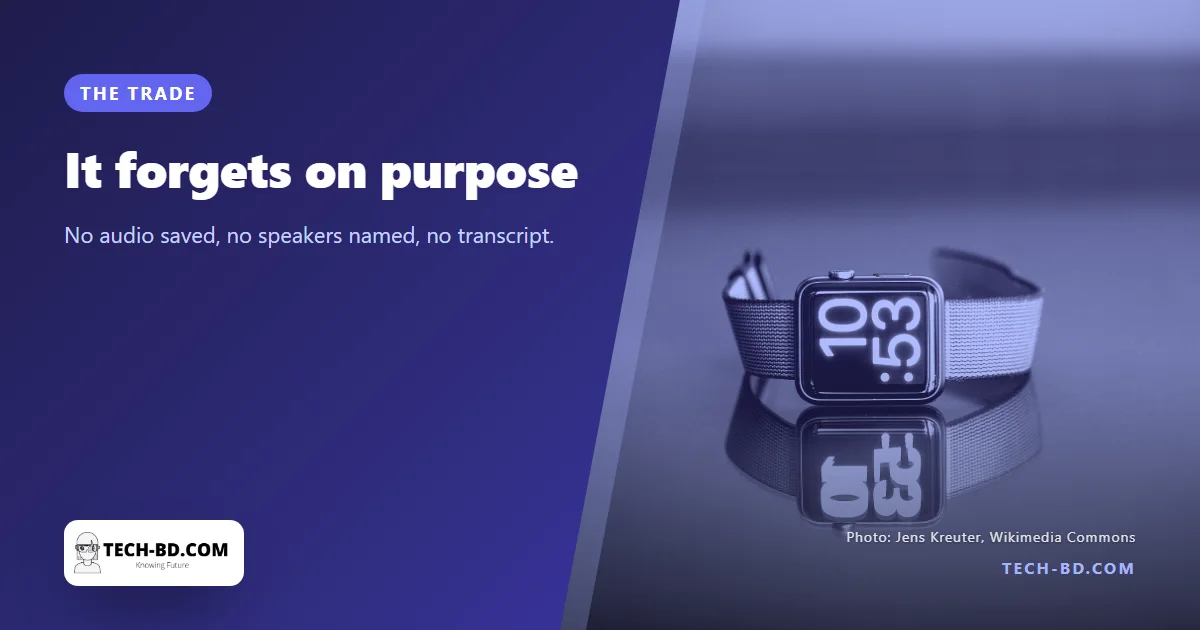
Apple is trying to avoid the privacy problems its rivals have run into. Siri Recap does not record or save audio, does not identify who is speaking, and does not produce a full transcript.
Mechanically: the Watch captures audio in a secure section of its own processor, kept separate from other computing. That audio goes to the iPhone, which also keeps it separate, and is turned into a condensed text version. The shortened text — not the audio — is sent to Apple's cloud to be summarised. The audio is discarded before it leaves the phone and is never saved, Apple says.
Some experts still object, on the grounds that capturing audio at all is worrying even when none of it is stored.
Where it runs
Siri Recap is in beta, still being updated, with no date announced for a wider launch. It works on the Apple Watch Series 12 and Ultra 4, paired with an iPhone 16 or later — not including the iPhone 16e.
The trade-off is structural, not a bug
CNN's finding is that the summaries are less useful than those from other AI tools, and the reason is the privacy design rather than a failure of it. A system that discards the audio, never identifies the speaker and summarises a compressed paraphrase has, by construction, less to work with than one that keeps the recording.
Which means the wrong health detail is not simply a bug to be fixed in the next beta. It is the shape of the compromise: Apple has chosen to know less, and a system that knows less will be wrong more often. The question each person has to answer is whether a summary they must verify is worth more than no summary at all.
There is a second question the privacy design does not answer, and it is the one that will decide how these features are received. Siri Recap takes the wearer's consent. It does not take the consent of whoever the wearer is talking to, who has no way of knowing a summary is being made and no setting to object. Apple can fairly say nothing is recorded and nobody is identified. It cannot say the other person agreed, because there is no mechanism by which they could.
For anything that matters — a dose, a date, a figure — the honest reading of this test is that the feature is a prompt to remember, not a record to rely on.