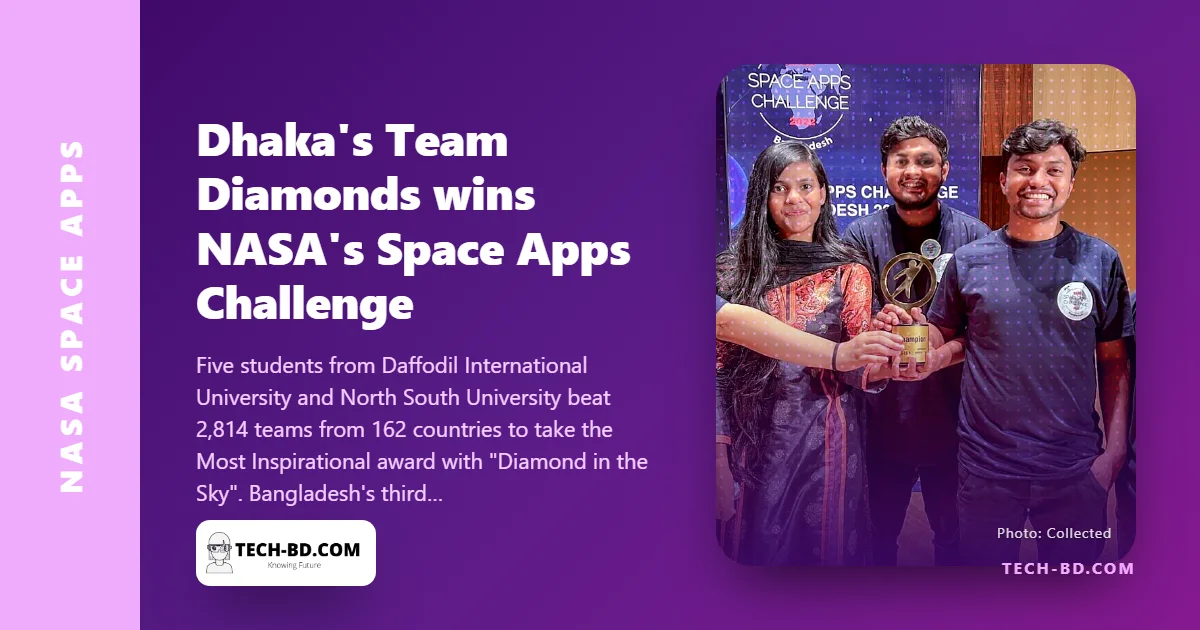
NASA announced the ten global winners of its 2022 Space Apps Challenge, the largest hackathon in the world, in a broadcast on Facebook, Twitter and YouTube on Friday, 9 December 2022, Bangladesh time, and one of the ten was from Dhaka. Team Diamonds won the Most Inspirational category with "Diamond in the Sky", an interactive game that teaches children the mysteries of space by letting them play through them.
The team
Tisha Khandaker led the team; Injamamul Haque, Munim Ahmed and Abu Niaz are, like her, students of Daffodil International University, and Zareen Chowdhury studies at North South University. They built their entry in the 48-hour Bangladesh round in September, organised by the Bangladesh Association of Software and Information Services, which sent the 18 best local projects on to NASA. From 2,814 teams in 162 countries, NASA's judges picked 35 global finalists and then a winner in each of ten categories.
What Space Apps is
Every October NASA publishes a set of challenges built on its open data, from tracking wildfires with satellite imagery to visualising the sounds of the solar system, and teams anywhere in the world have a weekend to build something. The prize is not money but a trip to a NASA launch, and the reputation. The competition rewards a working prototype, a clear story and the use of real NASA data; polish counts, and so does the answer to "who is this for?" Diamond in the Sky answered that plainly: children.
Bangladesh's record
This is not a first. Team Olik from Shahjalal University won the Best Use of Data award in 2018 with a project on planetary data, and Bangladeshi teams have been global finalists several times since; the local round, run by BASIS since 2014, routinely draws thousands of participants across university campuses. A country with no space agency to speak of has become one of the more reliable sources of Space Apps winners, largely because the hackathon plays to what Bangladeshi computer science students already do well: build fast, present well, and compete.
Why it matters
For the five students the prize is a line on the CV that opens doors abroad. For the country it is a data point in the argument the ICT industry keeps making to foreign clients: that the talent is here. And for the children who will play the game, it is a lesson in the sky from people who grew up under the same one.