
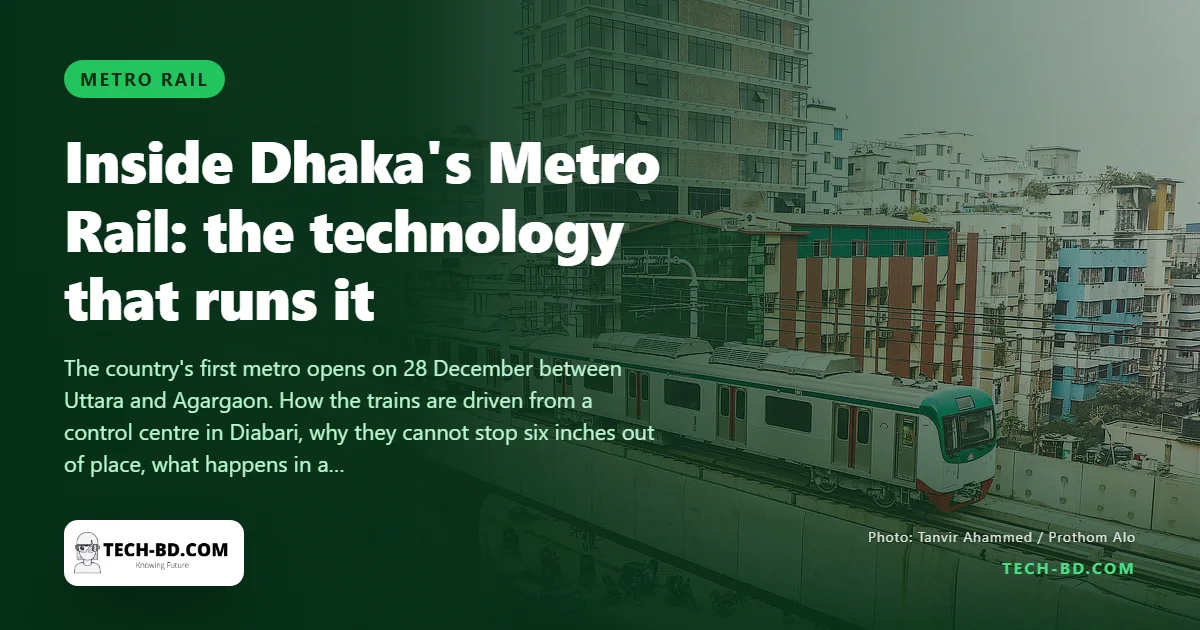
On 28 December 2022 the first metro train in Bangladesh carries passengers from Uttara to Agargaon, and with it come several firsts: the country's first fully electric train, its first train run automatically from a control room rather than by a driver's judgement, and its first fully computerised ticketing. Here is how the machine works.
Driven from Diabari
At the depot in Uttara's Diabari sits the Operations Control Centre. Every train's stops, dwell times and speeds along the line are programmed there in advance. Radio antennas stand every 200 to 300 metres along the track and each train carries four, so the train and the control centre are in constant contact. The result is precision no human driver could hold: a train must stop within six inches of its mark at every station, because the platform's screen doors and the train's doors must line up. There is still an operator in the cab and a controller at each station, but their job is to watch that the instructions are being followed. If safety cannot be confirmed, or there is an obstacle on the line, the train stops itself. The software also keeps the gap between trains, which will run every five minutes at full service.
The line and the trains
MRT Line-6 runs 20.10 kilometres from Uttara to Motijheel with 16 stations; the first section to open, Uttara to Agargaon, has nine. The project costs about Tk 33,500 crore, financed largely by Japan's JICA, and is built and operated by Dhaka Mass Transit Company Limited. Each train, designed and built by Japan's Kawasaki-Mitsubishi consortium, has six air-conditioned coaches: two trailer cars at the ends with the cabs and 48 seats each, and four motor cars with 54 seats each, 306 seated in all and up to 2,308 passengers standing and sitting. Coaches are nine and a half feet wide with four doors a side, wheelchair spaces in the end cars, and audio-visual announcements of the next stop. Top speed is 100 km/h. Each train passed 19 kinds of test at the depot, then trial runs to Pallabi and Agargaon at full commercial speeds and rules.
Power that does not fail
The Uttara-Agargaon section needs about 17 MW. It has its own substation at the depot, with a second under construction at Motijheel; each has two transformers, one live and one on standby, so a local outage does not stop the trains. If the national grid itself collapses, as it did in October, batteries carry every moving train to the nearest station.
How you ride
Stations are three storeys: lifts, escalators and stairs from the road to a concourse on the second floor with ticket machines and offices, and platforms on the third, which only ticket holders can reach. A fence along the platform edge opens in sync with the train doors and closes automatically. There are two tickets. The MRT Pass, a weekly, monthly or family smart card bought in advance and topped up at station machines, later from anywhere like a phone recharge, is tapped at the gate to enter and again to leave; without the second tap the gate does not open. The single-journey card is bought at the station for a specific destination and taken back by the exit gate; travel further than you paid for and the gate refuses until the difference is paid to staff. Fares run from Tk 20 minimum to Tk 60 for the full Uttara-Agargaon trip.