Global Brand PLC is selling a solar-powered surveillance camera in Bangladesh that is designed to run without mains electricity or Wi-Fi: the Tiandy TC-H363N 9dB-4 4G.
The intended places are the ones where a socket is the problem — homes without reliable supply, farms, buildings under construction, warehouses and other sites that need watching continuously.
Power, which is the point
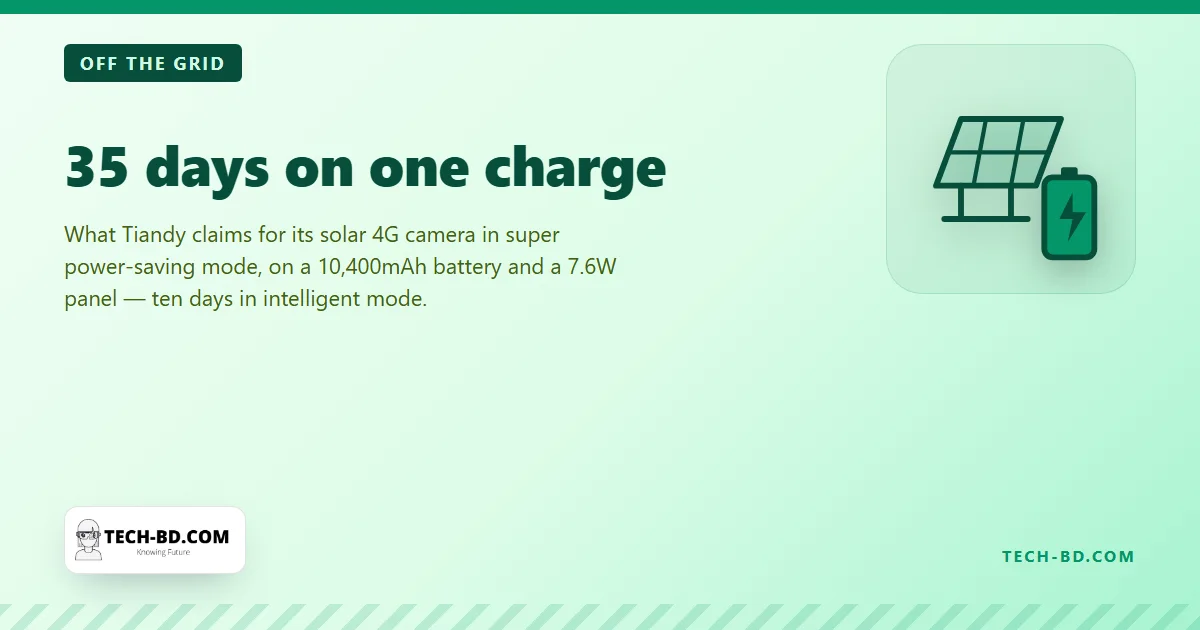
The camera carries a 10,400mAh battery charged by a 7.6W ETFE solar panel. Tiandy claims up to 35 days on a charge in super power-saving mode, and up to 10 days in intelligent AV mode.
Those two figures are three and a half times apart, which tells you how much the claim depends on the mode. The 35-day number is the one that will be printed on the box; the 10-day number is closer to what a camera doing useful work will deliver.
What it can see and do
There are two 3-megapixel lenses, one fixed and one covering the surrounding view. It offers digital zoom and auto-tracking, and can distinguish people and vehicles from other movement — which matters mainly because it is what keeps a battery-powered camera from waking up for every passing bird.
There is infrared night vision, a built-in microphone and a two-way speaker, so someone watching remotely can speak through it. Recording goes to a microSD card of up to 256GB. Purchase includes one year of after-sales service.
The source lists two video compression formats whose Bengali transliteration is garbled; they are almost certainly H.265 and H.264, but we have not been able to confirm that from the announcement, so treat it as likely rather than established.
The cost that is not in the announcement
Two things are missing, and one of them is the price — it does not appear in the release at all. Anyone shopping on this should ask for it directly.
The second is more interesting. "Works without electricity or Wi-Fi" is accurate but incomplete, because the model name ends in 4G. A camera that sends video over a mobile network needs a SIM and a data plan, and the announcement does not explain how that connection is provided or what it costs to keep running.
For a camera watching a remote field or a warehouse, that monthly data cost is a real part of the total, and it continues for as long as the camera does. Video is not a light payload. The solar panel solves the electricity bill; it does nothing about the data bill.
None of which makes it a bad product. For a site with no power and no broadband, a camera that runs on sunlight and a mobile signal solves a problem that otherwise needs a trench and a contractor. It is simply worth knowing the full running cost before the panel is bolted to the wall.
What 3 megapixels actually buys you
Resolution is the specification most often misread on a security camera. Three megapixels is enough to see that a person is there, what they are wearing and which way they went. It is frequently not enough to identify a face at twenty metres, or to read a number plate at an angle, which is what people assume they are buying.
That is a limitation of physics and lens placement more than of this particular model, and it argues for mounting the camera where people pass close to it — a gate, a doorway, the mouth of a yard — rather than high on a wall overlooking a wide area.
One more practical point: a camera that needs sunlight needs the panel kept clear. Dust in the dry season and leaf litter in the wet will both cut charging well before the battery is at fault.