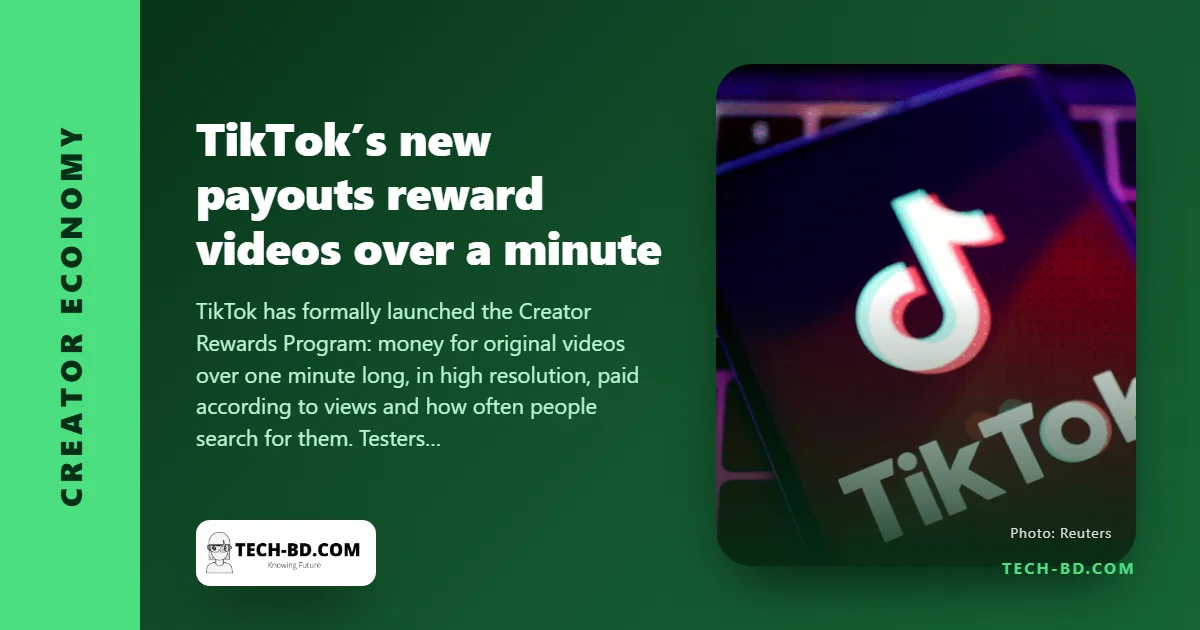
TikTok became the biggest thing in media by making fifteen-second videos irresistible. It now wants the people who make them to slow down. The Creator Rewards Program, formally launched this week after months of testing, pays creators for videos longer than one minute — and only those.
What it pays for
To earn, a video must be original, over sixty seconds, and in high resolution; the payout is calculated from how many people watch it and how much of that audience arrives through search, which TikTok now treats as a signal of lasting value. During the test phase, run in the United States and several other countries with invited creators, participants’ earnings rose by as much as 250 times compared with the old scheme, the company says — a figure that mostly reveals how little the old scheme paid. That scheme, the Creator Fund launched in 2020, was closed in November after years of complaints that a video with millions of views brought in a few dollars.
Why TikTok wants long videos
Three reasons, none of them about art. Longer videos carry more advertising, and mid-roll ads on a three-minute video are worth far more than a single pre-roll on a clip. Longer videos keep people in the app, which is the number TikTok reports to investors. And longer videos are what YouTube has and TikTok did not — the platform is chasing YouTube’s creators just as YouTube chased TikTok’s with Shorts. Creators are divided: those who built audiences on quick cuts see the incentive as a demand to become something else.
Who can join
The programme requires 10,000 followers, 100,000 video views in the past 30 days, an account in good standing, and residence in a supported country. That last item is the one that matters here: Bangladesh is not on the list, as it was not for the Creator Fund. Bangladeshi TikTokers — and there are millions, some with audiences larger than any local television programme — earn through live-stream gifts, brand deals and cross-posting to Facebook and YouTube, where monetisation does reach them.
What it signals anyway
The direction is worth noting even for those who cannot yet be paid. Every major platform is now rewarding longer, searchable, original video and punishing reposts and clips; the creator who builds a library of one-to-three-minute pieces that people look for by name is positioning for the moment the payouts open, and for YouTube today. TikTok has not said when more countries will be added.
Why the money per view is smaller than it sounds
Payout programmes are advertised as a rate per thousand views, and the rate is not the number that determines your income.
What a platform actually pays for is advertising it can sell against your video, divided by the views. A minute of watch time holds one or two ad slots; fifteen seconds holds none. That is the whole reason the threshold is a minute, and it also explains why the rate varies so widely between countries: an advertiser in Dhaka pays a fraction of what one in Toronto pays for the same thousand viewers, so the same video earns a fraction.
What paying for watch time does to what gets made
The second-order effect is the one worth watching. Pay by the second and videos get longer than their content justifies: the forty-second idea padded to sixty-five, the recap at the start, the question answered at the end. YouTube went through exactly this, and the ten-minute video that should have been four is its legacy.
For a creator, the honest version of the incentive is to find subjects that genuinely need a minute, rather than to stretch the ones that do not. The audience notices the padding long before the algorithm does.
Source: Mashable, via Prothom Alo.