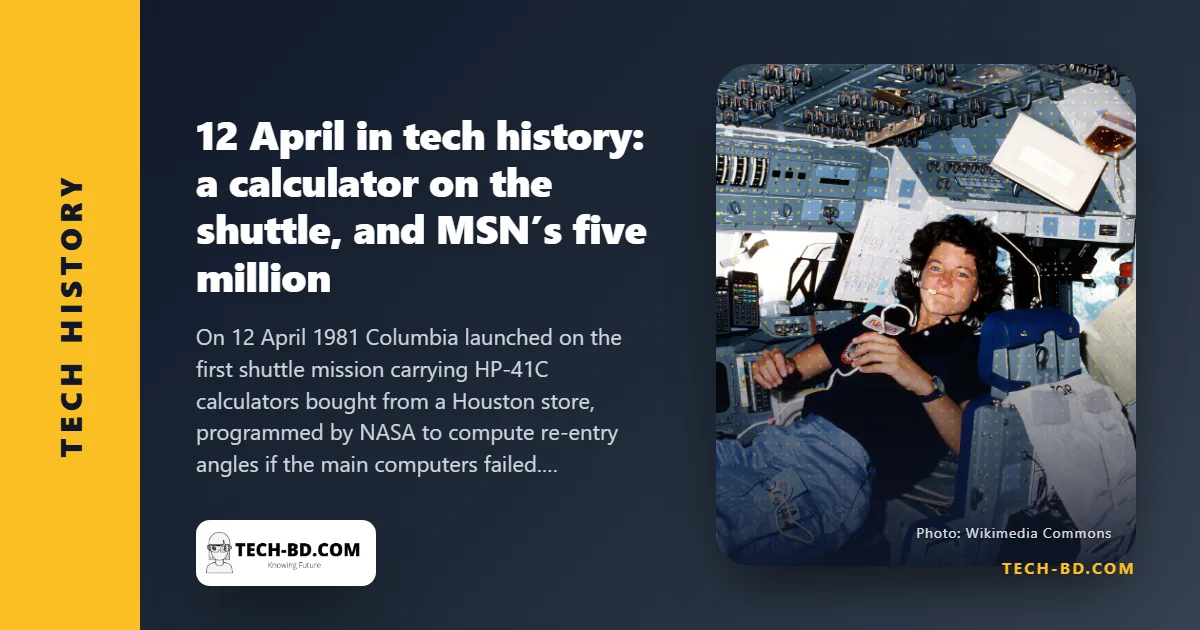
12 April is space’s own date — Yuri Gagarin became the first human in orbit on 12 April 1961 — and exactly twenty years later NASA chose it for the first flight of the space shuttle. On board Columbia that morning, alongside the most advanced flight computers ever built, was something you could buy in a shop.
1981: a calculator goes to orbit
The HP-41C was Hewlett-Packard’s programmable pocket calculator, sold from 1979 to 1990. NASA bought its units from a local store in Houston, and for each mission loaded them with custom software. Their most important job was the arithmetic of coming home: computing the precise angle at which the orbiter should re-enter the atmosphere. If the shuttle’s main computers failed, the astronauts could work out the re-entry from the calculator in their hands. The HP-41C flew on nine shuttle missions through the 1980s, and it was not decorative. During STS-1 the crew used it to time the firing of the engines that brought them back to Earth.
There is a lesson in that for anyone who assumes space runs only on bespoke hardware. NASA’s flight computers were slow, expensive and certified over years; the calculator was fast to program, cheap to replace and understood by every engineer in the building. The pattern repeats today, with off-the-shelf laptops and phones on the International Space Station doing work that once required custom consoles.
2001: MSN reaches five million
On 12 April 2001 Microsoft announced that MSN Internet Access, its dial-up service in the United States, had passed five million subscribers. It credited retail partners Radio Shack and Best Buy, and a distribution deal with Dell that put MSN sign-up on new PCs — the era when getting online meant a CD, a modem and a monthly fee, and when Microsoft was still trying to beat AOL at being the front door to the internet. It never did; broadband and the browser made the dial-up portal irrelevant within a few years, and MSN survives as a news homepage.
The Bangladesh footnote
In 2001, when MSN was counting five million American subscribers, Bangladesh had roughly 100,000 internet users, nearly all on dial-up through a handful of Dhaka ISPs, paying by the minute. The submarine cable that changed that arrived in 2006. The HP-41C, meanwhile, remains a collector’s item, and working units still sell for more than they did new.