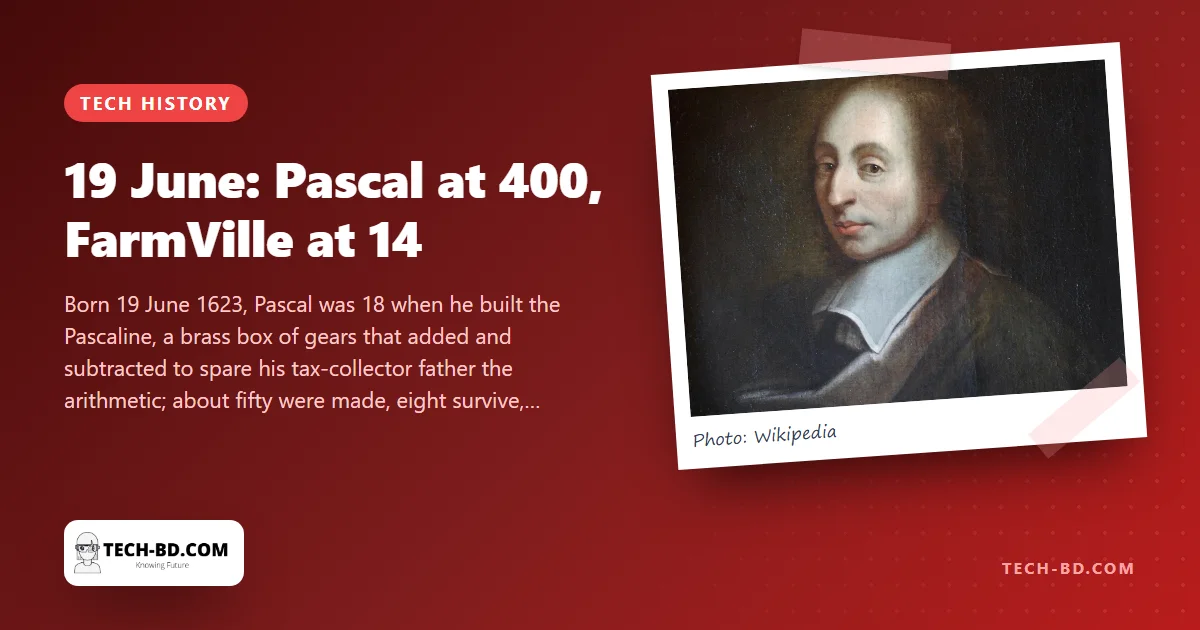
Four hundred years ago today, on 19 June 1623, Blaise Pascal was born in Clermont-Ferrand, France. He lived only 39 years and in them produced the theory of probability, the hydraulic press, the syringe, a proof of the vacuum, a philosophy that is still read, and — the reason he belongs on a technology site — the first working mechanical calculator.
The Pascaline
His father, Étienne, was a tax commissioner in Rouen, and the job in the 1640s was arithmetic: columns of sums in livres, sous and deniers, done by hand and checked by hand. In 1642, aged 18, Pascal built him a machine. The Pascaline is a brass box the size of a shoebox with a row of numbered dials on top; turn a dial with a stylus to enter a digit, and a mechanism of gears carries the tens automatically, so that the sum appears in small windows above. It added and subtracted directly and could multiply by repeated addition. He spent the next decade refining it and built about twenty himself; some fifty were made in all, and eight survive, four in the Musée des Arts et Métiers in Paris and two in the Zwinger in Dresden. It was too expensive to sell in numbers — a status object for the rich rather than a tool — but the carry mechanism it introduced was the idea that Leibniz, Babbage and every adding machine until the electronic era built on.
19 June 2009: FarmVille
On the same date in 2009 the developer Zynga released FarmVille on Facebook: plough fields, plant crops, buy tractors, raise cows, and come back tomorrow because the strawberries will have withered if you don’t. It was free, ran in Flash, and sold “Farm Cash” for real money — one of the first mass-market freemium games. It became Facebook’s most-played game within weeks and stayed number one for more than two years; at its peak in March 2010 it had 83.76 million monthly players and 34.5 million a day. Its decline began in 2011, it had slid to 110th by 2016, and when Facebook dropped Flash, Zynga shut the original on 31 December 2020. FarmVille 2 and 3 live on as mobile apps.
What the two have in common
Both were machines for extracting value from repetition. Pascal’s made a tedious task fast; Zynga’s made a tedious task compulsive, and its real invention — the timer, the energy bar, the notification that a neighbour needs help — is the design of every free game on every phone in Bangladesh today, from Free Fire to Ludo King. Pascal gave his machine away to the powerful. Zynga gave its away to everyone and charged for the strawberries.