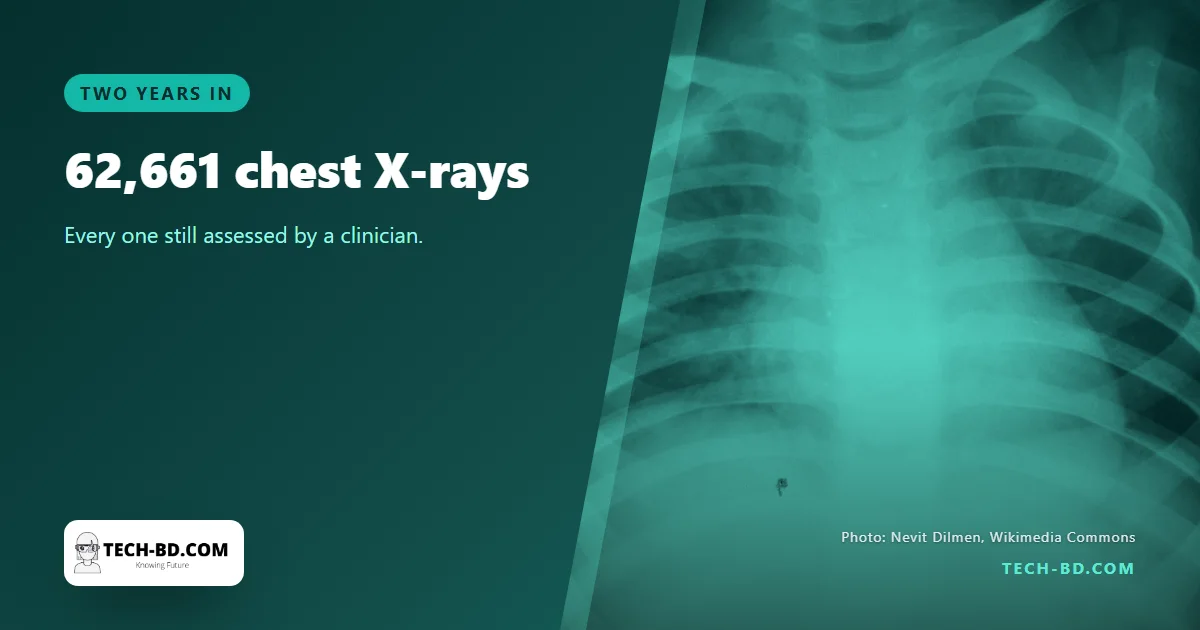
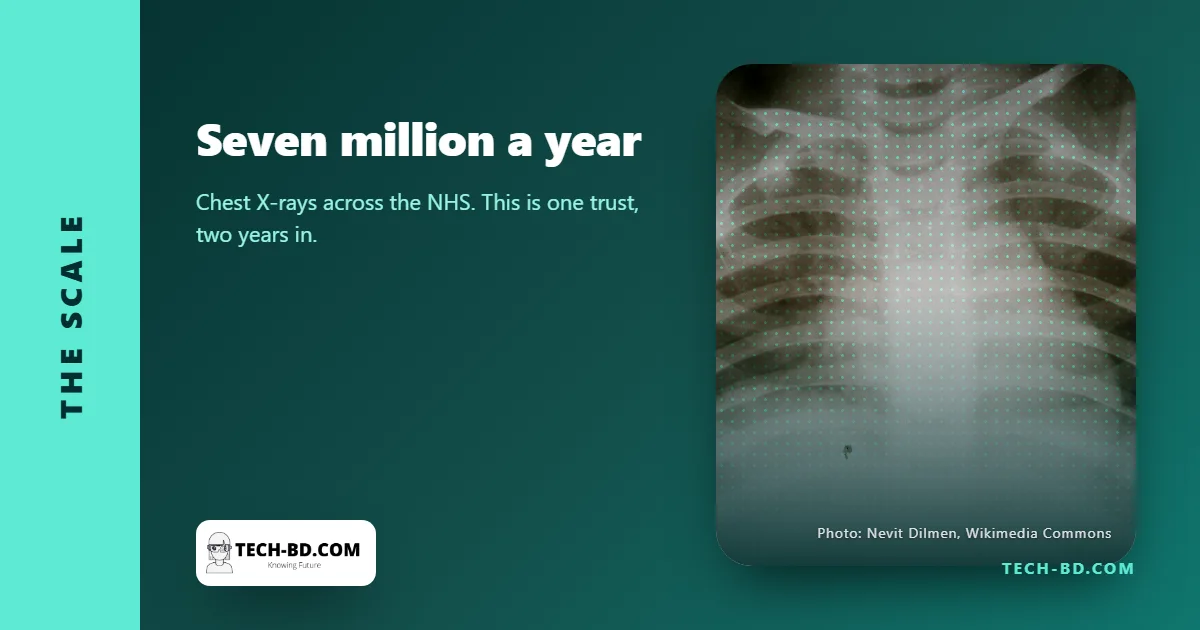
An AI tool at Kettering General Hospital NHS Foundation Trust in Northamptonshire reviews patients' scans and highlights subtle abnormalities that would be difficult to see otherwise. Since it was introduced in November 2024 with NHS England funding, it has helped staff examine 62,661 chest X-rays.
What the trust says about it is unusually restrained, and that restraint is the story.
What it actually does
Once the AI has analysed a scan, the radiology team assesses whether the finding needs further investigation. The tool does not make the call.
"It increased confidence in the final judgement made by a clinician," said consultant radiographer Cornilius Mushambi — while stressing that it does not replace human expertise.
The trust puts it plainly: "AI offers another layer of support for patient care. It does not replace clinical expertise: every X-ray still requires a clinician's assessment and final judgement."
The benefit is time, not accuracy
This is the part worth understanding, because it is where the value sits.
Two things change. Possible lung cancer can be investigated earlier, and the scans that look most urgent can be prioritised for review ahead of the queue.
Mushambi gives the concrete version: "It means potentially a patient can leave our hospital with both their X-ray and CT completed and reported on by a radiographer. Without input from AI, these steps might otherwise have taken place days apart."
Days apart, for a suspected lung cancer, is the difference the tool is being bought to remove.
Where it could go next
The AI scan reports are currently accessible to radiology staff. The trust says there are discussions about making the marked-up images available to other teams, including the emergency department, which could help medical staff see potentially serious findings sooner — particularly in out-of-hours care, when a specialist may not be on site.
The numbers behind it
The UK government describes chest X-rays as one of the most important tools in diagnosing lung cancer, which is the country's biggest cancer killer and accounts for about one in five cancer deaths. Around seven million chest X-rays are carried out across the NHS each year.
Against seven million, 62,661 is a pilot. That is the right way to read it.
What this means here
Bangladesh has the opposite constraint to the NHS. The bottleneck is not the time between an X-ray and a CT; it is the number of radiologists, who are concentrated in the big cities while the X-ray machines are not.
That makes triage software more attractive here than in Kettering, and also more dangerous. The whole safety case in Northamptonshire rests on a clinician assessing every image regardless of what the AI said. Where there is no clinician to do that, the same tool stops being a second opinion and quietly becomes the first one.
Worth holding onto as these systems are offered to hospitals here: the useful question is not how accurate the model is, but who is required to look at the image afterwards, and whether that person actually exists in the building.