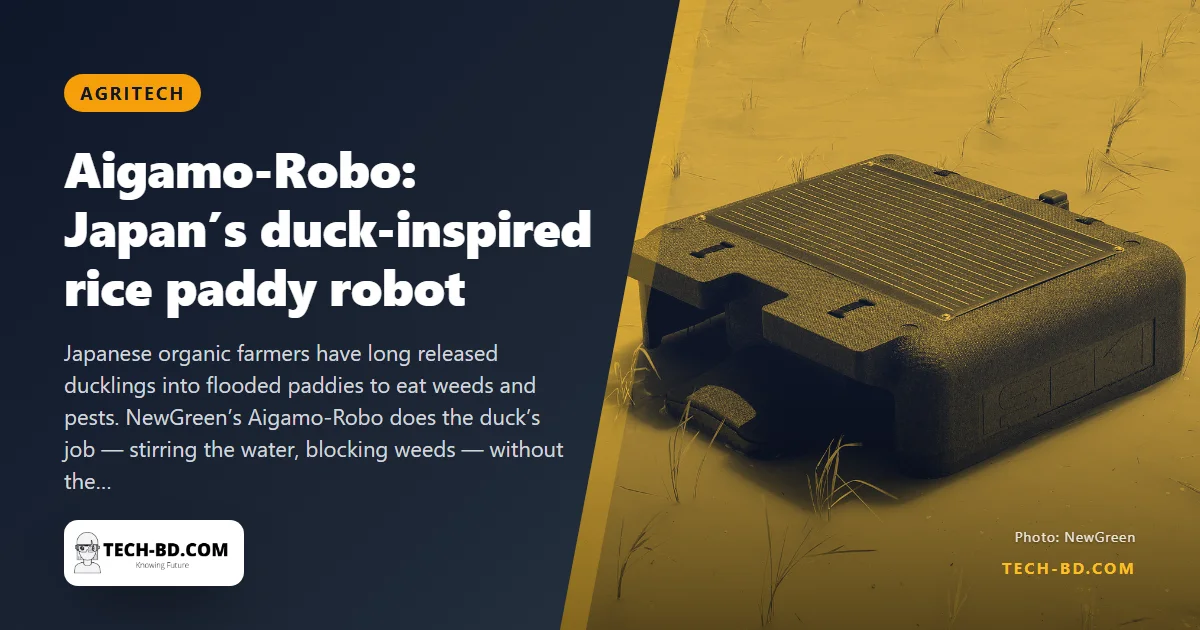
On the Shonai plain in Yamagata, northern Japan — mountains on one side, sea on the other, rice in between — an ageing farming population is testing what technology can do for a crop grown by hand for two thousand years. The most photographed answer is a small robot paddling through the paddies, doing the work ducks used to do.
The duck method it is copying
Aigamo is the Japanese name for a cross between wild and domestic ducks, and the aigamo method, popularised by the farmer Takao Furuno, is a piece of organic ingenuity. A few weeks after transplanting, ducklings are released into the flooded field. They eat weeds, insects and small pests but leave the rice alone; their paddling stirs the water, oxygenates the soil and keeps it soft; their droppings fertilise the crop. No herbicide, no pesticide, and at the end of the season the grown ducks are sold for eggs and meat — a second income from the same field.
Why it needed a machine
The method is elegant and demanding. Ducks must be protected from predators, weather and disease. They have to be removed once the rice forms ears, because by then they are large enough to damage the plants. The timing, housing and daily care add up to exactly the labour that Japan's shrinking, greying farm workforce cannot supply. Weed control is the single biggest obstacle to organic rice, and doing it by hand or by repeated mechanical passes costs time, labour and money.
What the robot actually does, which is not weeding
It is counterintuitive, and it explains every limitation below.
NewGreen's robot does not pull weeds, cut them or poison them. It moves through the rows stirring the water and the surface mud, and the mud it raises clouds the water. Weed seedlings germinating in the top centimetre of soil are then sitting in darkness, and they fail before they establish. The stirring also keeps the soil aerated and soft, which is the other half of what the ducks provided.
So the mechanism is light deprivation, not removal — which means timing is everything. Run it early and often while weeds are germinating and it works. Run it late, once weeds have leaves above the waterline, and it does nothing at all, because a plant already reaching the light cannot be shaded by muddy water.
Each unit covers about 1.5 hectares. The first version weighed around 16 kg; the second weighs about 6 kg, light enough for one person to carry between fields. It does not eat pests or lay eggs — the trade-off for a machine that never has to be caught, fed or protected from foxes.
How a machine finds its way across a flooded field
A paddy is an unusually forgiving place for a robot and an unusually hostile one. Forgiving because it is flat, bounded by a bund, and contains nothing to collide with except rice. Hostile because there are no landmarks, the surface is water, and anything that bogs down is stuck.
Machines in this category navigate either by following the rows themselves — sensing the planted lines and steering between them — or by satellite positioning accurate enough to drive a pre-planned path. Ordinary GPS is accurate to a few metres, which is useless when rows are 30 centimetres apart, so precise work needs a correction signal from a fixed reference station to bring that down to centimetres. Row-following needs no infrastructure and no subscription, which matters a great deal for whether a technology travels to a small farm in another country.
Power is the other constraint, and it is why these machines are small and slow. A light robot moving gently through water for hours on solar and a modest battery is a design shaped entirely by the energy available, not by what would be fastest.
What would have to be true elsewhere
Bangladesh grows more rice than almost any country on earth and, unlike Japan, has no shortage of farm labour — yet. But herbicide use has climbed steeply as wages rise and young people leave the fields, and organic rice commands a premium in Dhaka's supermarkets that few farmers can reach, because weeding without chemicals is too costly.
A 6 kg robot a co-operative could share across a village is the kind of appropriate technology that travels well, if the price does. The barrier, though, is not the engineering. It is the agronomy, and it is specific.
The method needs the field flooded continuously to a fairly precise depth — deep enough for the robot to float and stir, shallow enough not to drown young rice. That requires water control, which requires a reliable supply and a levelled field. It needs straight, evenly spaced rows, which in practice means machine transplanting rather than hand transplanting. And it needs the farmer to run it on the weeds' schedule rather than their own.
Those conditions describe a well-organised commercial farm rather than a typical smallholding, which is the honest assessment of how far this transfers in the near term. It is also a list of things that are achievable rather than exotic — and the sequence matters: levelling and machine transplanting first, the robot afterwards. A village that buys the robot before the field is level has bought a boat.