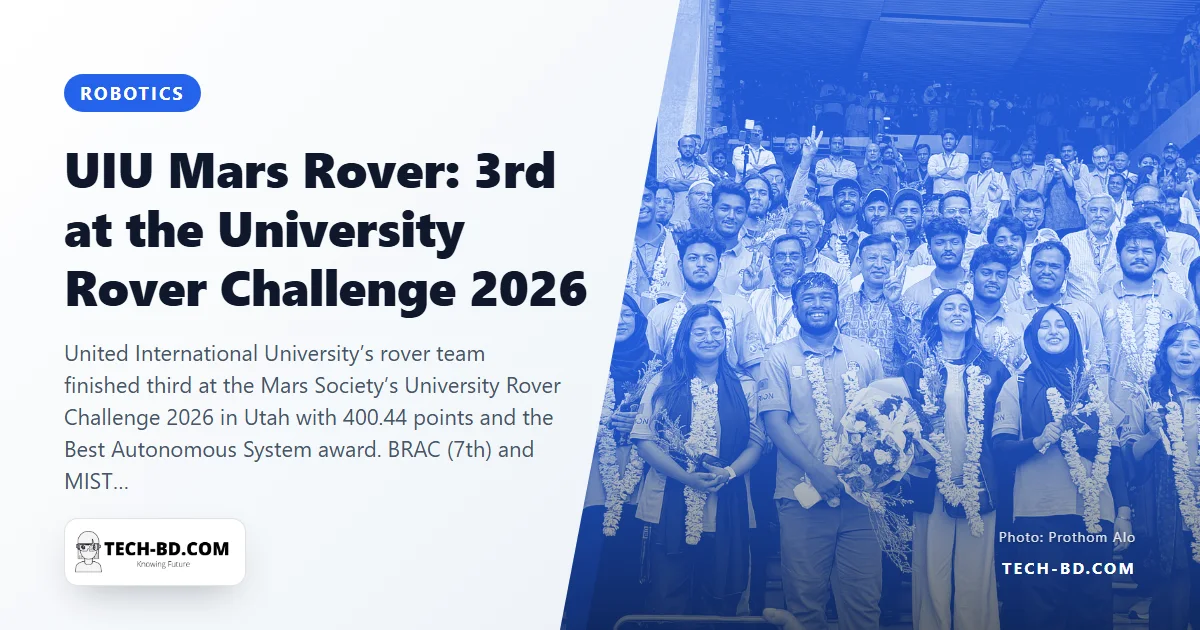
The University Rover Challenge is run by the Mars Society in the Utah desert, on terrain chosen because it resembles Mars, and it is the closest thing student robotics has to a world championship. This year's podium had a Bangladeshi team on it. UIU Mars Rover, from United International University, finished third overall with 400.44 points and took the Best Autonomous System award.
Not a one-off
The result sits on a run few university teams anywhere can match. In 2025 the team's rover Axios finished sixth in the world, was named Asia's best team for the fourth consecutive year, and became the first Asian team in the competition's history to win Best Science Team after full marks on the science mission.
And UIU is not alone. BRAC University's BRACU Mongol-Tori finished seventh and the Military Institute of Science and Technology's MIST Mongol Barota eleventh — three Bangladeshi universities in the top dozen of a field that regularly includes MIT, Stanford, Warsaw and Bengaluru.
What the competition actually asks for
"Build a Mars rover" undersells the problem, because the scoring is spread across separate missions that pull the design in different directions.
The science mission requires collecting a subsurface soil sample in the field and analysing it on board or in the team's own equipment, then defending conclusions about past or present habitability to judges who are actual scientists. This is a geology exam attached to a robot.
The equipment servicing mission has the rover operate human-designed hardware — opening a drawer, flipping switches, typing on a keypad, connecting a cable — which demands a manipulator arm with real dexterity and an operator interface good enough to use it through a camera.
The delivery mission involves locating and carrying objects across terrain to crew positions, testing payload handling and navigation together.
The autonomous navigation mission is the one UIU won an award for. The rover must reach a sequence of GPS waypoints and visual markers entirely on its own, avoiding obstacles, with nobody on the controls.
These requirements conflict, and that is the point. An arm precise enough for a keypad is heavy; weight costs you on rough terrain. Sensors for autonomy cost power; power is mass. A chassis stiff enough to protect a laboratory is harder to make climb. The competition is not a robotics test so much as a systems-engineering test — the skill being measured is making mechanical, electrical, software and scientific requirements fit inside one budget and one deadline.
Why autonomy is the hard award
Remote driving is difficult. Letting the machine drive itself is a different category of problem, and the desert is a deliberately cruel place to attempt it.
Visual navigation depends on recognising landmarks, and desert glare flattens contrast at exactly the hours judges run the trials. Dust coats lenses within minutes. GPS gives a position to within a few metres, which is useless for approaching a marker precisely, so the rover must switch from satellite navigation to visual servoing at some point and get the handover right. Wheels slip on sand, so odometry drifts and the rover's estimate of where it is degrades the longer it drives. And every failure must be recovered from without a human, because a human touching the controls ends the run.
Doing that reliably, on a budget assembled from sponsorships and university funds, is why judges single it out.
The question the trophy does not answer
UIU's acting vice-chancellor was careful not to declare victory: third is not the end, and the work has to be turned to the benefit of the country. That is the right note, and the gap it points at is worth naming precisely, because it is not a shortage of talent.
Bangladesh produces thousands of engineering graduates a year and very few places to build something physical, end to end, against international competition. Rover teams are one of the few. Their alumni are demonstrably capable — the results say so — and they overwhelmingly end up in robotics and autonomous-vehicle work abroad.
The reason is structural rather than cultural. A software startup needs laptops and time. A hardware company needs capital before revenue, a supply chain for components that mostly arrive as imports with duty and clearance delays attached, machining and prototyping capacity that barely exists locally, and customers willing to buy a first-generation physical product. A student team sidesteps all of that: the university pays, the sponsors pay, the parts arrive once, and the deadline is a competition rather than a market.
So three teams in the top eleven is a real signal, and it is a signal about the pipeline rather than the destination. The talent is proven. What has not been built is the thing that would keep it — and that is a question about industrial policy, component imports and capital, not about students.