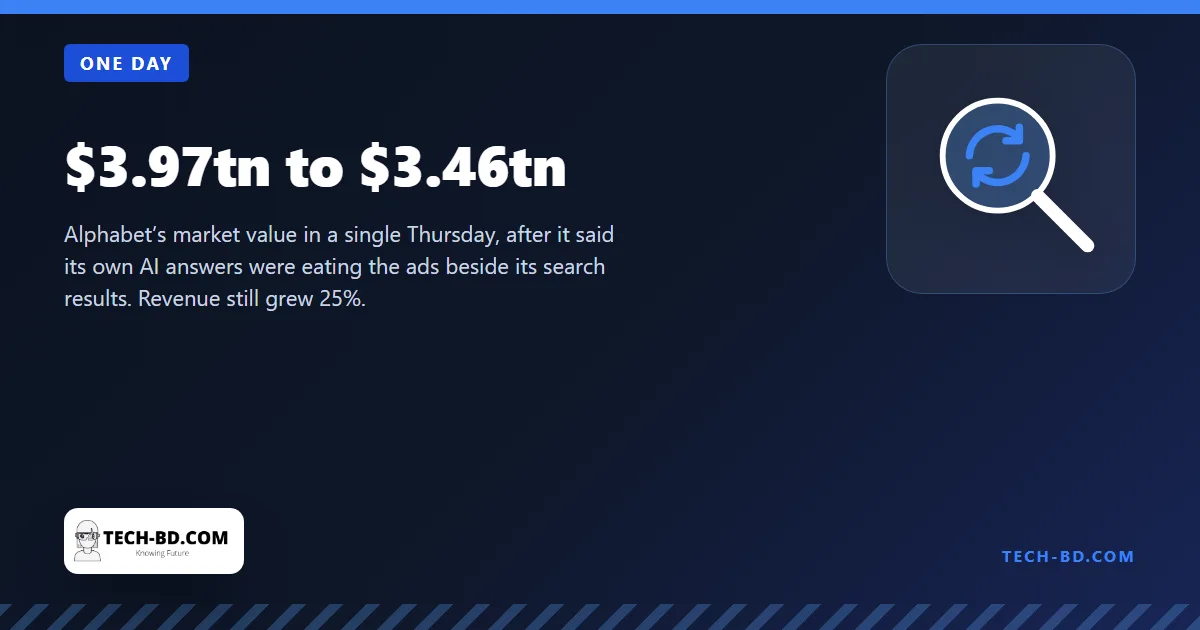
Alphabet lost a little over $500bn in market value on Thursday — its total fell from $3.97 trillion to $3.46 trillion — after the company said the artificial intelligence summaries it now puts at the top of search results were cutting into the advertising revenue those results used to carry.
Chief business officer Philipp Schindler said Google’s “AI mode”, which answers questions conversationally, was eating into the money made from the ads that appear beside traditional search results. He added that he felt “very good about our trajectory”.
The results were good
That is what makes the fall interesting. Total revenue for the September quarter grew 25% against the same period last year, reaching $127.6bn. By any ordinary measure that is a strong quarter.
But the advertising arm came in below what analysts had expected, and shares fell more than 12% to a six-month low. Tracy Woo, a principal analyst at Forrester, said the disappointing search numbers “highlight the challenge of funding massive AI investments while maintaining the strength of established businesses”. Alphabet expects to spend up to $205bn this year, almost all of it on AI.
Why a company would do this to itself
Kim Scott, who used to run Google’s advertising business, put it to the BBC’s Today programme in one line: the company would “rather eat its own lunch than allow someone else to eat their lunch”.
That is the whole strategy. Google’s position as the place people go with a question is under direct attack from ChatGPT and Claude, and the only defence is to answer questions the same way — which means answering them on the page instead of sending the visitor to ten blue links with ads beside them. The ad slots that made Google the most profitable advertising business ever built exist because search was a list. An answer is not a list.
So the company is deliberately damaging the mechanism that funds it, on the theory that the alternative is having the mechanism taken away. Scott’s reading is that this is Google doing what it has always done — a long-term bet that hurts in the short term.
What it means for anyone who publishes
This is not only a story about Alphabet’s share price. The same change that removes an ad slot also removes a click, and the click is how every publisher on the open web is paid — including this one.
Cloudflare’s chief executive Matthew Prince said this month that about three-quarters of Google searches now end without a click at all. If that is the direction, then a Bangladeshi news site, recipe site or price-comparison site is not facing a traffic dip to be optimised around; it is facing the removal of the reason search engines sent it readers. The companies with a direct audience — an app, a newsletter, a WhatsApp channel, a following that arrives by name rather than by query — are the ones with somewhere to stand.
Microsoft and Amazon reported in the same week and both committed to spending heavily on AI. Investors marked them down too, and Amazon disclosed negative cash flow of $42bn, a six-fold increase in three months.