Microsoft says its profits for the quarter that closed on 30 September jumped to more than $36.6bn (£27.5bn) — days after announcing plans to cut its workforce by more than a quarter.
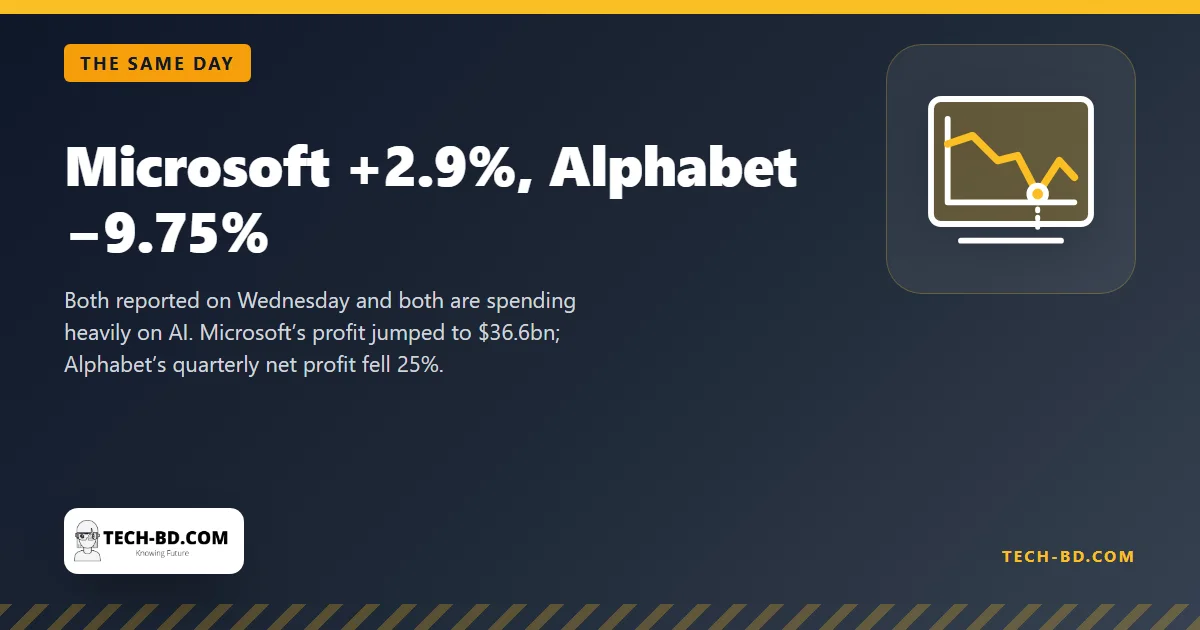
Quarterly revenue rose to $92.3bn, up 19% from a year earlier, driven by strong growth in cloud computing. Microsoft Cloud, its range of enterprise technology services, grew revenue 30%. Shares rose almost 2.9% in after-hours trading in New York on Wednesday.
On Monday the company said it would offer buyouts to around 60,000 workers to cut costs while it pours billions into AI. We covered that offer, and the question it left open, yesterday: is this AI making the company more productive, or the cost of AI infrastructure being found somewhere in the accounts?
The earnings do not answer it
They narrow it slightly. Revenue up 19% with cloud up 30% is growth in the business the buyouts are not aimed at — the money is coming from enterprise cloud services, not from doing the same work with fewer people. Nothing in these results demonstrates that AI replaced the roles being bought out.
What the results do show is that the spending has not yet hurt the reported profit, which is a different and weaker claim than the one usually made for it.
Microsoft also flagged risks in its own filing, including “substantial investments” in AI among other uncertainties that could affect its finances. Chief executive Satya Nadella said AI development has helped grow adoption of the technology and delivered “real-world impact across every industry”.
The comparison is the story
Alphabet reported on the same Wednesday and disappointed investors. The owner of Google posted a 25% drop in quarterly net profit from a year earlier and said it will continue to spend heavily on AI. Its shares fell 9.75%.
Two companies, same day, both committed to enormous AI spending, opposite reactions. That is as close as a market gets to stating a rule: it will fund AI capital expenditure out of a business that is visibly growing, and it will punish the same spending when the profit line is going the other way.
Which means the AI spending question is not really being asked about AI at all. It is being asked about whether the rest of the company can carry it.
The scale of what is being carried
Amazon, Meta and Alphabet are among the large technology companies whose combined outlay on AI chips and infrastructure such as data centres is expected to pass $700bn during this year. Recent financial results have been watched closely by investors gauging whether that is sustainable.
We have been reporting the individual commitments as they land: Anthropic’s listing filing disclosed $321.4bn in data-centre leases this year alone, and SpaceX committed to roughly $40bn of GPU financing through Apollo. The $700bn figure is what those individual numbers add up to.
And the buyouts, in Microsoft’s own words
This week the company said it would extend a voluntary redundancy offer to eligible employees across Canada, India, the UK and the US, to adapt its workforce to “changing needs”. It will create “greater flexibility” and allow workers to leave with financial support and career planning resources, Microsoft said. The company currently employs more than 220,000 people worldwide.
Those two facts — a record quarterly profit and an offer to a quarter of the workforce to leave — are not a contradiction, and it is worth being precise about why. A profitable company can still conclude it has the wrong shape, and a buyout is cheaper than a redundancy programme. But it does dispose of one explanation: whatever is driving this, financial distress is not.
For readers here, the thing to carry forward is the market rule rather than the Microsoft numbers. Companies in this region pitching AI investment to a board or an investor will be asked the Alphabet question, not the Microsoft one: not whether AI will pay off eventually, but whether the existing business can fund it while everybody waits to find out.