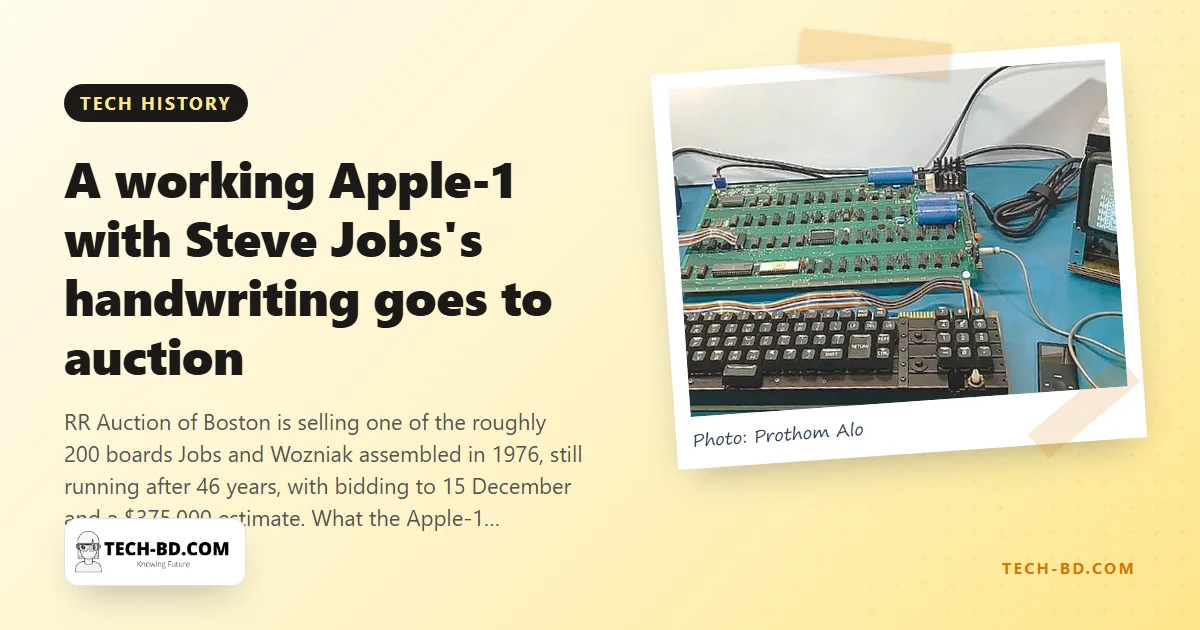
The Apple-1 is a bare green circuit board. It has no case, no keyboard, no screen and no power supply; in 1976 the buyer supplied all of those and, if lucky, a wooden box. Around 200 were made, by hand, and about 60 are known to survive. One of them, still working and carrying a serial number written in Steve Jobs's hand, is being sold by RR Auction of Boston in a sale that closes on 15 December 2022. The estimate is about $375,000. Previous examples have sold for between $400,000 and $900,000 depending on condition and provenance.
What it was
Steve Wozniak designed the Apple-1 in 1975-76 as a hobby project: a MOS 6502 processor at 1 MHz, 4 KB of memory, and, unusually for the time, a built-in interface for a keyboard and a television, so that a user could type and see the result without a bank of switches and lights. Jobs saw the business. The two sold a van and a calculator to fund the first batch, assembled the boards in the Jobs family garage in Los Altos, and persuaded Paul Terrell's Byte Shop in Mountain View to order 50 at $500 each. The retail price was $666.66, chosen by Wozniak because he liked repeating digits. Apple Computer was founded on 1 April 1976 to sell it.
Why it is worth a house
Scarcity, and the story. Most of the 200 were traded in for the Apple II in 1977 and destroyed; the ones that survive are usually the ones nobody bothered to return. This board's hand-written number ties it to Jobs personally, and "working" is the rare part: 46-year-old capacitors do not usually cooperate. Collectors of computing history treat an Apple-1 the way collectors of cars treat a Bugatti, and the auction house has confirmed it runs.
The Bangladesh footnote
By the time Jobs and Wozniak were soldering in a garage, Bangladesh already had a computer: an IBM 1620 installed at the Atomic Energy Centre in Dhaka in 1964, the first in what was then East Pakistan, a machine the size of a room that did rather less than the board on the auction block. The personal computer, the thing the Apple-1 began, reached Bangladesh a decade after the Apple-1 through IBM PC clones assembled in Dhaka's Stadium Market in the late 1980s, and the country's first Bangla software, ShahidLipi, was written for the Apple Macintosh in 1985. The garage in Los Altos is a long way from Elephant Road, but the road runs straight.