Banglalink has launched Mukto Pay, a digital payment platform for everyday transactions. The announcement was made on Wednesday.
The service covers the familiar list: sending money, paying utility bills for electricity, gas and water, recharging a mobile number on any operator, and adding money to the wallet from a bank account or card. Banglalink's own services can also be paid for inside the app.
Two ways in, and the second one matters more
The app is on Google Play and the iOS App Store, and registration takes a National ID and a mobile number. Customers of any mobile operator can register — not only Banglalink's.
The second route is the one worth noticing. Banglalink customers can use the service from a basic feature phone, with no internet connection at all, by dialling *525#.
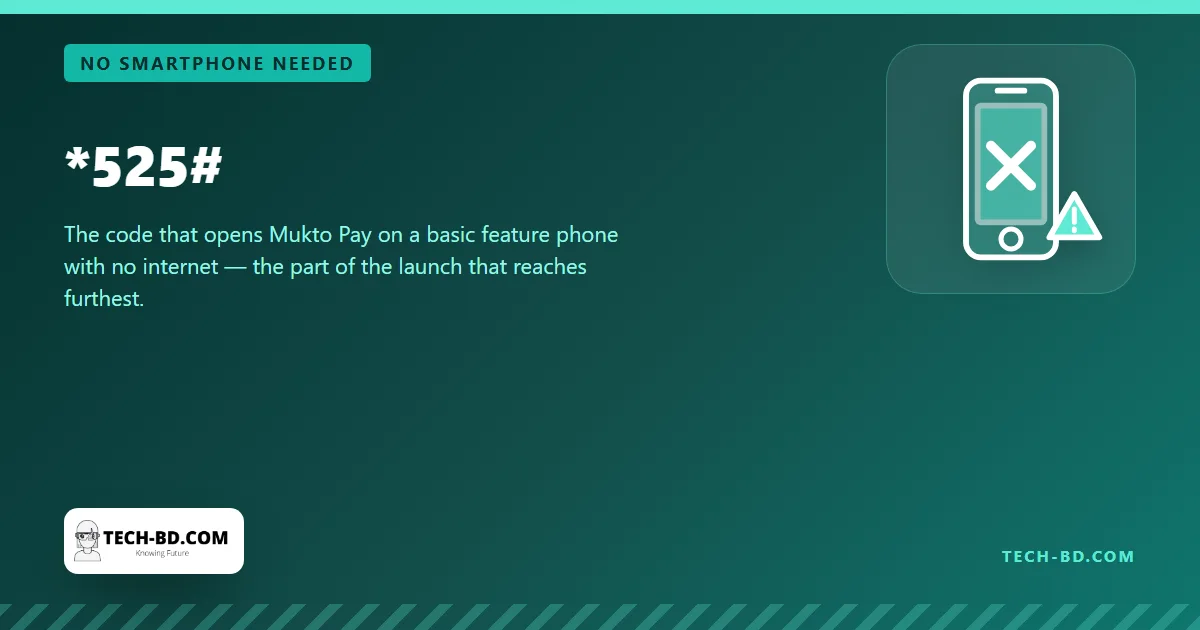
That matters because the population least served by digital finance is the one least likely to be holding a smartphone with a reliable data connection. A payment service that exists only as an app selects its users before it signs them up. A USSD code does not: it works on the cheapest handset, on a weak signal, with no data balance.
The limitation is that this route is for Banglalink customers, while the app is open to everyone. So the platform is operator-neutral where a smartphone is involved and operator-bound where it is not — which is the opposite of how the reach would ideally run.
Merchants, and the QR question
A separate merchant app lets businesses register, take payments and see their transaction records from one dashboard. The company says that when Bangla QR, the national QR payment standard, is added, Mukto Pay customers will be able to pay at any Bangla QR merchant.
That is a plan rather than a feature, and it is the single most consequential item on the list. Interoperability through a national standard is what stops a new wallet from being another island its users have to top up separately.
What the company says it is for
Chief executive Yohan Buse said Banglalink is now connected to customers' daily financial transactions and not only their connectivity, and described Mukto Pay as a base for wider digital financial services, aimed particularly at people and small traders still outside them.
Chief FinTech Officer Dmitry Kashtanov went to the name: the core idea is freedom, and "Mukto means independent". Mukto Pay's own chief executive, K M Zakaria, said the aim from the start was a service that is fast, simple and reliable from the first transaction, usable by customers of every operator.
The number to watch, and the one that is missing
Sending money and paying bills carry no extra charge for the first three months after launch. No figure has been given for what happens after that, and no transaction limits have been published.
Introductory pricing is normal and tells you very little. In a market where customers compare cash-out rates to two decimal places, the fee schedule that takes effect in February is the number that will decide whether Mukto Pay keeps the accounts it opens this week.