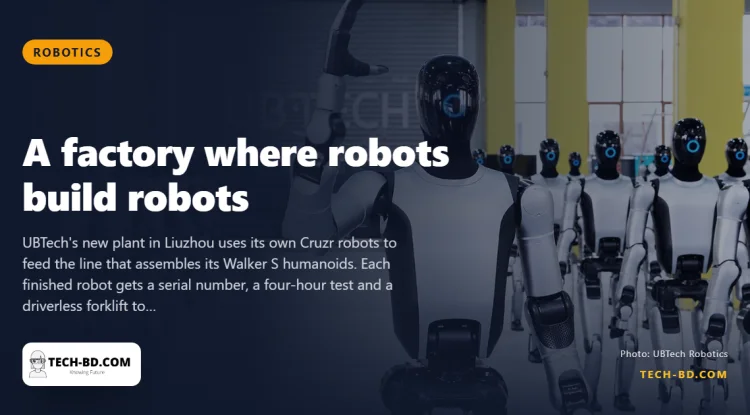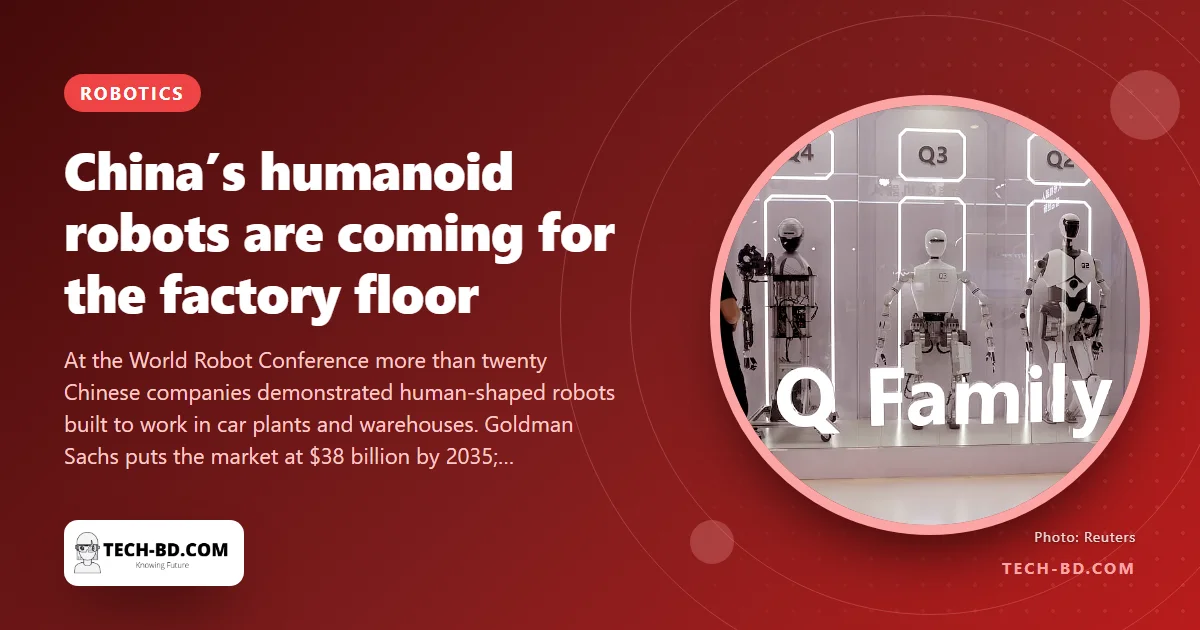
Western carmakers have spent two years worrying about Chinese electric vehicles. The five-day World Robot Conference that closed in Beijing on Sunday gave them a second thing to worry about. More than two dozen Chinese companies showed humanoid robots — two arms, two legs, a torso and a head, built to do a person’s job in a car factory or a warehouse — and the industrialists in the halls came away, in Reuters’ description, startled by how far they had come.
What was on show
The robots walked, sorted parts, carried boxes and, in the demonstrations that drew crowds, worked at stations on mock assembly lines. Arjen Rao of Beijing’s LeadLeo Research Institute said China’s humanoids are being built specifically for industry and manufacturing, and that new robot factories are opening as part of the state’s “new productive forces” push. The number that mattered came from Hu Debo, chief executive of Shanghai’s Kepler Exploration Robotics: his company is testing its fifth-generation robot on its own factory floor and intends to sell it for under $30,000. Tesla has talked of $20,000–$30,000 for Optimus, but has not shipped one.
How Tesla started it
The trail leads back to 2019, when Tesla opened its Shanghai Gigafactory and set off a wave of investment in Chinese EV and robotics suppliers. In 2021 Elon Musk announced Optimus and said the robot would eventually matter more than the car business; Tesla’s approach — training the robot with the same AI stack as its self-driving software — set the template. Chinese analysts concede Tesla still leads on the AI that lets a robot learn a new task from video. What Chinese firms have is the supply chain: the motors, reducers, batteries and sensors that make up most of a humanoid’s cost are the same components that go into EVs, and China makes nearly all of them.
The market
Goldman Sachs raised its forecast in January to a $38 billion humanoid market by 2035, a sixfold increase on its previous estimate, citing faster-than-expected falls in component costs. The first buyers will be factories with repetitive, dangerous or hard-to-staff work — which is why nearly every robot in Beijing was demonstrated lifting a box.
Why Bangladesh should watch
Bangladesh’s two largest exports are garments and people. A $30,000 humanoid that runs three shifts is a new kind of competitor to both: to the sewing-floor worker in Gazipur, whose employer’s buyers are the same companies that visit Beijing, and to the migrant in a Gulf or Malaysian warehouse whose remittance is a fifth of the national economy. The technology is not there yet — the demonstrations were choreographed, and a robot that folds a T-shirt reliably does not exist — but the price curve is the same one that took Chinese EVs from curiosity to dominance in five years.
Source: Reuters, via Prothom Alo.