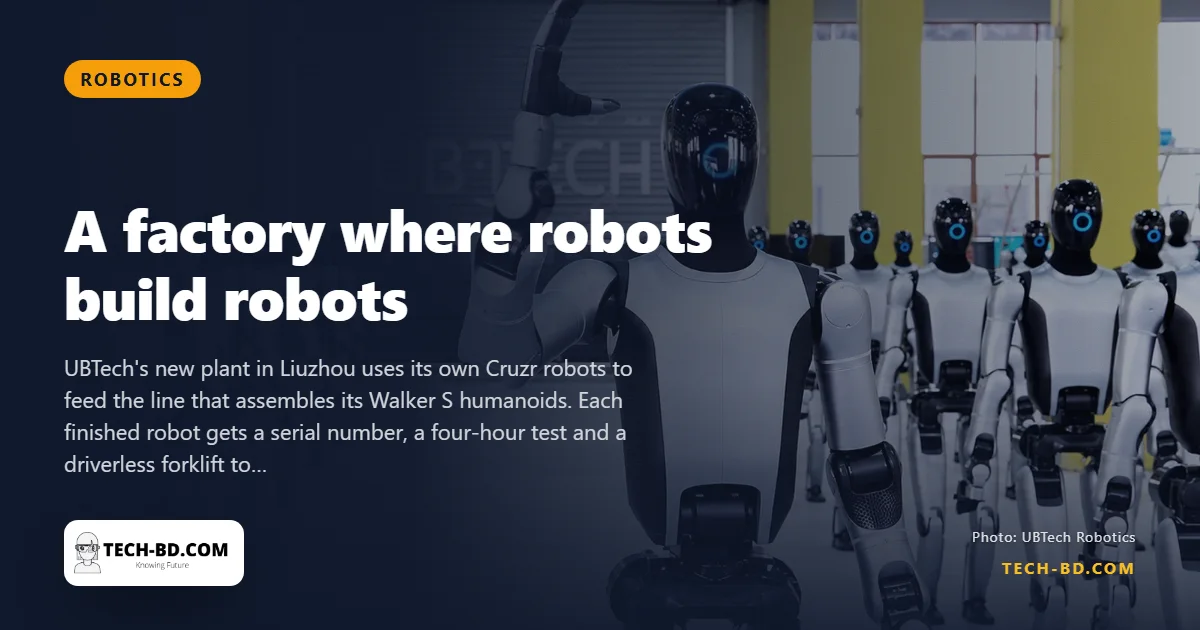
In Liuzhou, an industrial city in southern China's Guangxi region, robot maker UBTech Robotics has switched on a factory whose workers are, to a large extent, its own products. The plant builds humanoid robots for industrial use, and much of the fetching, carrying and moving inside it is done by robots too. UBTech's claim: a finished industrial humanoid rolls off the line every ten minutes.
The numbers
The building covers 14,000 square metres, with a ceiling 13.8 metres high, and is rated for 10,000 robots a year. It makes UBTech's Walker S series, the full-size humanoids the company has been placing in car plants, and its Cruzr series of wheeled service robots. Every robot leaving the line carries its own serial number, so the company can trace a single unit's parts and test results from the first bolt to delivery.
How the robots help build the robots
According to UBTech, Cruzr Y1 and Cruzr S2 robots handle the logistics: unloading components, sorting them, delivering them to the right point on the line and moving work in progress between stations. In other words, the parts that will become a new robot are brought to the assembly line by robots that came off the same kind of line earlier. Automated equipment does much of the assembly itself, which the company says reduces the need for direct human supervision on the floor.
A robot is not shipped the moment it is assembled. Each one goes through more than four hours of functional and quality testing of the whole machine. Finished units are moved into storage automatically, and the leftover materials are cleared away by driverless forklifts and other unmanned equipment.
The bigger picture
The factory is one data point in a much larger trend. China's National Bureau of Statistics counted 98,677 industrial robots produced in the country in July alone, up on the same month a year earlier, and the government has named humanoid robots a strategic industry. UBTech, listed in Hong Kong, competes with Unitree, Agibot and a dozen well-funded start-ups, all racing to bring the price of a working humanoid below that of a year's wages for the worker it replaces. A factory that builds them at scale, with its own robots doing the logistics, is how the price comes down.
What it means here
Bangladesh's factories are not about to be staffed by humanoids; the economics still favour people for most garment work, and the robots UBTech sells are aimed at car plants and electronics. But the wheeled Cruzr-style robots doing the fetching in Liuzhou are exactly the kind of machine that already moves fabric rolls in a few of Dhaka's larger garment units, and they get cheaper every year the Chinese lines run. The country that supplies most of Bangladesh's factory machinery is now building the machines that build the machines, and the workers on the receiving end of that will need to learn to run them rather than compete with them.