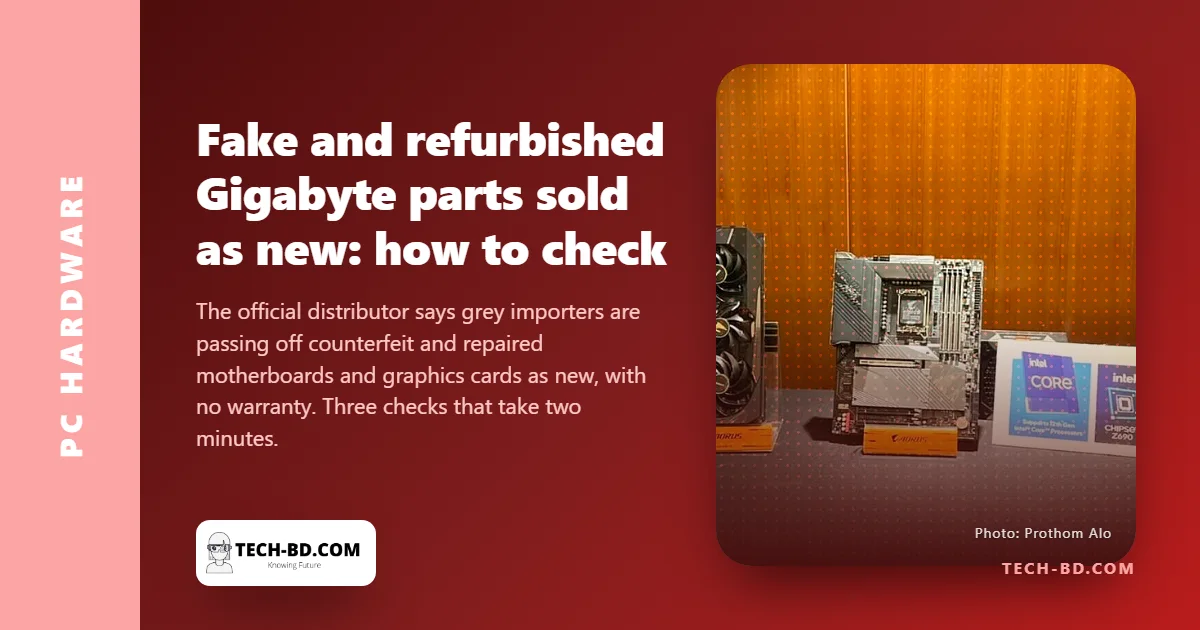
If the Gigabyte graphics card at the shop in IDB Bhaban is a few thousand taka cheaper than everywhere else, there may be a reason. Smart Technologies, the brand's official distributor in Bangladesh, told a press conference at a Dhaka hotel on Saturday, 6 August 2022, that "some dishonest traders" are selling counterfeit Gigabyte products and passing off refurbished, repaired parts as new, imported through unofficial channels with no after-sales service.
What was said
"Those selling fake products under the Gigabyte name are a threat to us and to buyers," said Zafar Ahmed, Smart's director of distribution. "We have informed the Bangladesh Computer Samity." Khaja Md Anas Khan, Gigabyte's country head, said the company would take legal action if needed, and pointed out that the brand now makes far more than the motherboards and graphics cards it is known for: laptops, monitors, RAM, SSDs, cases, power supplies, coolers, mice and keyboards are all sold here. Gigabyte also announced BIOS updates for its Intel 600-series motherboards to support Intel's next-generation processors.
Why now
The timing is not a coincidence. The crypto-currency crash of spring 2022 ended the mining boom, and hundreds of thousands of graphics cards that spent two years running at full load in mining farms are being dumped on the market across Asia, cleaned, re-boxed and sold as new. Motherboards returned under warranty abroad are repaired and re-exported the same way. Bangladesh, where most PC parts arrive through informal importers, is an easy destination.
Three checks before you pay
- The distributor's sticker. Genuine Gigabyte products sold through the official channel carry a Smart Technologies warranty sticker with a serial number. No sticker, no local warranty, whatever the shop says.
- The serial number online. Gigabyte's website has a warranty-check page; enter the serial from the box and the board. A card that shows as already registered, out of warranty, or sold in another region is not new.
- The invoice. Ask for a printed invoice naming the model and serial. A shop that will not give one is telling you something. For graphics cards, also look at the PCIe connector for wear and the fan bearings for noise; mining cards have run 24 hours a day.
The warranty gap is the real cost. Official Gigabyte motherboards carry three years and graphics cards three years of local service; a grey card that dies in month four is Tk 40,000 of e-waste. Buy from a Smart-authorised dealer, keep the invoice, and register the serial the day you get home.
What a refurbished card looks like up close
Counterfeit packaging is improving faster than counterfeit hardware, so the tells are physical and they are on the card, not the box.
Look at the screws holding the cooler on: rounded slots or scratched heads mean the shroud has been off. Look for dust in the fin stack and fan blades — a genuinely new card has none, and no amount of wiping reaches the middle of a heatsink. Check whether the warranty sticker over one screw is intact or has been lifted and replaced. And ask the shop to power the card up in front of you and show you the clock speeds and temperatures under load; a card that was mined on will often run hot at stock settings because its thermal pads are spent.
Then register the serial with the distributor the same day. A serial that is already registered to somebody else is the one check no reseller can talk their way around.