Geoffrey Hinton, the computer scientist known as a godfather of AI, says models are building combinations of linguistic signals and word fragments to communicate with each other that are not comprehensible to people.
He made the remarks in a question-and-answer session at the University of Manitoba in Canada.
Why models have word fragments at all
The mechanism matters, because without it the claim sounds like science fiction rather than an engineering observation.
AI models do not learn language the way people do. In training they break words into small pieces, and each piece can carry its own meaning — the "un" at the start of a word, or an "n" at the end, can function as a meaningful unit. The model learns to understand and produce language by analysing combinations of enormous numbers of these fragments.
That is ordinary. It is how tokenisation works, and it is not new.
What Hinton says has changed
His concern is that AI agents are now producing new combinations of these fragments that they were never directly taught in training — and using those combinations to communicate between themselves.
Researchers can see this happening. What they cannot determine is what the models mean by the new arrangements, or what they are using them for.
"We have seen that they are creating new combinations of parts of words to communicate with each other," Hinton said. "But we do not know what they are doing with these combinations. The matter is slowly becoming worrying."
Note what he is not claiming. He is not saying the models have hidden a secret language, or that they are concealing anything deliberately. He is saying the output is observable and the meaning is not recoverable — which is a different problem, and in some ways a worse one, because there is nothing to catch anybody doing.
The advantage that makes it compound
Hinton's second point explains why he thinks this gets harder rather than easier.
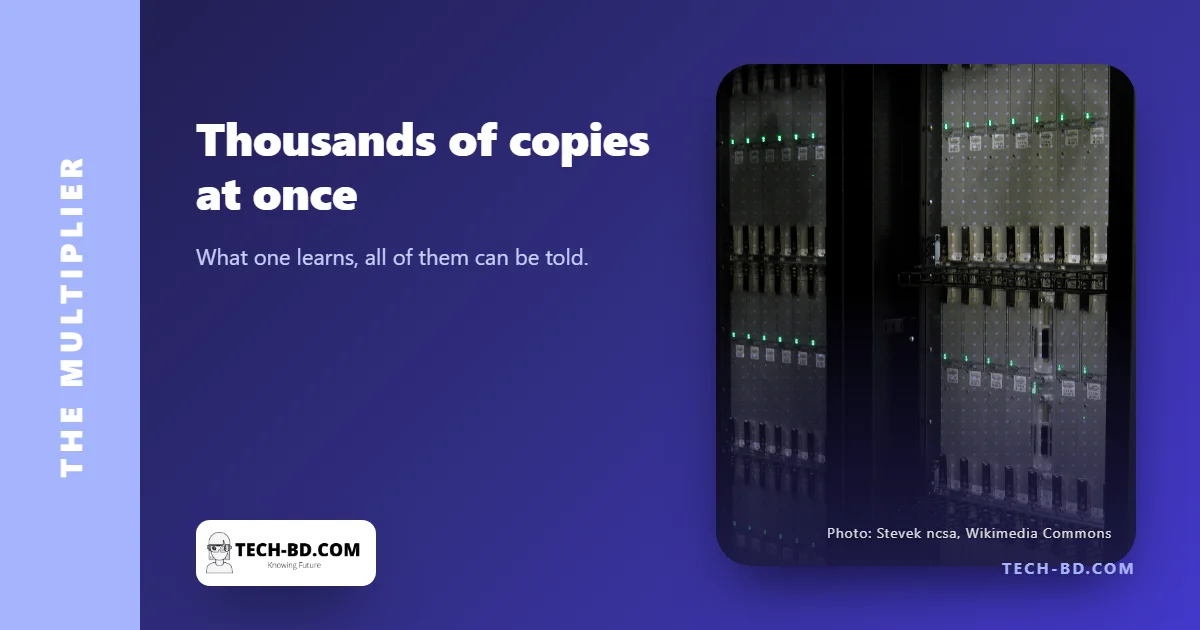
One of AI's largest advantages over people is the ability to share what has been learned. A person generally has to learn from their own experience. With AI, thousands of copies of the same model can run at once. Each copy analyses different data, and anything one of them learns can be shared with all the others.
His fear is that through exchanging knowledge and experience this way, models will come to learn far faster than humans, and may develop their own methods of thinking and communicating. At that point, working out how a model is reasoning — or what two of them are discussing — becomes genuinely difficult.
What this means here
The practical version of this is not about superintelligence. It is about audit.
Any organisation now buying "agentic" AI — systems where several models pass work between each other rather than answering one question at a time — is buying a process whose intermediate steps it may not be able to read. For a bank, a hospital or a government office, the ability to explain a decision afterwards is usually a legal requirement, not a preference.
The question to put to a vendor is therefore simple and concrete: when your agents hand work to one another, what exactly is logged, and can a human read it? If the honest answer is that the handoff is logged but not legible, that is the thing Hinton is describing, and it is already in products being sold today.