
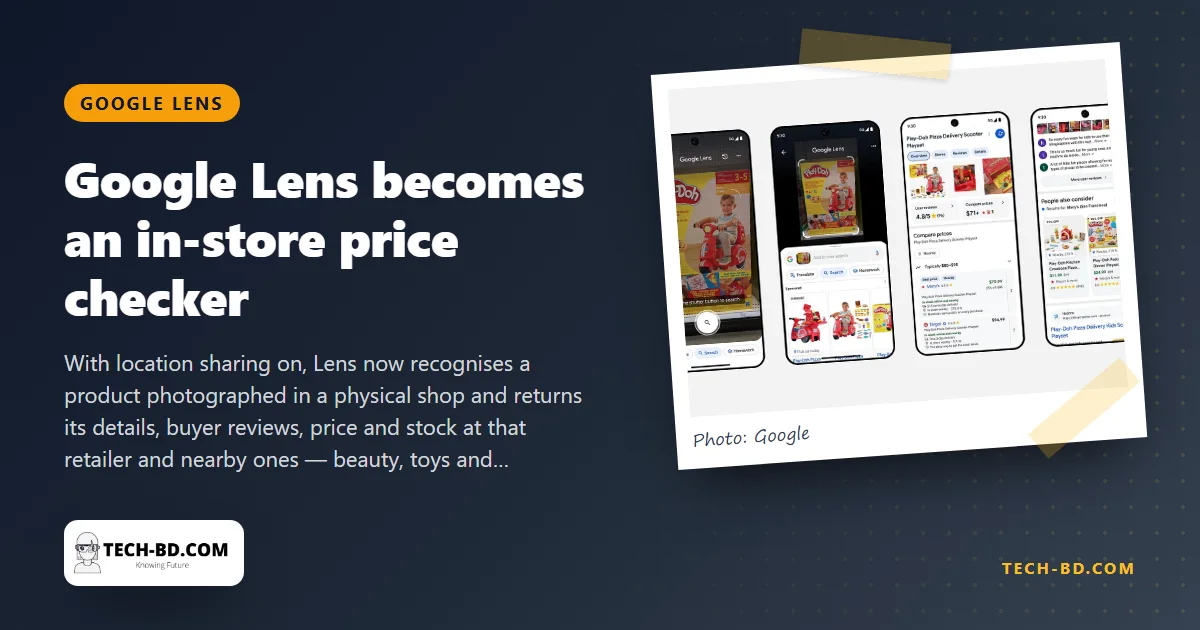
Google Lens has always been able to identify a thing from a photograph. The new version, announced this week, knows where you are standing when you take it. Share your location with the Google app, photograph a product on a shelf in a shop, and Lens returns not just what it is but what this shop charges for it, whether it is in stock here and nearby, what buyers have said about it, and how the price compares elsewhere.
How it works
Lens identifies the product from the image, as before. Location tells it which retailer you are in; Google’s Shopping Graph — the inventory and pricing feed that retailers already supply to Google for Search — tells it what that retailer stocks and at what price, and the same feed for nearby shops supplies the comparison. Reviews come from Google’s own listings and the retailers’ sites. The result is a card with the product’s description, star rating, price here, and a list of alternatives. It launches in the United States on Android and iPhone, for beauty products, toys and electronics, with more categories to come.
Why Google built it
Lilian Rincon, Google’s vice-president for consumer shopping, gave the numbers: 72 per cent of American shoppers use their phone while in a store, and more than half of them walk out without buying because they could not find the information they needed. That is the gap Lens is meant to close. It is also a defence: the phone in the shop is usually open to Amazon, checking whether the thing on the shelf is cheaper online. Google would rather the check happen in its app, with its retail partners’ prices in front of the shopper and its own ads alongside.
What it is not
It is not a price-scanner that works anywhere. It depends on the retailer feeding stock and prices to Google, which large American chains do and small shops do not. Photograph a product in a store that is not in the Shopping Graph and you get the old Lens result — what it is, and where to buy it online.
If it reached Dhaka
It has not, and there is no date. But the thought experiment is instructive. Bangladeshi retail runs on the absence of posted prices — the same phone costs different amounts in adjacent shops in Bashundhara City, and the price you pay in New Market depends on the conversation. A tool that showed the going rate at the shop next door would change the conversation for the buyer’s benefit. It would need Daraz, Pickaboo, Ryans and Star Tech to feed prices to Google — the online ones already do — and it would need Google to bother with a market where it sells few ads. The first condition is nearly met; the second is the one that keeps features like this American.
Source: The Verge, via Prothom Alo.