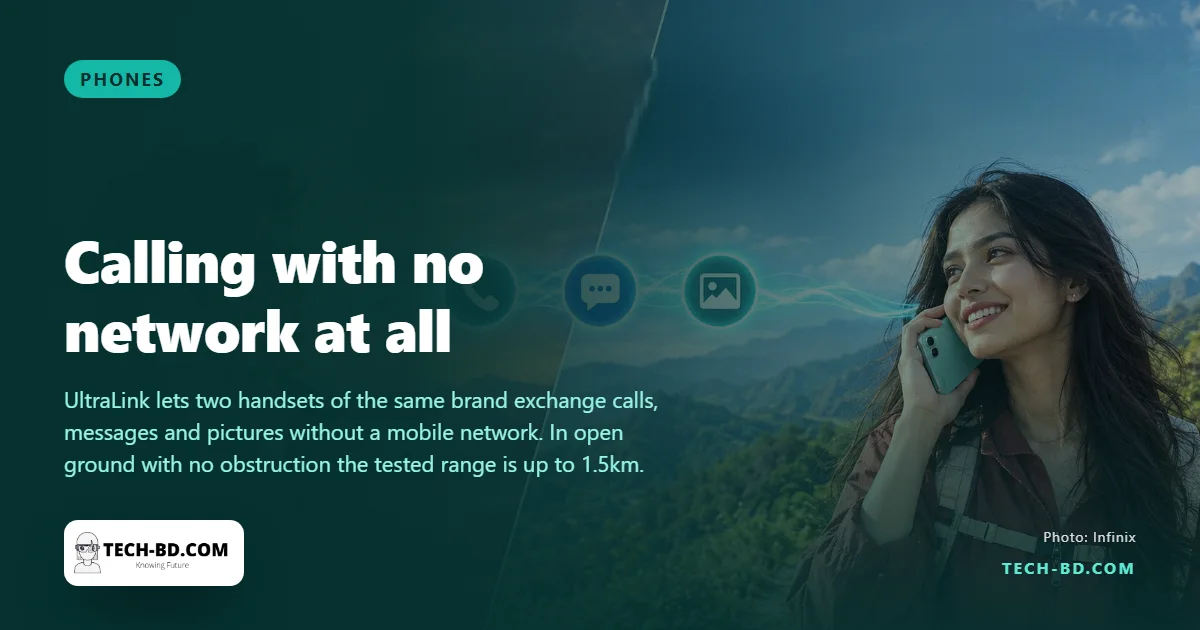
Being close to someone and still unable to reach them is a familiar problem when there is no mobile coverage, and a weak signal can make even an emergency call difficult. Infinix has added a feature called UltraLink to its handsets to work around it.
What it does
Two UltraLink-equipped phones from the brand can exchange calls, messages and pictures without the help of a mobile tower. Infinix Bangladesh announced it in a press release on Monday.
In open ground with no obstruction, the company says communication is possible at a range of up to 1.5km between two handsets. Its own testing found the feature working on the Infinix Hot 70 Pro 5G. Range may be shorter depending on the environment and the model.
Infinix is explicit that this is not a replacement for a network, but an additional way to reach known contacts when there is no signal. It currently works across the Hot 70, Note 60 and Smart 20 series, with more models to follow.
What it means in Bangladesh
Of all the features a budget phone brand could add for this market, this is an unusually well-chosen one — and the reason is not convenience.
Bangladesh loses mobile coverage in exactly the situations where communication matters most. In a cyclone, towers lose power and backhaul before they lose their masts; in the 2024 and 2025 floods, whole upazilas went dark for days. Coverage is also simply thin in parts of the haor basin, the Chittagong Hill Tracts and the offshore chars. A device-to-device link that needs no infrastructure at all is genuinely useful in every one of those cases.
Three honest caveats, because the marketing will not supply them. Both phones must be Infinix with the feature — this is not a standard, and it will not reach a neighbour on a different brand. 1.5km is the open-ground figure; in a village with trees, buildings and terrain it will be a fraction of that, and Infinix says so. And the people most likely to need it in a disaster are the least likely to have coordinated on buying matched handsets in advance.
The useful way to think about it is as a household or team feature rather than a public one: a family that buys two, a rescue team, a set of field staff on an NGO project, a fishing boat and the shore. Used that way it is a real capability at no extra cost.
It also raises a fair question for the regulator and the operators. If a phone brand can ship peer-to-peer messaging as a product feature, the absence of any interoperable emergency mesh standard across brands is a policy gap, not a technical one — and Bangladesh has more reason than most countries to care about closing it.
The other route to coverage where there are no towers is in Banglalink switching on Starlink direct-to-cell.