As heatwaves scorched Europe this summer, workers at a US battery company noticed demand climbing.
What is being sold
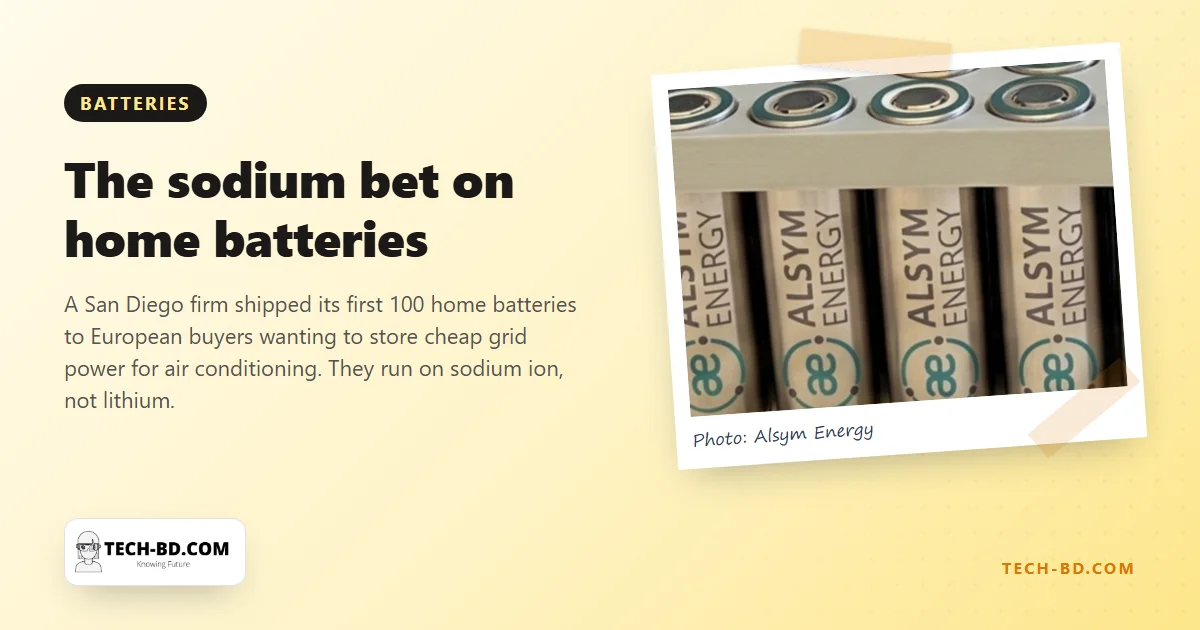
San Diego-based Unigrid sells a nine kilowatt hour battery for people's homes. Sweltering European homeowners were looking for a way to store power when it was cheap from the grid, then run air conditioning off the battery through the worst of the day.
"We have requests coming from Spain, France, Germany, The Netherlands," says co-founder and chief executive Darren Tan. "We've shipped the first 100 units and [expect to ship] 1,000 before the end of the year."
The battery is a sodium ion device rather than lithium ion. Sodium has energy storage experts interested because it could end up much cheaper to build and operate, is potentially less likely to catch fire, and should work across a wider temperature range — down to minus 40C.
There is no consensus yet on the best and safest sodium ion design, and more than one US company in the space has floundered in recent years.
What it means in Bangladesh
Read the customer, not the country. What those European buyers wanted was not green credentials — it was to move their electricity consumption to a cheaper hour. That is a demand Bangladesh has in an acute form and mostly meets with diesel.
Three things make sodium chemistry more interesting here than lithium.
Temperature. Lithium cells degrade faster in sustained heat, and a battery in a Bangladeshi rooftop enclosure or a shop backroom spends much of the year above 35C. A chemistry with a wider tolerance loses less capacity per year in exactly this climate.
Fire. Bangladesh already has a serious battery fire problem — the informal lead-acid trade and increasingly cheap lithium packs in easy-bikes and rickshaws, charged overnight in residential buildings with no ventilation. A cell chemistry that is harder to set alight is not a marketing point here; it is a safety argument.
Materials. Sodium is abundant and not geopolitically concentrated the way lithium and cobalt are. For a country that imports every cell it uses, a chemistry with fewer chokepoints is worth watching on price grounds alone.
None of that changes where Bangladesh can realistically compete, which is downstream of the cell: putting packs together, building the electronics that manage them, and recycling them somewhere other than a backyard. What a cheaper chemistry changes is the price of the thing being assembled — and that price is what decides whether a rooftop panel can replace a diesel generator or only run beside one.
Europe's own attempt at this is in its second run at batteries, and the demand case in how oil country took to solar.