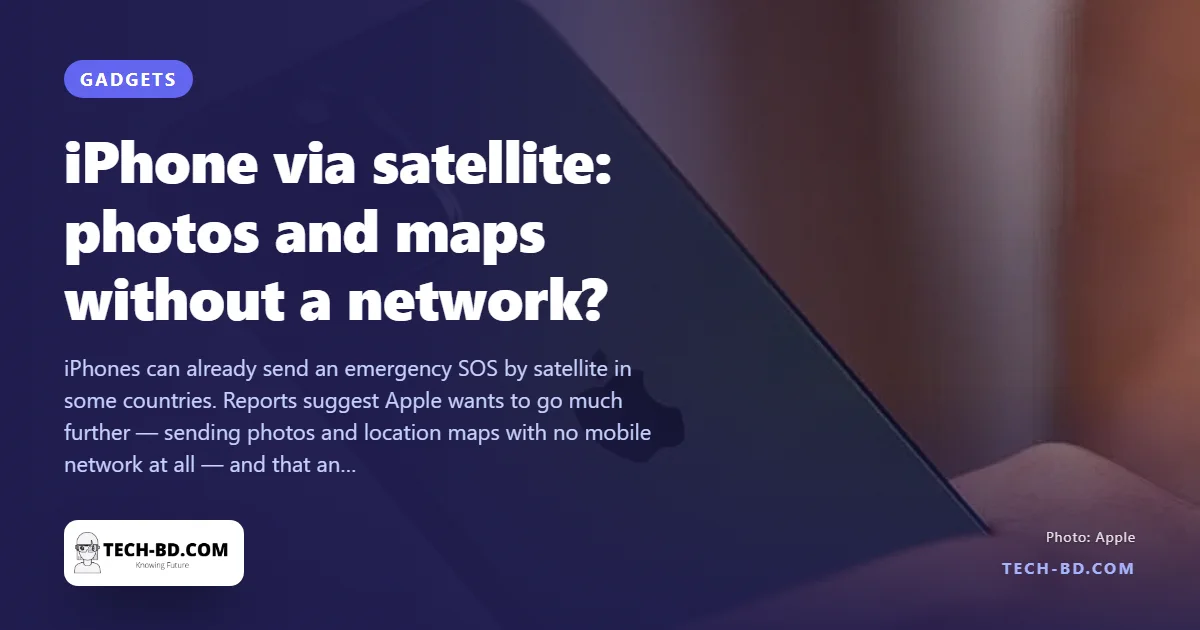
Since the iPhone 14, Apple's phones have done something that sounds like science fiction: with no signal at all, point the phone at the sky and send an emergency message through a satellite. The feature is limited — text only, emergencies only, and only in countries where Apple has switched it on, which does not include Bangladesh. Reports now suggest Apple wants to widen it to photos and location maps.
What is being claimed, and why the story has legs
The rumoured expansion would let an iPhone send images by satellite and use maps when the network drops — not only in genuine emergencies but in the everyday case of coverage simply vanishing.
Apple has said nothing. The reason the story persists is corporate: Amazon is reported to be in line to acquire Globalstar, the operator currently carrying the iPhone's emergency service. If that closes, Apple could gain access to Amazon's low-earth-orbit constellation — better coverage, faster connections, and the kind of capacity that moving a photo rather than a short message actually needs. Analysts treat the feature as contingent on that infrastructure rather than as a product on a schedule.
The one fact that explains everything
Why do you have to point the phone at the sky, hold still, and wait minutes for a message that a mobile network would deliver instantly? Not software. Physics, and specifically the link budget.
A mobile phone has an antenna a few centimetres long and transmits at a fraction of a watt. A mobile tower is a few kilometres away. The satellite carrying today's emergency messaging is in a much higher orbit, and a signal weakens with the square of distance — so by the time that fraction of a watt arrives at the satellite it is extraordinarily faint, close to the noise of the universe itself.
Everything users experience follows from working at that margin. You point the phone because the antenna must face the satellite to gain what little directionality it has. You stay still because moving breaks the lock. It takes minutes because the only way to pull a signal out of noise that deep is to send very little information very slowly and repeat it.
Which is why the limit is text. A 160-character message is a few hundred bytes. A compressed photo is a couple of million — roughly four orders of magnitude more. At the data rate a handset-to-satellite link achieves today, that is not a slower photo; it is a transfer that would take so long nobody would complete it.
What would have to change
Bring the satellite closer. A low-earth-orbit satellite sits a few hundred kilometres up rather than tens of thousands, and the signal loss falls dramatically with that distance — which is the entire reason constellations like Amazon's Kuiper and SpaceX's Starlink exist in that orbit.
The cost is that a low satellite covers a small patch of ground and moves fast across the sky, so continuous service needs hundreds or thousands of them handing off between each other. That is why these systems took so long to be feasible: the physics was never in doubt, the launch economics were.
Round-trip delay improves too, from the fraction of a second a distant orbit imposes to something closer to a normal connection — which matters less for a text and a great deal for a call.
Two different approaches, routinely confused
This distinction decides which phones work and where, and almost no coverage makes it.
Dedicated satellite messaging is what the iPhone does now. It uses spectrum licensed to the satellite operator, and the phone needs hardware and software built for those specific bands. It works only on supporting models, and the feature set is whatever the operator and the phone maker agreed.
Direct-to-cell is the other approach, and the more interesting one. The satellite behaves like a mobile tower in orbit, transmitting on ordinary mobile bands, so an unmodified phone can connect without knowing a satellite is involved. Starlink's service with carriers works this way.
The catch is regulatory rather than technical, and it is the answer to why your country may not be on anyone's list. Mobile spectrum is licensed nationally, to national carriers. A satellite cannot simply transmit on those frequencies over a country — it needs an arrangement with a licensed operator there and permission from that country's regulator. So direct-to-cell rolls out one country and one carrier agreement at a time, and the constraint is paperwork rather than orbits.
What this means where coverage is worst
Bangladesh has decent mobile coverage across most inhabited areas and poor coverage exactly where it matters most: the Sundarbans, the haor wetlands during flooding, the hill districts, and the sea. Those are also the places where a photograph of where you are would be worth far more than a description.
There is no framework yet for consumer satellite-to-phone services, and Apple's existing SOS feature is not enabled. A future in which any phone can send a photo from a fishing boat in the Bay of Bengal is technically foreseeable once the constellations are dense enough. Whether it arrives depends on a licensing conversation rather than on engineering — which is a less exciting answer and the accurate one.
Android is not standing still: Google and Samsung have shipped satellite messaging, and direct-to-cell is in carrier testing. The reasonable expectation is that satellite text becomes ordinary on mid-range phones well before satellite photos become ordinary on anything.