
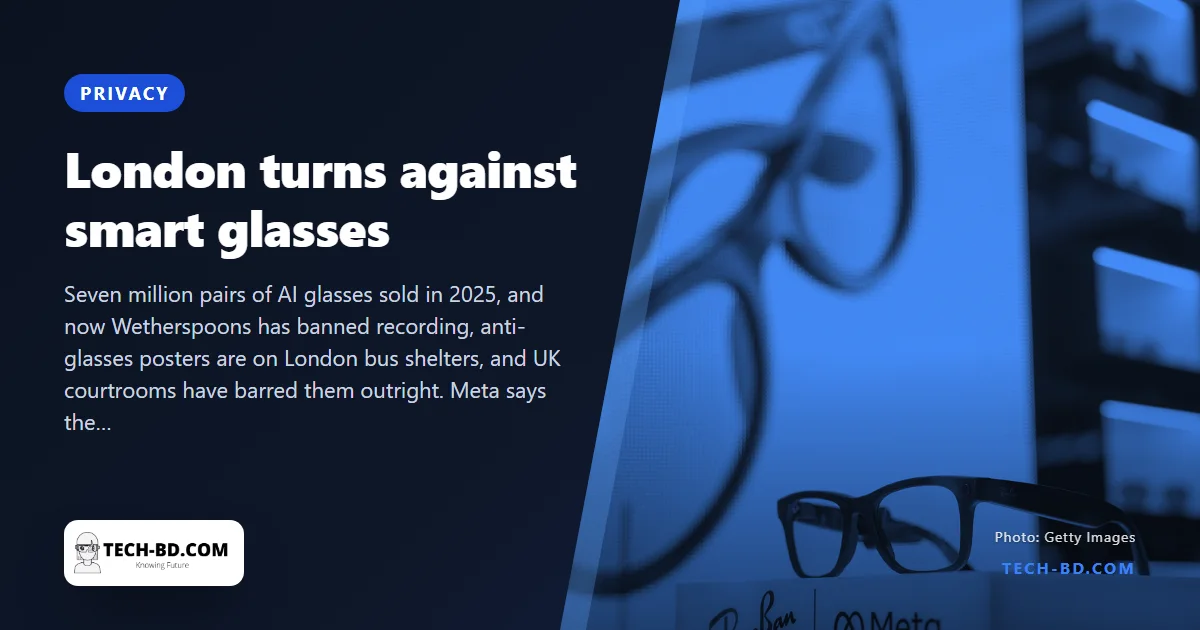
The bars, theatres and restaurants of central London have become an unlikely front line. The device at issue is smart glasses — spectacles that capture video, photos and audio from the wearer's point of view — and the fight is over whether the people around the wearer ever agreed to be recorded.
How big this has got
EssilorLuxottica, the eyewear giant that makes Meta's glasses, says seven million pairs of AI glasses were sold in 2025. Meta is expected to announce new glasses without cameras at its Connect conference this week, according to The Information; Samsung and Google are expected to launch jointly developed glasses this autumn. As the technology spreads, so does the backlash, driven partly by videos circulating on social media that appear to show men filming women who have no idea it is happening.
"It makes it harder and harder to protect yourself by just looking around and screening for things," Irina Raicu, who runs the internet ethics programme at Santa Clara University's Markkula Center, told CNN. "So the whole notion of consent is kind of disintegrating."
What London is doing about it
Wetherspoons, the pub chain, has prohibited customers from recording with the glasses. "With regard to Meta glasses, our instinct was to say, 'turn the cameras off,'" a spokesperson told CNN. Anti-smart-glasses advertisements have appeared at bus stations around the city, one of them turning Kylie Jenner's Meta advertising campaign into a skeletal X-ray with the line "We're Always Watching". Since August, the glasses have been banned from courtrooms across the United Kingdom. At the Piccadilly Theatre, staff and audience members told CNN the glasses could undermine live performance and hurt actors' livelihoods.
Ordinary drinkers gave the simplest version of the objection. "I don't really want to be filmed when I'm just out having a couple of pints," said Zak, a student in a central London pub, who called the practice of covering the recording light "ridiculous".
What the companies say
Meta says its glasses will not record if the recording light is covered, and that in August it updated them so the light cannot be covered after recording starts — a change that followed an earlier feature that detected tampering. The company says it has also acted against videos showing wearers harassing people. "Naturally some places shouldn't be filmed at all and that's reasonable, but rules should be applied consistently," a Meta spokesperson said. "Our glasses have a light that turns on to let people know when a photo or video is taken, something smartphones and other cameras don't have."
Google has been here before: Google Glass drew the same objections more than a decade ago and was discontinued. Sameer Samat, Google's president of the Android ecosystem, said the company is not surprised by the pushback and that details like how the glasses signal recording "really, really matter". Samsung's coming glasses, running Google's software, will have a tamper-resistant privacy light.
Why it is hard to fix
Calli Shroeder of the Electronic Privacy Information Center told CNN the obvious remedies all have problems. Automatically blurring faces, or requiring legal consent before upload, would be hard to implement and would still leave risks. Making glasses detect sensitive places — playgrounds, changing rooms — and disable recording there would require the glasses to sense their surroundings continuously, which is its own privacy problem.
Where Bangladesh stands
Smart glasses are not sold officially in Bangladesh, but they arrive in luggage, and a country where phone cameras already sit in every situation has fewer defences, not more. There is no equivalent of the UK courtroom ban here, no venue policy anywhere to point at, and the relevant law — the Cyber Security Act and the older provisions on obscene material — only engages after footage has been published, not when it is taken. The practical protection remains the social one: in Dhaka, as in a Wetherspoons, a person who is filming is expected to be visibly filming. Glasses are designed to remove exactly that signal, and the light Meta keeps pointing to is the size of a grain of rice.