Three French entrepreneurs have launched a literary award for books written with the help of artificial intelligence. It is called the Prix Pascal de la Littérature IA, after the French mathematician and scientist Blaise Pascal, and it was created by Philippe Rodriguez, Albin Serviant and Gilles Montrée.
The timing is not accidental. In September, France’s most prestigious literary prize, the Goncourt, removed a book by the Canadian-Haitian writer Thélyson Orélien from its longlist after allegations that an entire novel had been written with AI. The new prize takes the disqualifying condition and makes it the entry requirement.
The rules
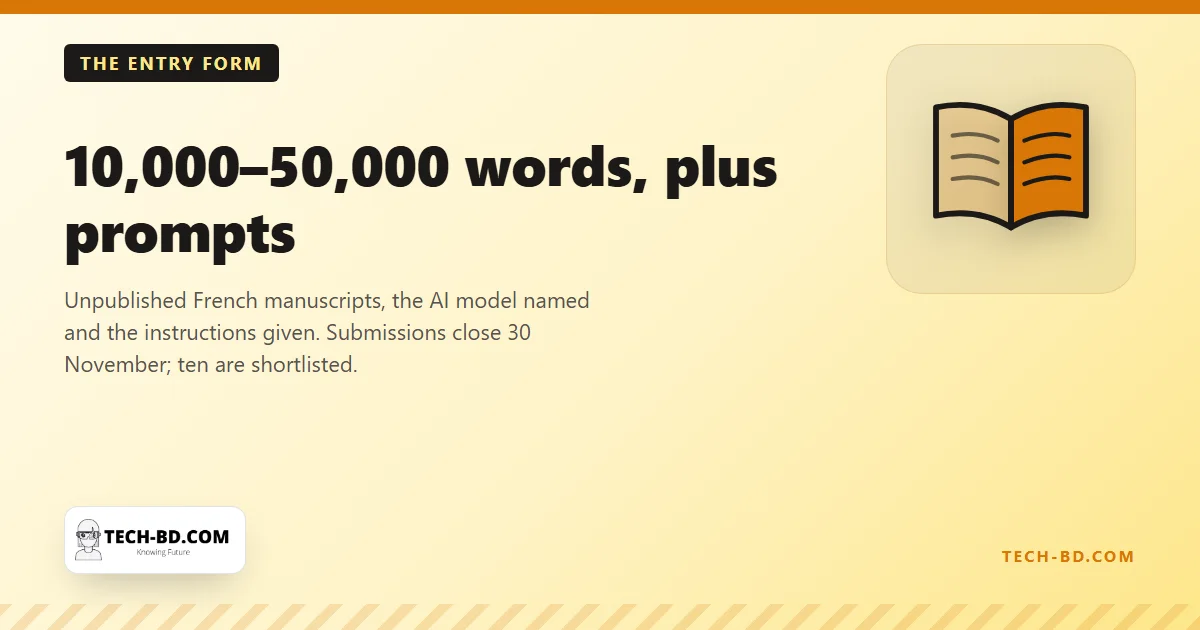
Entrants must submit an unpublished manuscript in French of between 10,000 and 50,000 words, written with the assistance of AI or a large language model.
They must also declare which AI model was used and what prompts or instructions were given.
And there is a subject constraint, which is the most unusual clause: the manuscript must address something that helps solve an ethical, social or environmental problem that has become a threat to humanity.
Submissions close on 30 November. A shortlist of ten manuscripts will be published before the winner is named, and a six-member judging panel will make the final decision. The winning manuscript will be published as a book free of charge.
Why the disclosure clause is the interesting part
The prompts requirement does more work than the prize money would. Every argument about AI in writing stalls at the same place: nobody can agree where assistance ends and authorship begins, and nobody can see inside anyone else’s process. Detection tools are unreliable, denials are unfalsifiable, and so the whole dispute is conducted on suspicion.
Requiring the model and the prompts converts that into a document. It will not settle what good AI-assisted writing is, but it makes a class of work comparable: ten manuscripts, each with its method attached, judged by people who can see what was asked of the machine.
It is also, incidentally, a research dataset that does not currently exist.
The problem it does not solve
A declaration is a declaration. Nothing stops an entrant from under-reporting how much the model wrote, and the organisers have no way to audit it beyond reading the manuscript and the prompts side by side. The prize is built on good faith, which is exactly what the Goncourt row showed to be in short supply.
And the subject requirement sits oddly with the rest of it. A prize that needs clear criteria has attached a theme broad enough to accommodate almost any serious book, which gives six judges a great deal of latitude in the first year — the year when everyone will be reading the result as a verdict on the whole category.
Why this reaches Bangla writing too
The debate arriving in French publishing will arrive in Bangla publishing, and the mechanics will be worse rather than better. AI models write Bangla far less fluently than French, which means assistance is easier to spot — and also that a writer using it well has done more work, not less, to get usable prose out of the tool.
So the question worth settling early, before a prize jury or a publisher here has to settle it in public, is the one this award has answered in its entry form rather than in a manifesto: not whether the machine was used, but whether the writer will say how.